
Landscapes Collection: Pierre-Auguste Renoir Oil Painting Reproductions
Renoir is remembered for people, which makes these 153 landscapes the least expected part of his catalogue and, for many rooms, the most usable. He painted outdoors from the 1860s onward, often beside Monet, and the habit never left him: riverbanks at Chatou and Croissy, wheat fields, wooded paths, thatched cottages in Normandy, the rocky coast of Brittany, and later the olive terraces of the Midi. Without a figure to organise the canvas, the paint becomes the subject, and these works are among his freest. A path dissolves into flickering strokes; a hillside is built from a hundred small touches of green, pink and blue that only resolve when you step back. On a wall they behave like landscapes are supposed to: they open the room rather than address you, they can be hung high or seen from a distance, and they sit comfortably in spaces where a large figure painting would feel like company you did not invite.
Showing 1–16 of 222 results
-
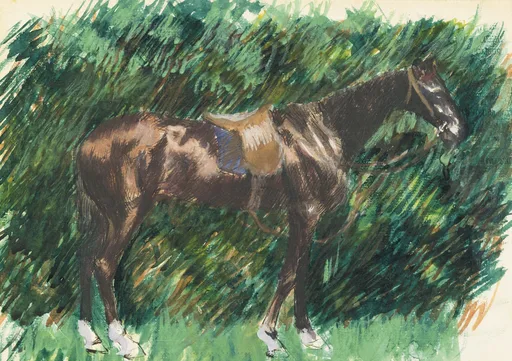
A Horse
From $109 -
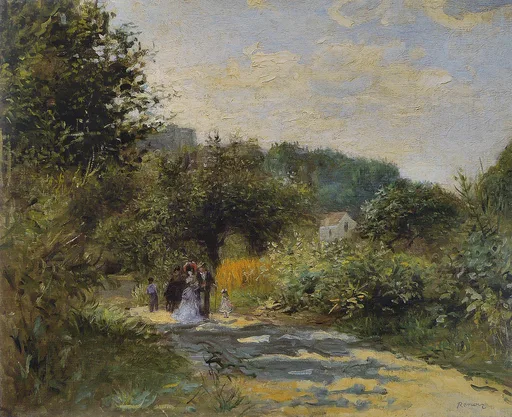
A Road in Louveciennes
From $109 -
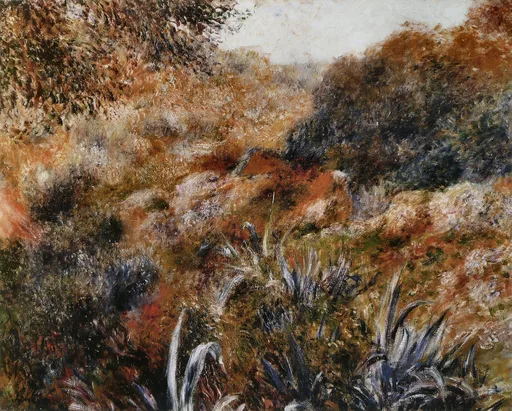
Algerian Landscape, the Ravine of the Wild Woman
From $109 -
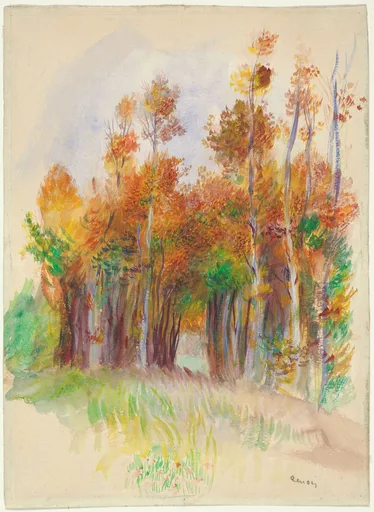
Autumn Grove
From $109 -
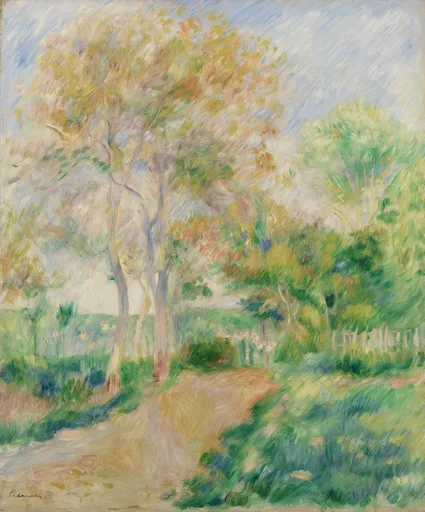
Autumn Landscape (Paysage d’automne)
From $109 -
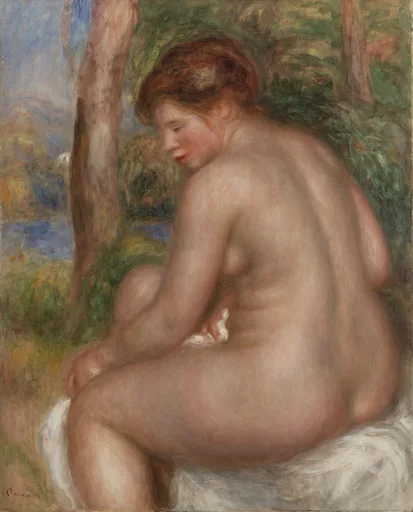
Bather in Three-Quarter View (Baigneuse vue de trois quarts)
From $109 -
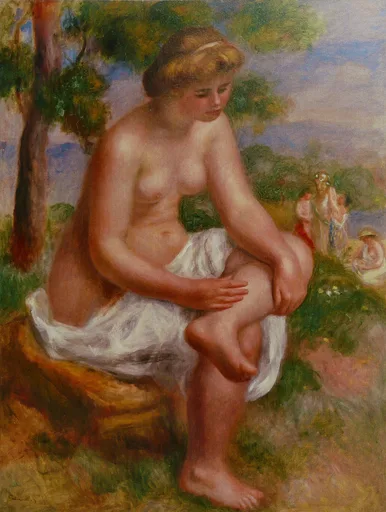
Bather Seated in a Landscape, Called Eurydice
From $109 -
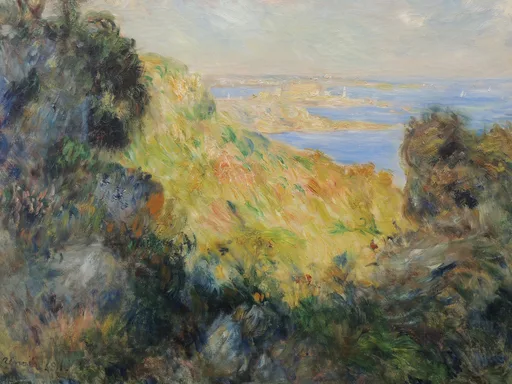
Bay of Salerno
From $109 -
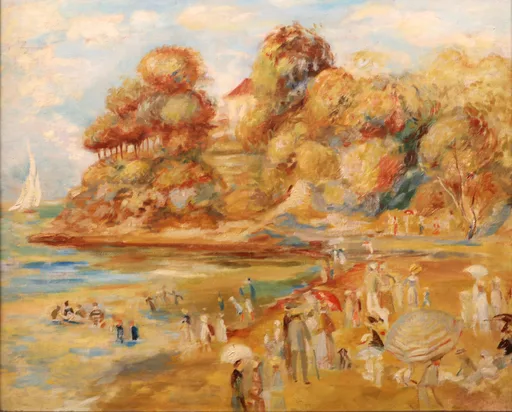
Beach at Pornic
From $109 -
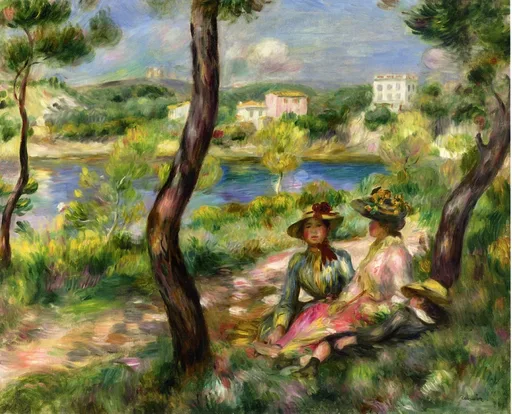
Beaulieu
From $109 -
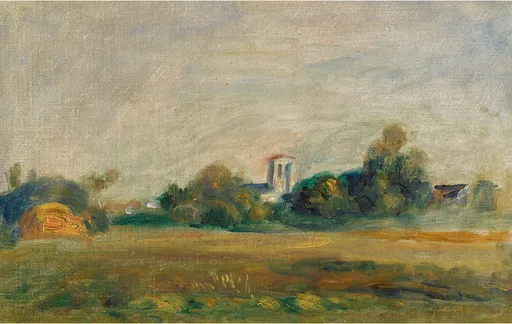
Belfry of Essoyes
From $109 -
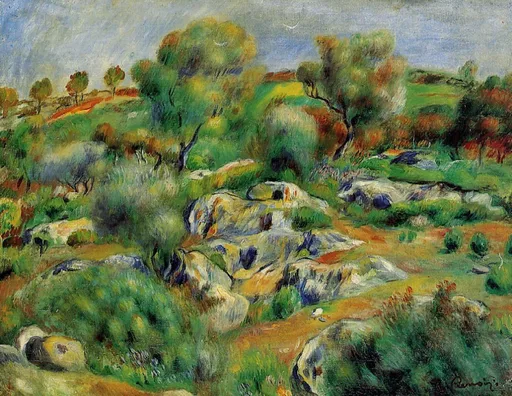
Breton Landscape
From $109 -
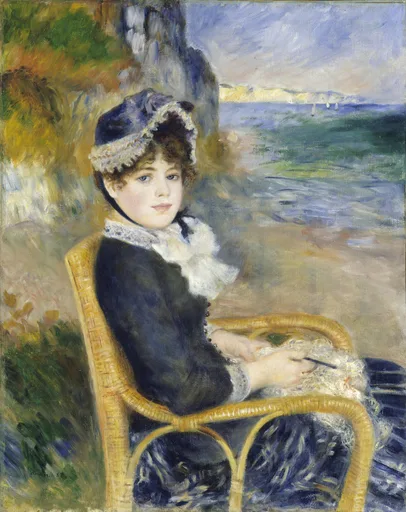
By the Seashore
From $109 -
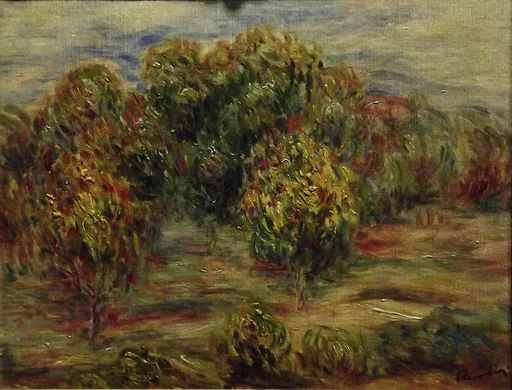
Cagnes Landscape
From $109 -
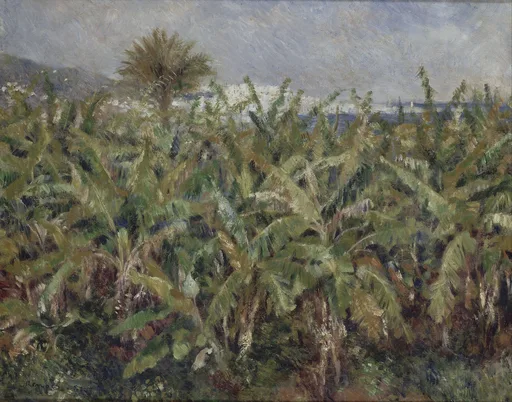
Champ de bananiers
From $109 -
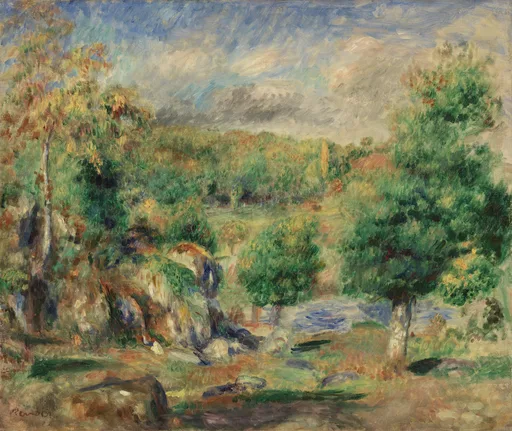
Chestnut Trees, Pont-Aven (Châtaigniers, Pont-Aven)
From $109
Painted beside Monet, and then away from him
The early landscapes come out of the same summers as Monet's: two easels on the same riverbank at La Grenouillere in 1869, painting the same water. Renoir's version is always warmer and looser, more interested in the flicker of light through leaves than in the structure of the motif.
Later the geography widens. There are canvases from Brittany and the Channel coast, from Louveciennes and the Seine valley, from Provence and the hills above Cagnes. The late southern landscapes, painted when his hands were badly deformed by arthritis, are the most abbreviated of all: olive trees reduced to warm smoke, and the ground a haze of rose and gold.
Why the landscapes suit walls the figures do not
A landscape has no eye contact. That sounds trivial and is not: it means the picture can be seen obliquely, at a distance and in passing, which is exactly how most walls are actually used. It also means the picture does not compete with the people in the room. If you want a Renoir in a working space, a corridor or a large open-plan room, this is the collection to look in first.
Which room this collection suits
Wide formats above a sofa or a sideboard; smaller upright ones in a stairwell or between windows. Because the palette is high-key and the tonal range narrow, they hold up well in bright rooms where a darker painting would go flat. On a strong wall colour they need a mount of light space around them, so give the frame a little room. Ninety to one hundred and thirty centimetres wide is the comfortable range on a main wall.
Frequently asked questions
Did Renoir really paint many landscapes?
Yes. He worked outdoors throughout his career, and landscape accounts for a substantial part of the catalogue. It is simply less famous than the figures, which is part of the appeal: these are the least reproduced pictures he made.
Where are these places?
Mostly France: the Seine at Chatou and Croissy, Louveciennes, Normandy and Brittany, and from the 1890s the Midi around Cagnes and the Esterel. A few come from further afield, including Algeria and Italy.
What size for a large living room wall?
Aim for the picture to occupy half to two thirds of the wall or the furniture below it. On a three metre wall that means roughly 130 to 180 centimetres. Landscapes survive enlargement better than crowd scenes because there are no small faces to lose.
Are they framed or ready to hang?
You choose. Rolled ships flat and assumes you have a framer, stretched arrives ready to hang with the image running to the edge, and framed arrives finished. Landscapes are the group that looks best unframed and stretched, in the modern gallery manner.