The Umbrellas
A Rainy Street Painted in Two Different Moods
Renoir began The Umbrellas in 1881, at a moment when he had grown restless with the loose handling of paint that had defined his work through the 1870s. He was starting to look back towards the firmer drawing of earlier French and Italian masters, an interest that would soon take him travelling to Italy to study Raphael’s frescoes.
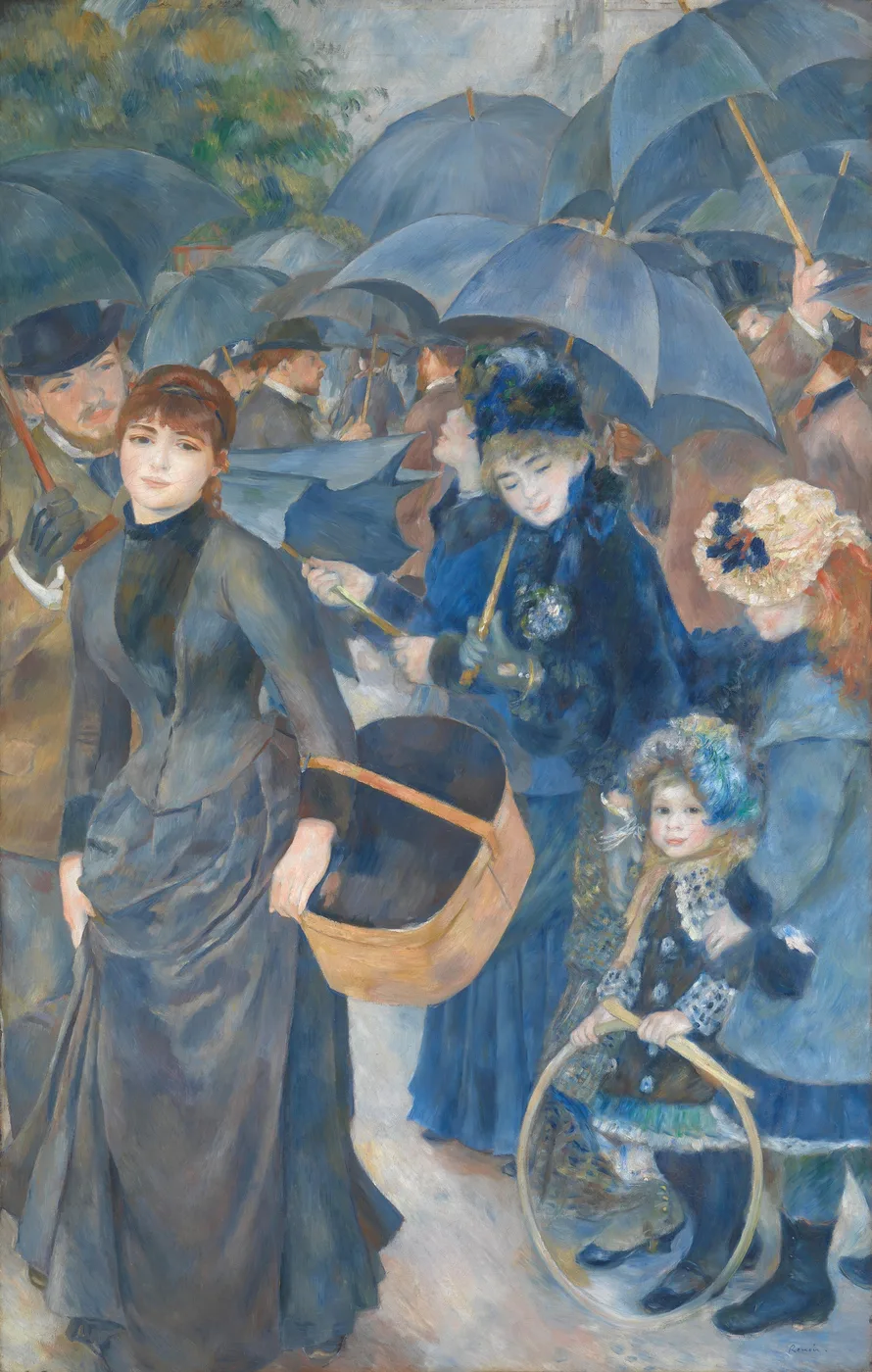
The picture he produced shows a crowded Paris street in the rain, a moment when a sudden shower has sent everyone reaching for an umbrella at once. It is one of his largest and most ambitious street scenes, built from a great many figures rather than the single sitter or small group he usually preferred.
Renoir appears to have set the canvas aside partway through and returned to it some time later, after his ideas about painting had shifted. The result is a picture in which two different approaches to paint sit side by side on the same surface, something visible to anyone who looks closely today.
On the right side of the composition, a woman in blue holding a bandbox and a small girl with a hoop are painted in the softer, feathery manner Renoir had used throughout the 1870s. On the left, the crowd of figures and umbrellas has a tighter, more linear quality, with cooler colours and firmer outlines.
A Crowd of Umbrellas Under Grey Paris Rain
The picture’s dominant colour is a cool blue-grey, repeated again and again across the canopy of umbrellas that fills most of the upper half of the canvas. Renoir varied the tone of each umbrella just enough that the crowd reads as a mass of individuals rather than a single flat pattern.
In the foreground, a fashionably dressed woman in blue stands with a round bandbox tucked under one arm, her face turned slightly away from the viewer. Beside her a young girl in a red-trimmed dress and hat holds a hoop, one of the few warm notes of colour in an otherwise grey and blue picture.
Further back, a man in a bowler hat is caught in the act of opening his umbrella, while another woman without a hat, carrying a basket, edges past him through the crush of bodies. Renoir arranged these figures so the street feels genuinely full, with people moving at different speeds and in different directions.
There is no view of shopfronts or named buildings to place the scene precisely; the crowd itself, pressed close under a canopy of near-identical umbrellas, is the whole subject. The rain is implied rather than shown, suggested by the wet grey light and by every figure’s readiness against it.
Where the Brush Changes Its Mind
Look closely at the boundary between the two halves of the canvas and the shift in Renoir’s technique becomes hard to miss. The woman and child on the right are built from soft, broken strokes that let the underlying canvas breathe between them, typical of the Impressionist method he had practised for a decade.
The umbrellas and figures on the left, by contrast, are painted with a smoother surface and more defined contours, closer to the drawing-based style Renoir was moving towards after studying Raphael’s work. Even the blue of the umbrellas differs subtly in temperature from one side of the picture to the other.
This is not a flaw so much as a visible record of an artist working through a change of mind about what painting should do. Few Impressionist canvases show that kind of internal argument as plainly as The Umbrellas does.
The little girl’s hoop, caught mid-roll at the very front of the crowd, is one of the picture’s few notes of pure play amid the adult business of getting out of the rain, and it sits exactly on the seam between the two painting styles.
A Grey Afternoon That Never Ends
The Umbrellas now hangs in the National Gallery in London, where its scale allows the crowd of figures to feel close to life size. Visitors often find themselves standing where the girl with the hoop seems almost to walk towards them, out of the crush of umbrellas behind her.
On a wall in a room with changing daylight, the picture’s cool blue-grey palette responds differently depending on the hour. Under flat, overcast light the umbrellas seem to merge into a single damp canopy; under warmer lamplight in the evening the blues separate out again and the girl’s red hat trim becomes the first thing the eye finds.
What stays constant is the sense of a single wet afternoon, caught in the middle of its business, that Renoir never quite finished making up his mind about. That unresolved quality, rather than weakening the picture, is a large part of why it continues to hold attention.
Sizes and materials for The Umbrellas are listed on its product page.