Woman with Parrot
Paris After the Siege
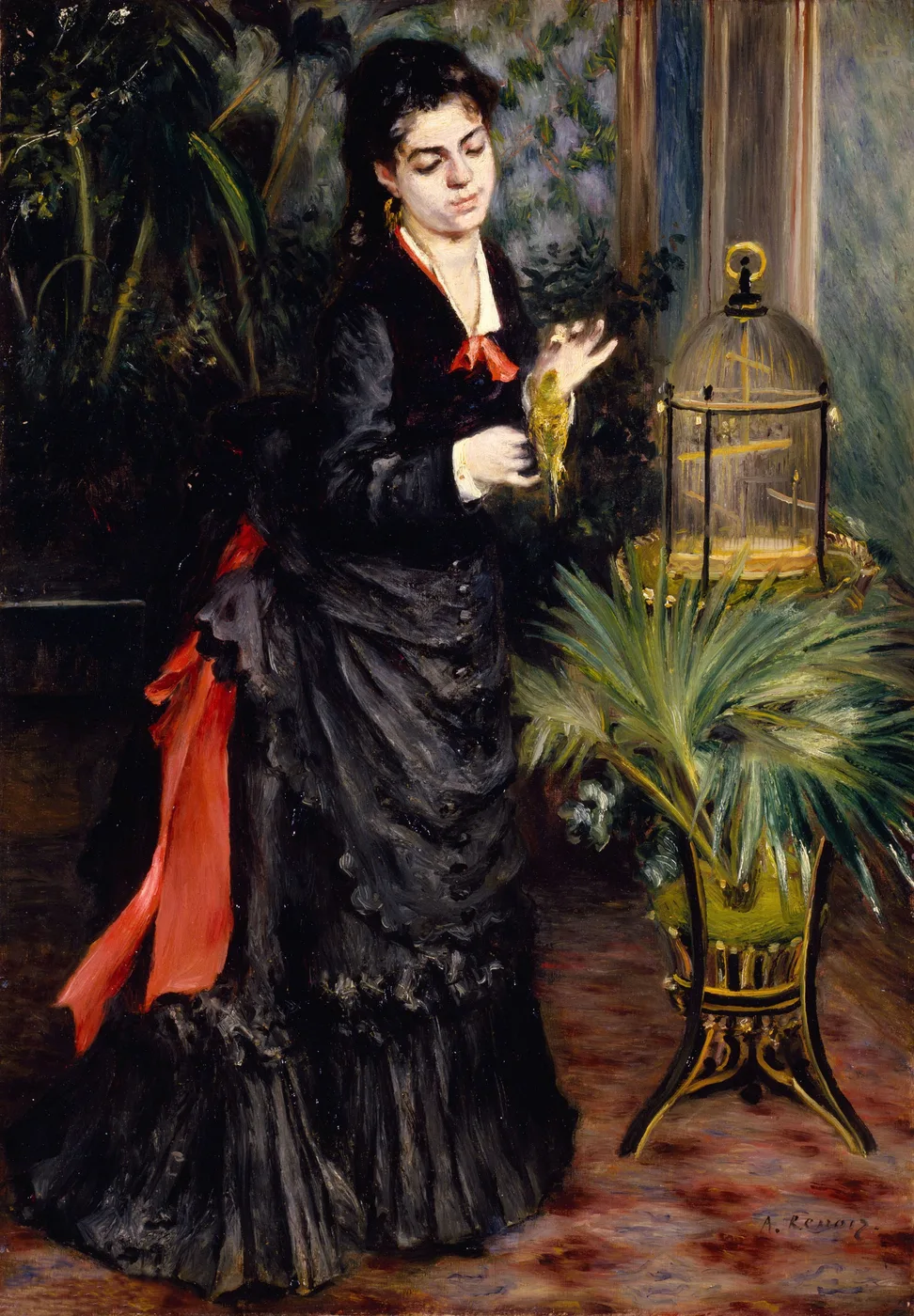
Renoir painted Woman with a Parrot in 1871, the year Paris emerged from the Prussian siege and then from the violent weeks of the Commune. He had spent part of the war attached to a cavalry regiment far from any fighting and returned to the capital eager to get back to work; 1871 was in many ways the first full year in which he could paint without the war intruding on his plans.
The model was almost certainly Lise Tréhot, the young woman who sat for Renoir repeatedly between the mid-1860s and 1872 and who appears, under various guises, in some of his most ambitious early paintings. By 1871 their long working relationship, and by most accounts their romantic one, was drawing toward its end, though nothing of that is legible in the picture itself.
A Debt to Manet, Openly Declared
The title and subject deliberately echo Manet’s own Woman with a Parrot, exhibited a few years earlier, and Renoir’s picture reads as a direct homage to an artist he admired above almost any other in Paris at that date. Both pictures show a woman in a long pale dress standing beside a parrot against a plain dark ground, a subject with roots further back still in Spanish and Dutch painting.
Renoir’s version is his own, though. Where Manet’s brushwork is famously flat and abrupt, Renoir softens the contours of the figure and lets the fabric of the dress catch light in small, broken touches that already point toward the Impressionist manner he would develop over the following years.
A Pale Figure Against a Dark Room
The composition is simple and frontal. The woman stands nearly full length, turned slightly so that the long fall of her dress reads as a single pale, luminous shape against a background kept almost featureless, in browns and greys close to black.
A parrot, perched near her raised hand, provides the one note of pattern and colour that breaks the dress’s pale sweep, its plumage picked out in small strokes of green and red. The bird’s presence turns what could be a straightforward standing portrait into something closer to a genre scene, a private moment of a woman occupying herself with a pet in a quiet room.
Renoir pays close attention to the fall of light on the dress, working it in near-white touches over a warmer ground so that the cloth seems to hold its own soft glow even against the surrounding dark. The face, by contrast, is handled more simply, in keeping with Renoir’s early habit of concentrating his finest work on drapery and surface rather than on minute facial detail.
Realism on the Way to Impressionism
In 1871 Renoir had not yet arrived at the broken, sunlit brushwork of his mid-1870s canvases such as his views of the Seine at Argenteuil. Woman with a Parrot still belongs to an earlier phase, closer to the tonal realism of Courbet and the restrained palette of Manet, dark grounds, careful modelling, a single figure given full attention.
Even so, the loose, flickering handling of the dress and the parrot’s feathers shows Renoir already loosening his brush, letting individual strokes stay visible rather than blending them into a smooth, academic finish. The painting sits at a hinge point in his development, looking back to the painters he learned from and forward to the Impressionist exhibitions that would begin only three years later.
At the Guggenheim, in the Thannhauser Collection
Woman with a Parrot now hangs in the Solomon R. Guggenheim Museum in New York, part of the Thannhauser Collection that the museum received as a gift in the 1960s and 1970s, a group of Impressionist and Post-Impressionist paintings assembled over decades by the dealer Justin Thannhauser and his family.
It is one of the earliest works by Renoir in that collection, and one of the clearest demonstrations of how much he owed, at the start of the 1870s, to the painters of the previous generation before he found his own sunlit voice.
Living with a painting like this today means living with restraint rather than colour. The picture offers no landscape, no interior detail beyond a bare, dark ground, and asks the eye to spend its attention on two things only, the pale rise of the dress and the small bright bird.
In low light the dark background can swallow the edges of the figure almost entirely, leaving the pale dress and the parrot’s colour to float free of any setting. In brighter light the tonal structure becomes clearer, and the debt to Manet’s own dark-ground portraits is easier to see.
It is a quiet, almost austere picture by the standards of Renoir’s later work, closer in spirit to a formal portrait than to the sunlit garden parties and dance scenes for which he later became famous. That reserve is part of what makes it worth returning to.
Nearly a century and a half after it was painted, Woman with a Parrot still reads as the work of an artist who had not yet decided exactly what kind of painter he wanted to be, testing debts to Manet and Courbet even as small passages of loose, coloured brushwork hint at the direction his art would soon take.
Sizes and materials for Woman with Parrot are listed on its product page.