Gabrielle à la rose
Gabrielle Renard and the Final Years at Cagnes-sur-Mer
By 1911, Pierre-Auguste Renoir was around seventy and working mainly from his house at Cagnes-sur-Mer on the Mediterranean coast, increasingly limited by rheumatoid arthritis that would soon force him to paint with a brush fixed into his hand. Gabrielle à la rose is one of many pictures from these years built around a single model, a rose, and very little else, a format he returned to repeatedly because it let him work through variations of colour and pose without an elaborate setting.
The model was Gabrielle Renard, who had been part of Renoir’s household for close to twenty years by this point. She arrived from Essoyes, the Burgundian village that was home to Renoir’s wife Aline, as a young cousin brought in to help care for the couple’s sons, and she stayed on to become Renoir’s most constant model through his final two decades of painting.
Gabrielle’s presence in Renoir’s late work is difficult to overstate. She appears in dozens of paintings from this period, sometimes clothed, sometimes not, sometimes performing an ordinary domestic task and sometimes, as here, simply presented for study, close to the picture plane, with a flower as her only prop.
Her familiarity with Renoir, built over two decades of shared domestic life, gave these late sittings an ease that a hired professional model could rarely match. Renoir could ask her to hold a pose for as long as his painting sessions required, and her comfort in front of him shows in the relaxed, unposed quality of pictures like this one.
Reading the Canvas: A Rose Held Close
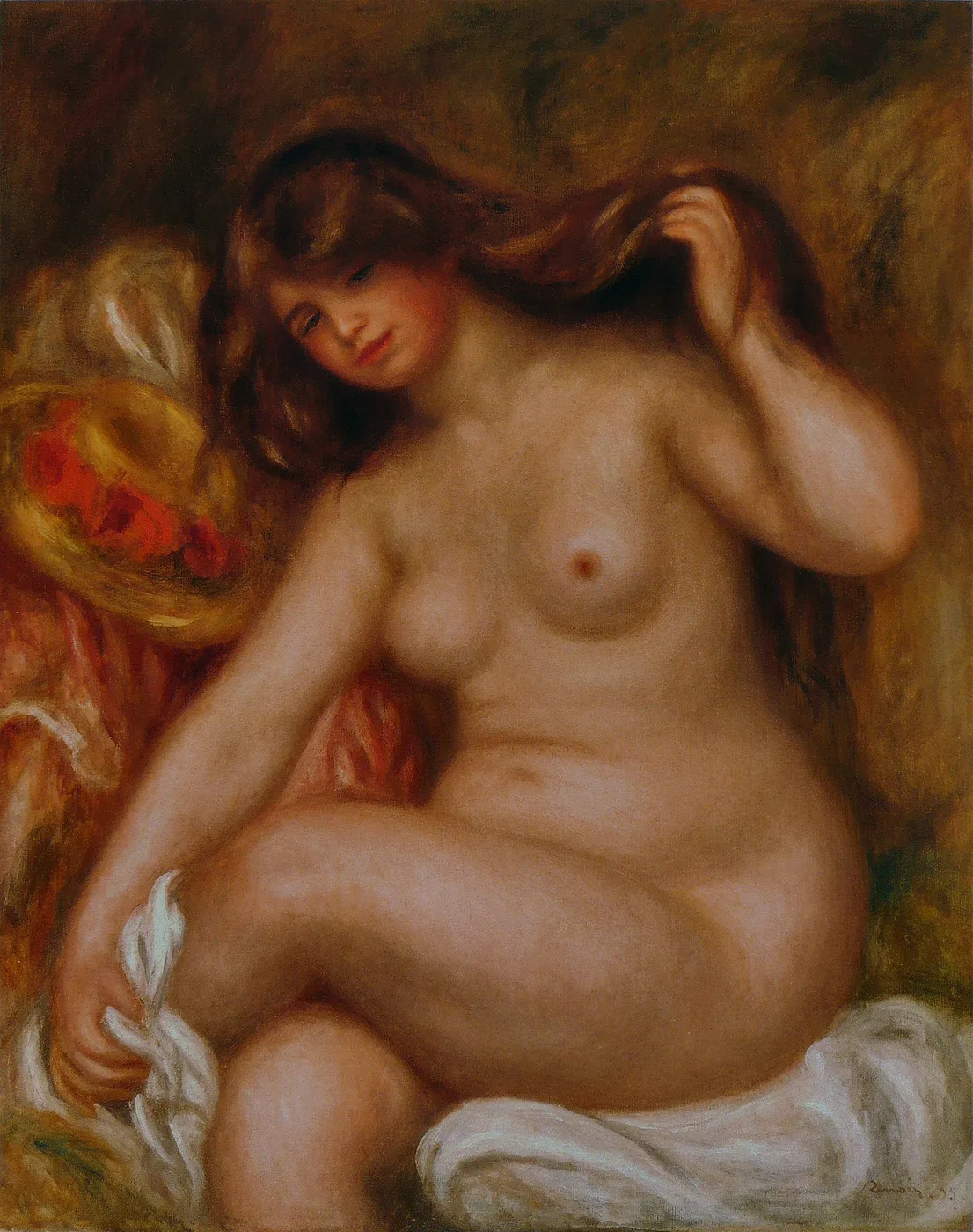
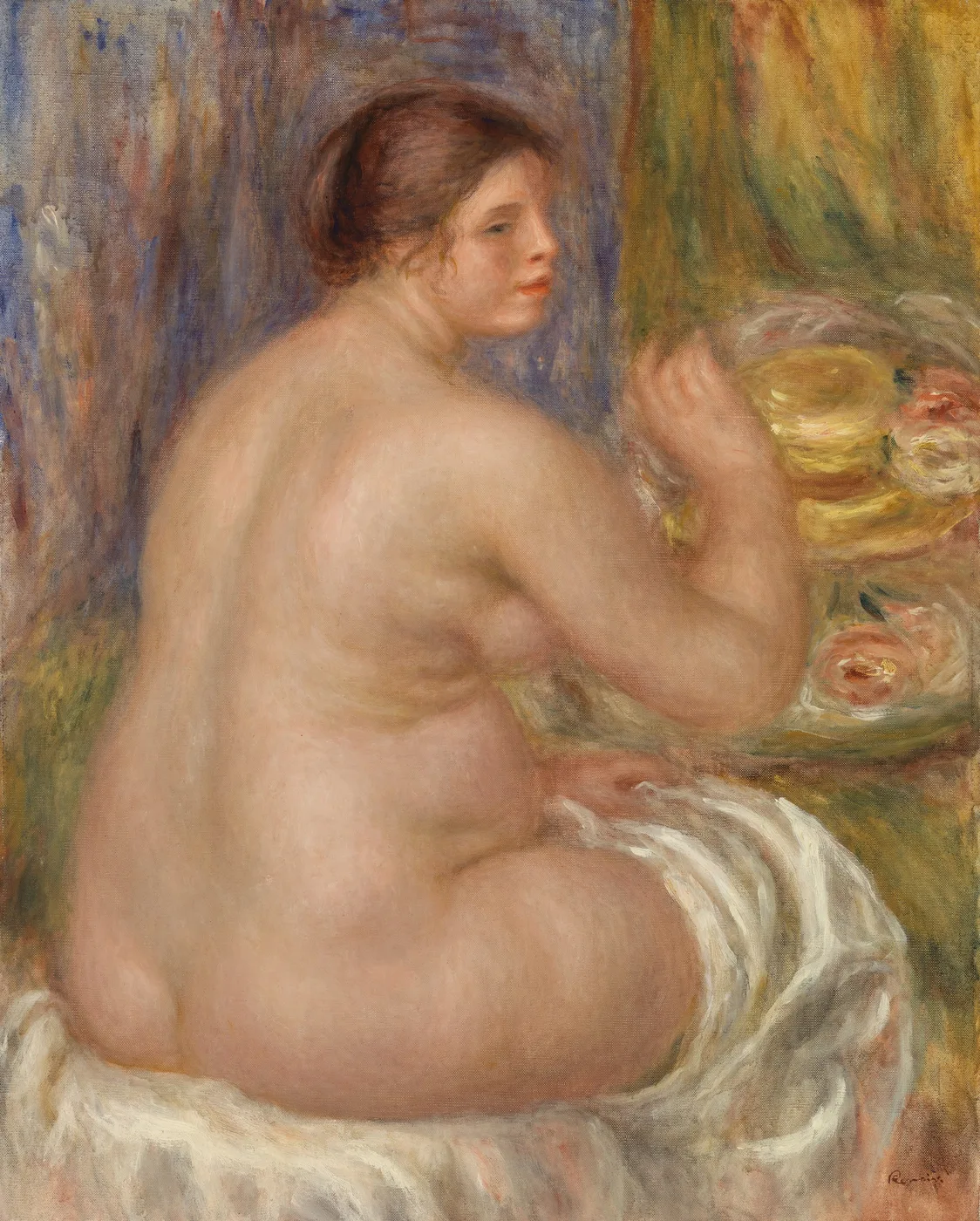
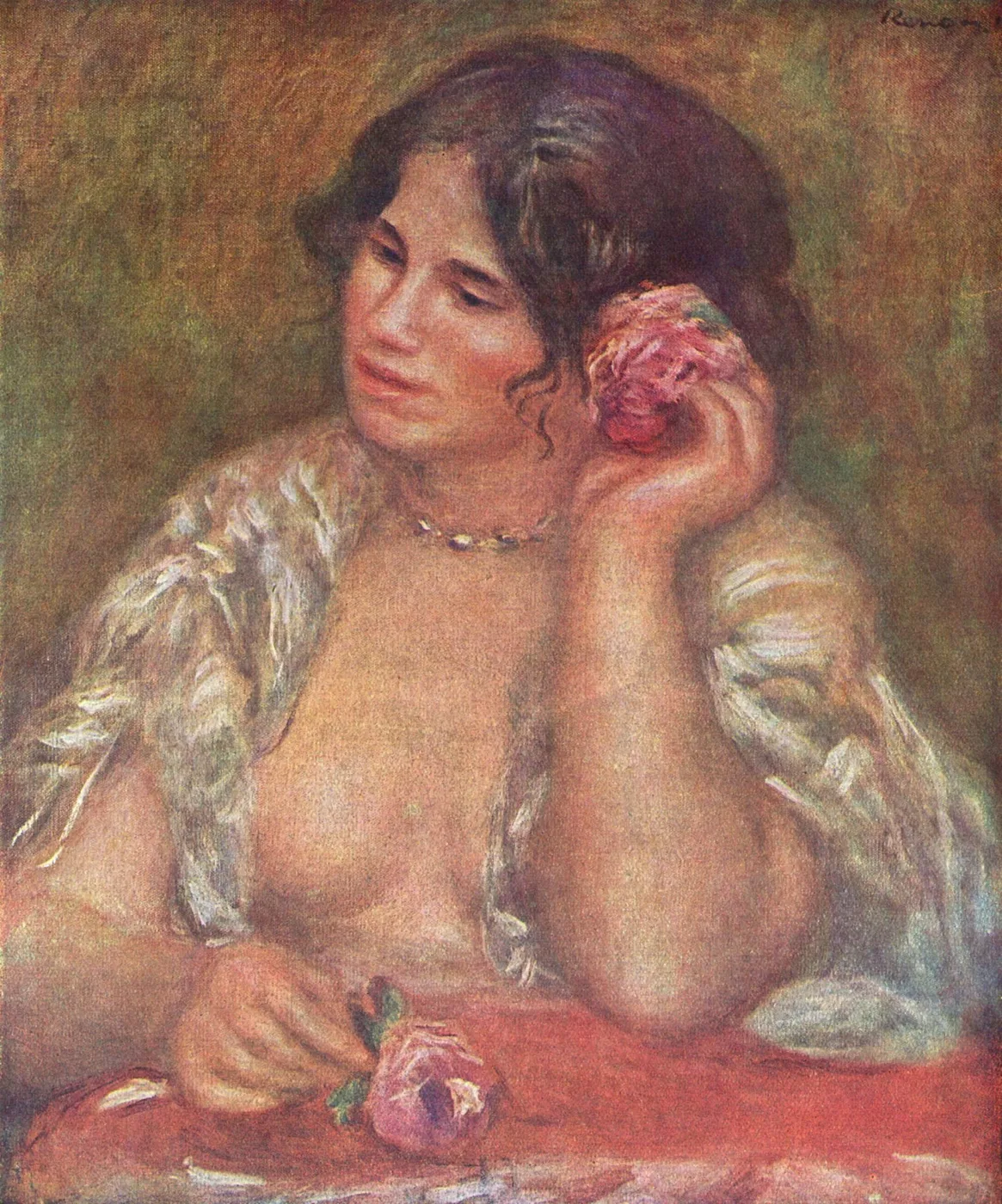
Gabrielle is shown close to half-length, a rose held near her body, her gaze turned gently towards or past the viewer rather than meeting it directly. The picture has almost no setting to speak of; Renoir strips away furniture, room and incident, leaving only the model, the flower and a loosely brushed field of colour behind her.
Flesh, hair and background are painted in the warm, saturated reds and golds that define Renoir’s final decade, a palette so consistent across these late pictures that it now reads as one of the clearest signatures of his old age. The rose picks up and intensifies that same red, so that flower and skin seem cut from related colour rather than sitting apart.
The brushwork is broad, fluid and visibly confident, laid down in sweeping strokes rather than the more careful, descriptive touch of Renoir’s Impressionist years. This looseness was partly a hard physical necessity, given how limited his hand movement had become, and partly a deliberate late style that younger painters such as Matisse would later admire.
A Repeated Subject, Never Quite the Same Twice
Renoir painted Gabrielle with roses often enough that the subject amounts to something like a sustained series. Each version is slightly different in pose, dress and mood, even as the basic formula, a woman, a flower, a warm field of colour, stays constant.
That repetition was not a failure of imagination but closer to a musician working variations on a single theme. Each picture tests a slightly different balance of red against skin tone, a slightly different turn of the head, a slightly different quality of light.
A Late Renoir Now at the Musée d’Orsay
Gabrielle à la rose is held today at the Musée d’Orsay in Paris. The museum is built inside a former railway station on the Left Bank and holds one of the largest concentrations of Impressionist and Post-Impressionist painting anywhere in the world.
There, the picture sits among work by Renoir’s contemporaries and rivals, including Monet, Degas, Cézanne and Manet. This allows a direct comparison between Renoir’s warm, flesh-centred late style and the very different directions his former Impressionist colleagues had taken by the same date.
Renoir’s late reputation suffered for decades after his death, with critics preferring the sharper, cooler Impressionism of the 1870s to the warm, fleshy pictures of his old age. That judgement has softened considerably, and pictures like this one are now valued precisely for the qualities once held against them.
Living with This Picture
A canvas built this heavily on warm red asks for light that lets it breathe rather than flatten. In gentle daylight the reds separate into skin, rose and shadow; under warm evening light, the whole picture can tip towards a single glowing field of colour.
There is no story to decode in Gabrielle à la rose, no anecdote beyond the plain fact of a model, a flower and a painter working in his final years against real physical difficulty. What remains on the canvas is warmth, plainly and directly stated, made by a seventy-year-old man who had lost almost nothing of his appetite for paint.
Sizes and materials for Gabrielle à la rose are listed on its product page.