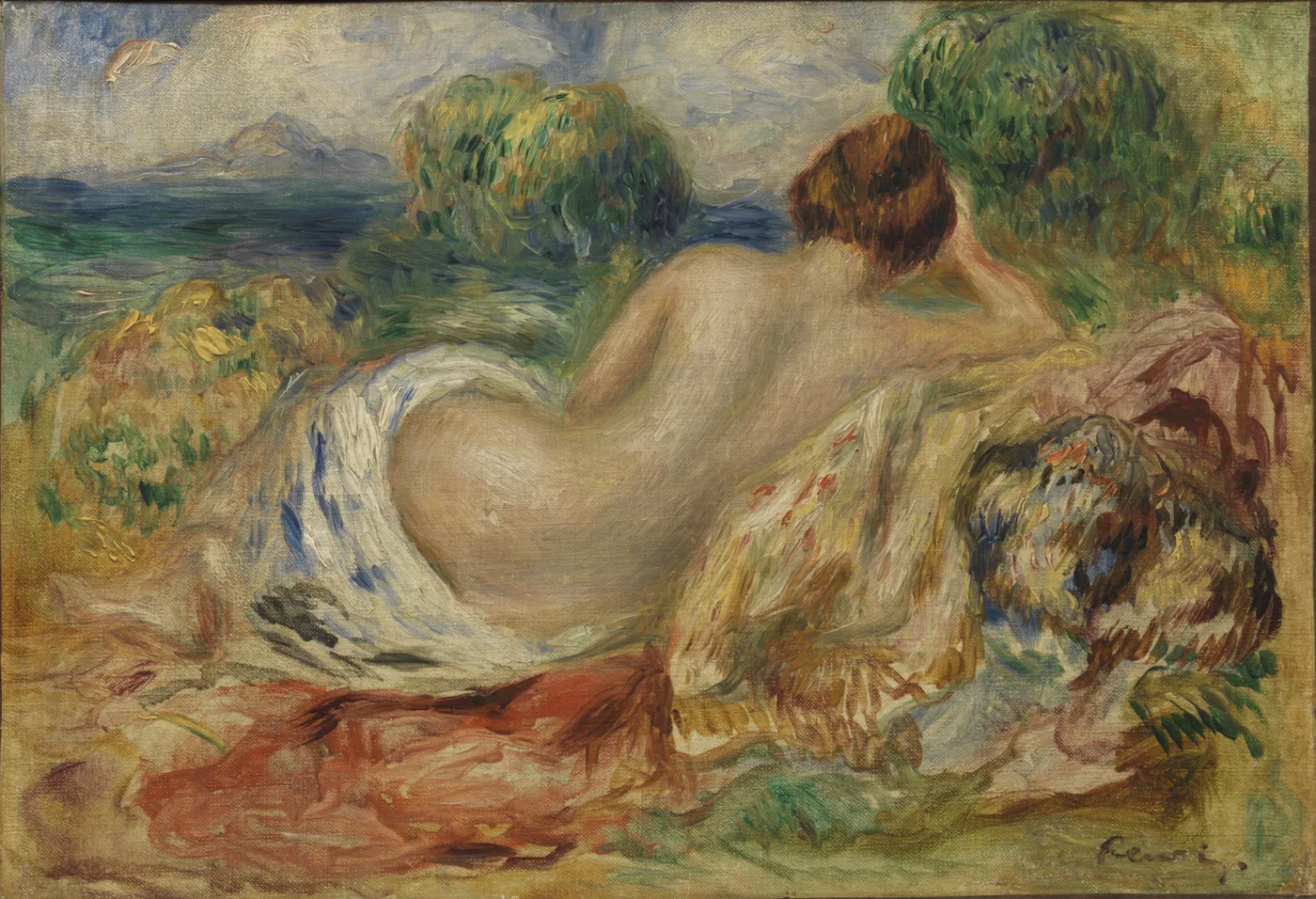
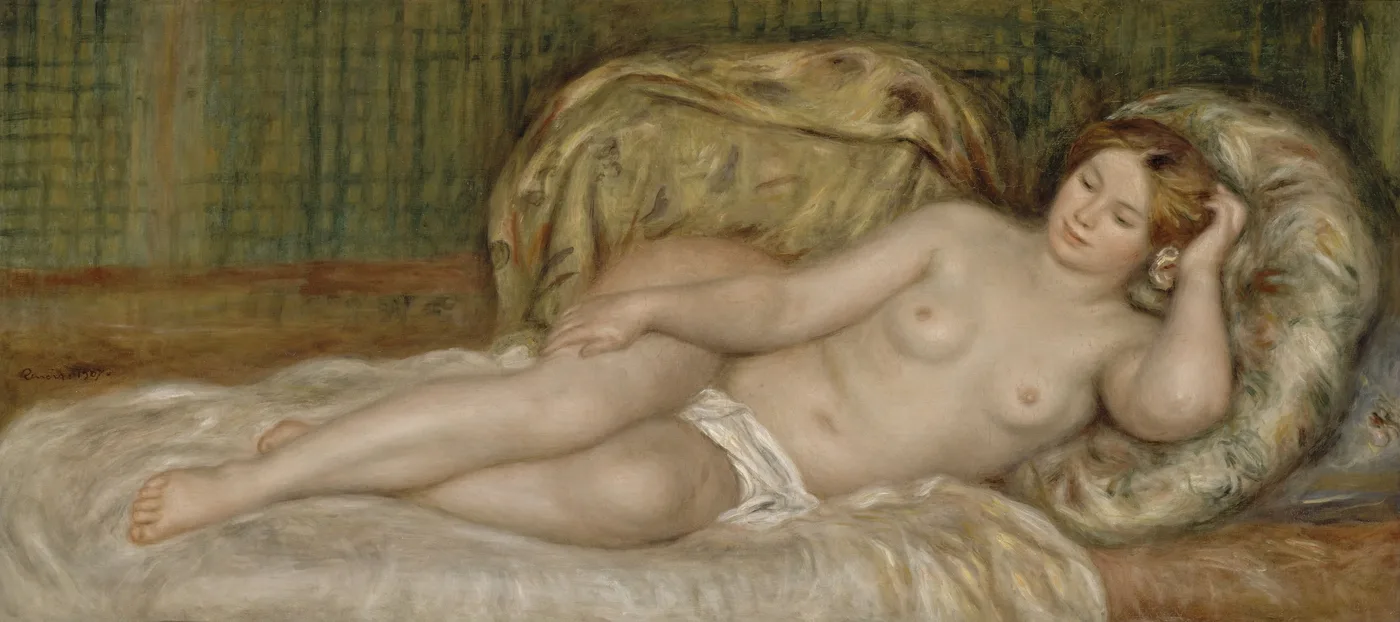
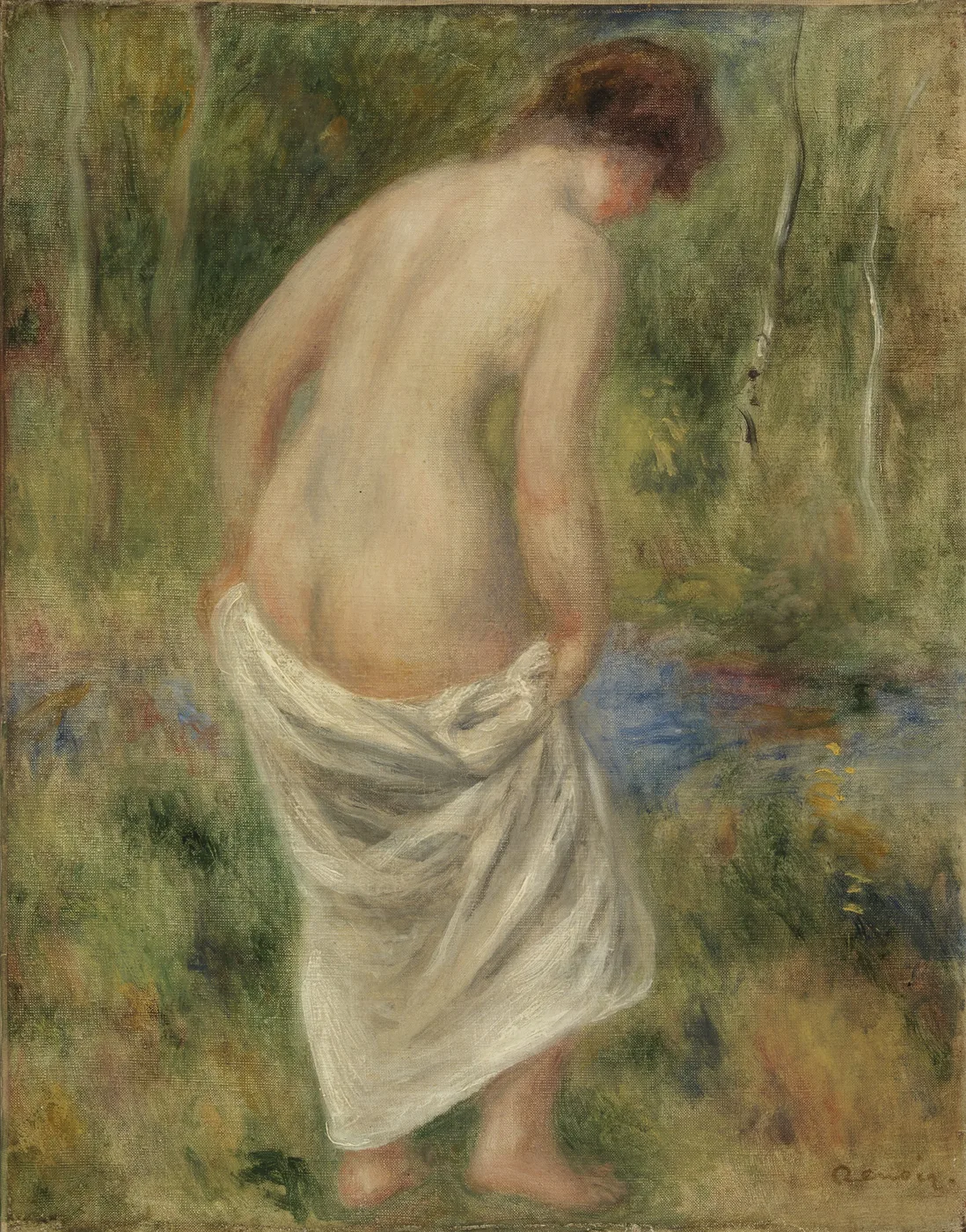
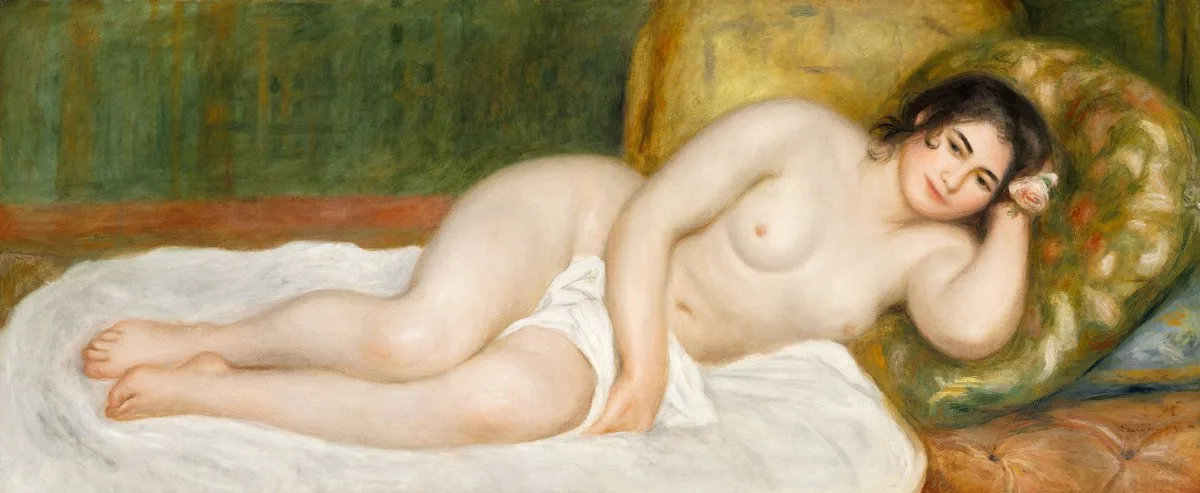
The Bathers (1918)
A Last Testament, Painted at Cagnes-sur-Mer
By 1918 Pierre-Auguste Renoir was living at Les Collettes, his house among the olive groves of Cagnes-sur-Mer on the French Mediterranean coast, in the final year of his working life. He was severely disabled by rheumatoid arthritis, his hands so deformed that he could barely hold a brush unassisted, yet he continued to paint every day that his strength allowed.
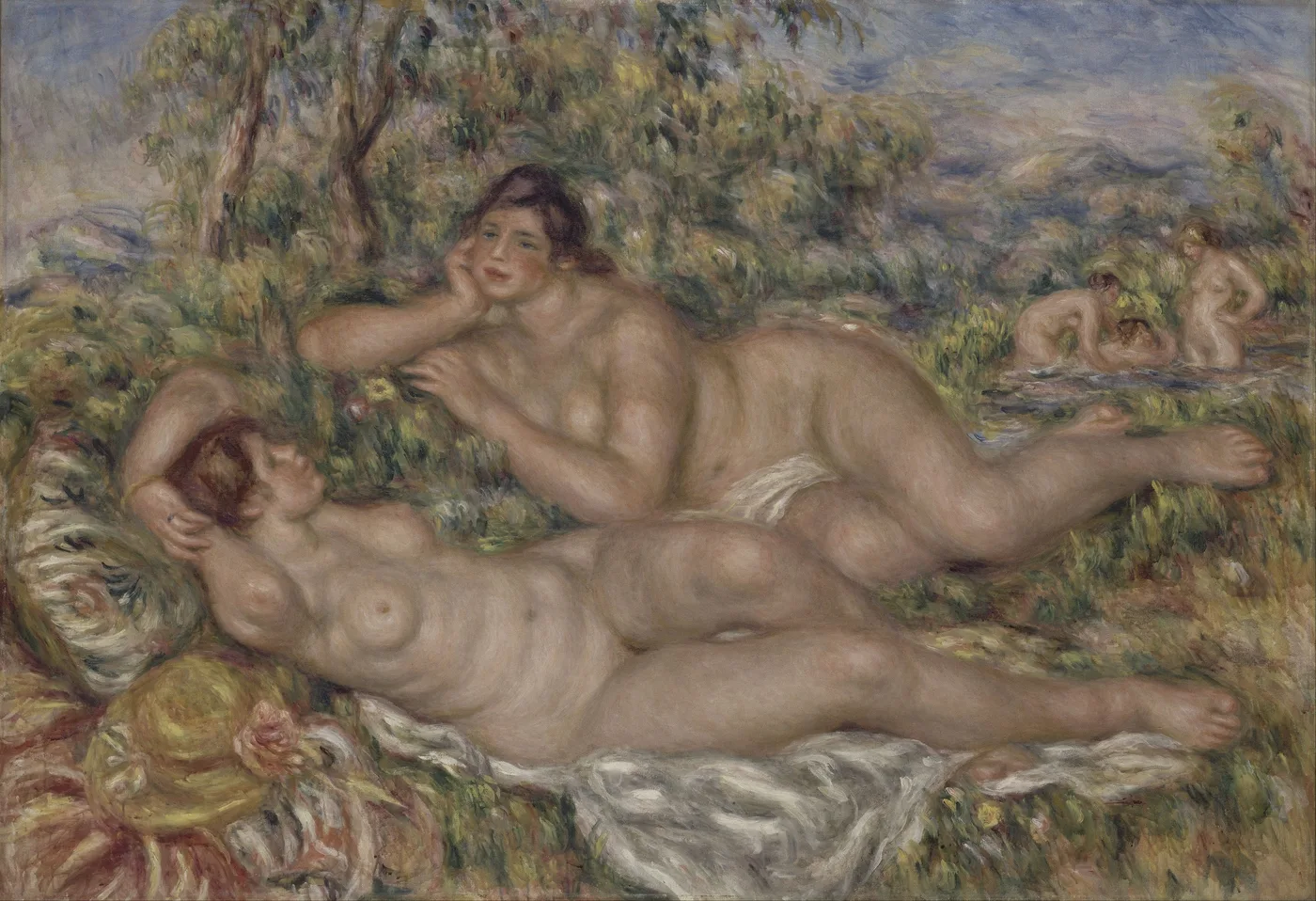
This large canvas of two bathers, begun in these last months, is generally regarded as the summation of everything Renoir had spent decades working toward: a celebration of the female nude in landscape, painted with a freedom that decades of illness had, paradoxically, done nothing to diminish.
It was among the last major works he completed before his death in December 1919, and it shows an artist still pushing his technique forward rather than repeating earlier successes.
Painting Through Pain in the Final Years
Renoir’s arthritis by this period had drawn his fingers into a fixed, claw-like grip; contemporaries who visited his studio described a brush sometimes wedged or tied into his hand so that he could keep working despite the pain. He worked from a wheelchair for parts of this period, assisted by studio helpers who prepared his canvases and paints.
None of that physical difficulty is visible in the finished painting. If anything, the brushwork in this late canvas is looser and more confident than in his earlier bather compositions, built from broad, fluid strokes rather than careful, constrained ones.
It is worth pausing on that contrast: a body in near-constant pain producing a picture devoted entirely to the ease, warmth and physical comfort of two figures at rest beside water.
Two Bathers Bathed in Rose and Gold
The canvas is dominated by two nude female figures set in a lush, loosely painted landscape, one seated and one reclining nearby, their bodies rendered in warm rose, peach and gold tones that seem to glow against the cooler greens and blues of the surrounding foliage and water.
Renoir gives the flesh an almost luminous quality, built from layered strokes of pink, orange and touches of red, so that the figures appear lit from within as much as from any external source. This is flesh painted for its warmth and weight rather than for anatomical precision.
The landscape around the bathers is suggested rather than described in detail: patches of green foliage, a hint of water, warm golden light suffusing the whole scene. Nothing competes for attention with the two central figures, who dominate the canvas both in scale and in the intensity of their colour.
The eye meets the nearer figure’s rounded shoulder and hip first, then travels across to her companion, the two bodies forming a single, unified passage of warm colour against the cooler landscape.
A Debt to Rubens and to Classical Sculpture
Renoir had spent years by this point studying the fleshy, monumental nudes of Peter Paul Rubens and the sculpture of classical antiquity, both of which he saw as models for a kind of painting that celebrated the human body without apology or restraint. This late canvas is the clearest statement of that ambition in his entire output.
Where his Impressionist nudes of the 1870s had broken flesh into small, flickering patches of colour, this painting works in broader, more sculptural masses, closer in spirit to the old masters he admired than to the movement he had helped found decades earlier. It is a deliberate late turn, not a decline in ambition but a change of direction toward something warmer and more monumental.
The Bathers Today, at the Musée d’Orsay
The painting now hangs at the Musée d’Orsay in Paris, where it is generally presented as one of the culminating statements of Renoir’s long career, made at the very end of a life spent almost entirely at the easel.
Seen in that context, it carries an unmistakable weight: an artist in his late seventies, in constant physical pain, still reaching for warmth, colour and physical wellbeing as his central subject, right to the end.
On a wall in a real room, its effect depends heavily on the light available to it; direct sunlight makes the rose and gold tones in the flesh almost incandescent, while in dimmer evening light the figures settle into a softer, more contemplative glow, the two moods sitting inside the same canvas depending entirely on the hour.
Sizes and materials for The Bathers are listed on its product page.