Yvonne and Christine Lerolle at the Piano
A Portrait Commission from a Friend’s Household
By the late 1890s Renoir had moved well past the financial hardship of his early Impressionist years and was increasingly welcomed into the homes of collectors and fellow artists. Among the closest of these was Henry Lerolle, himself a painter and an important patron of contemporary art, whose Paris apartment was a regular meeting point for musicians, writers, and painters including Edgar Degas.
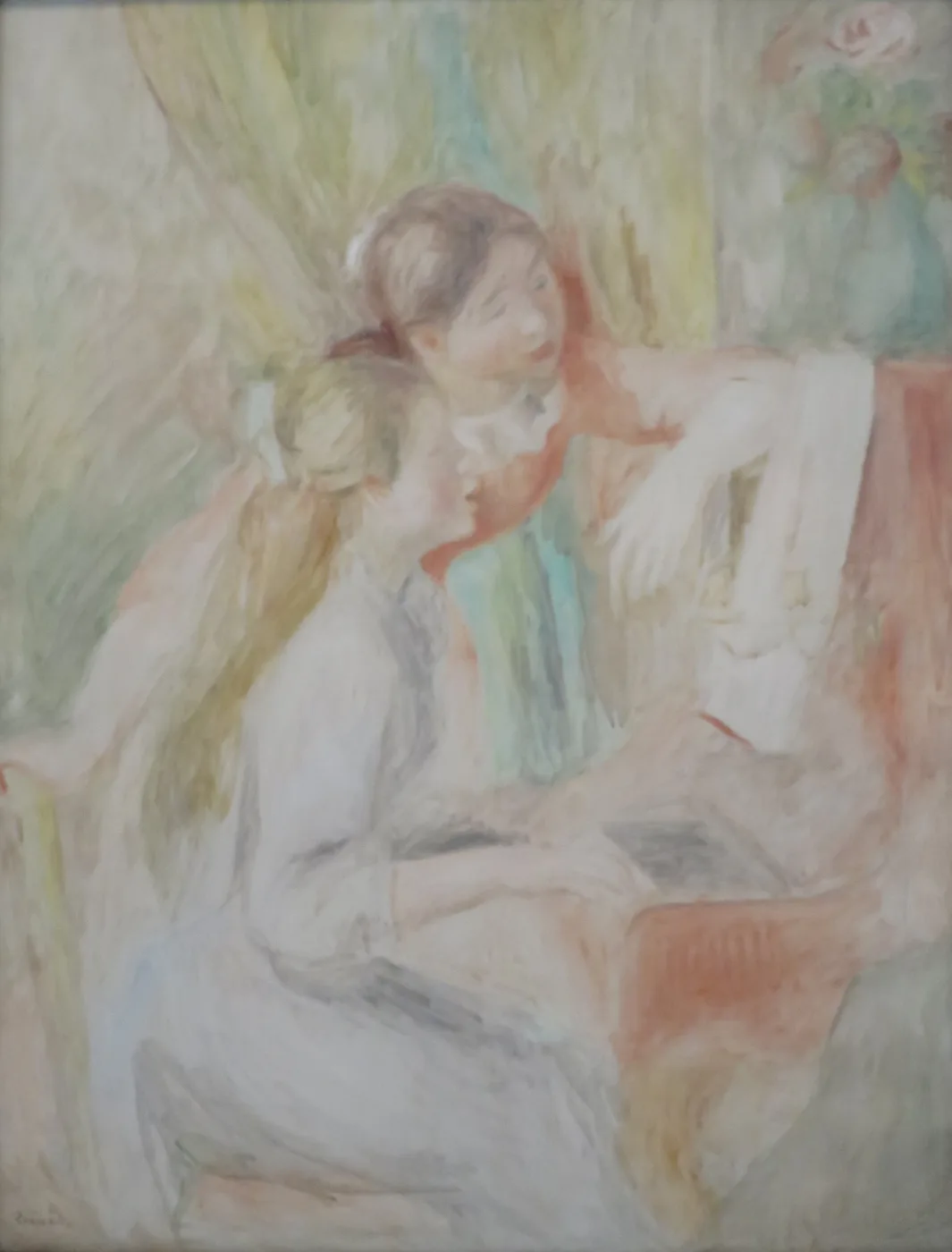
Renoir painted Lerolle’s two daughters, Yvonne and Christine, on several occasions during these years, and the piano scenes that resulted are among the most warmly domestic pictures of his mature period. The version now in the Musée de l’Orangerie dates from 1897.
Music was central to life in the Lerolle household, and a scene built around the piano allowed Renoir to paint the sisters engaged in a shared, absorbing activity rather than posed stiffly for a formal double portrait.
Two Sisters, One Instrument
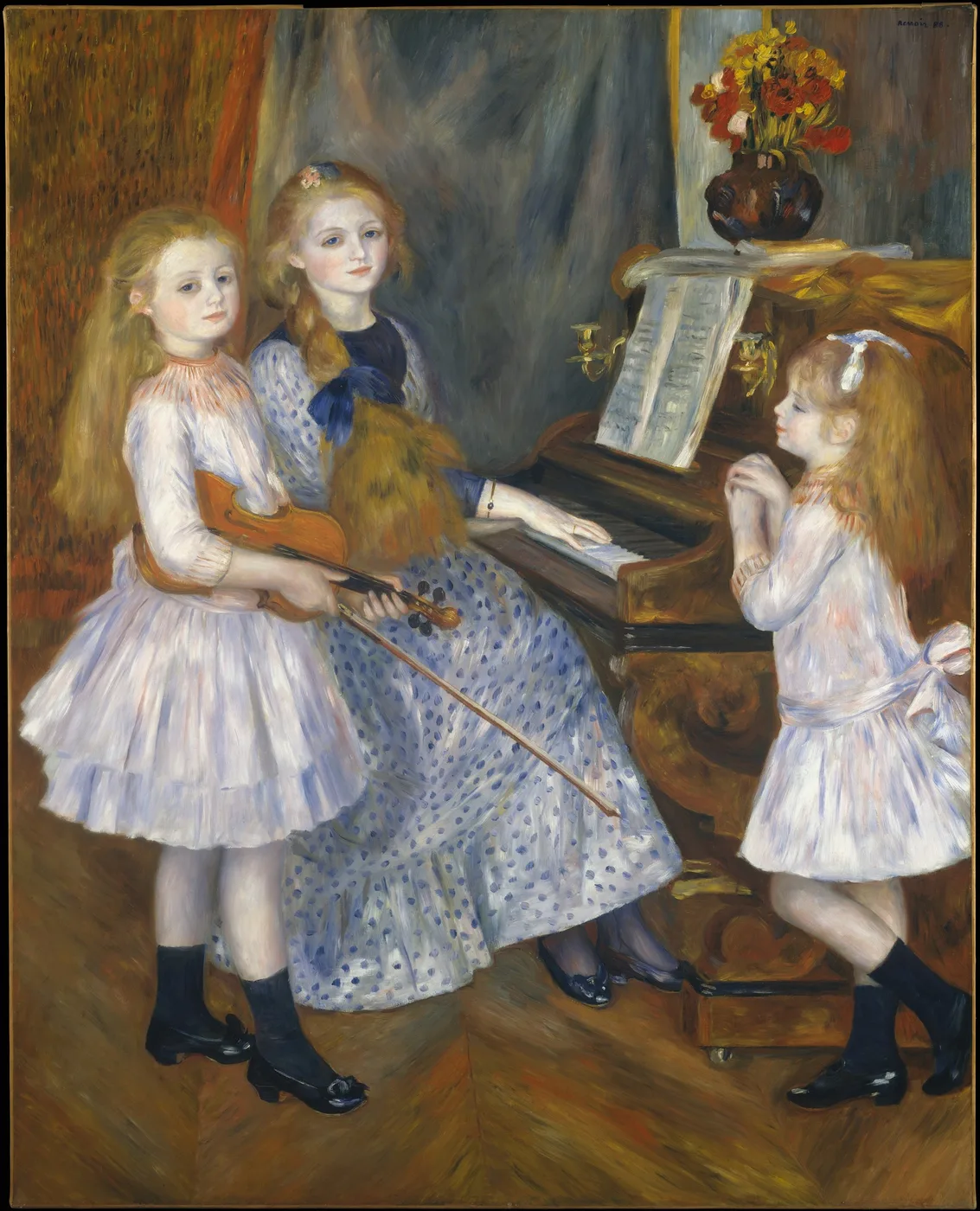
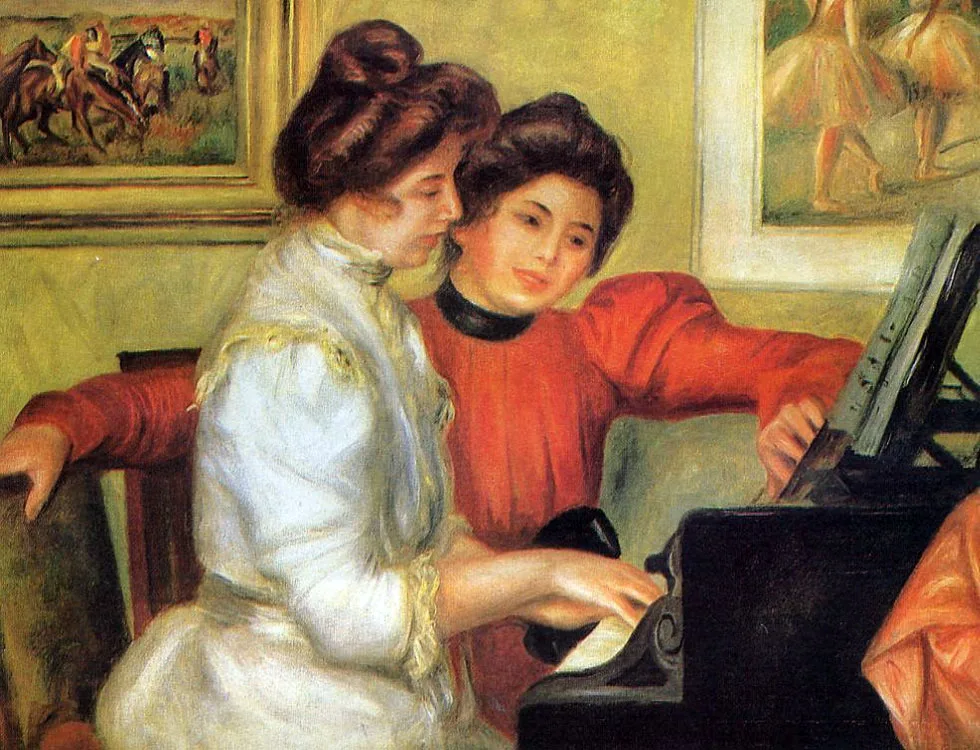
The canvas shows Yvonne and Christine Lerolle close together at an upright piano, one seated at the keyboard, the other standing just behind and beside her, leaning in as though following the music over her sister’s shoulder. Their heads are close, their attention entirely on the instrument rather than on the viewer.
The piano itself, along with sheet music and the furnishings of the room, is rendered with enough detail to place the sisters firmly in a comfortable, well-appointed domestic interior, though Renoir keeps the surrounding detail secondary to the two figures.
Both sisters wear pale, softly coloured dresses that catch the light of the room, their fair hair and calm, absorbed expressions giving the picture an atmosphere of quiet concentration rather than performance for an audience.
Colour Built from Roses and Golds
Renoir’s palette in this period had moved away from the drier, more linear manner he had experimented with in the mid-1880s and returned to the warm, saturated colour for which he remains best known. Rose pinks, warm golds, and soft creams dominate the sisters’ skin and dress, set against cooler background tones that let the two figures stand forward from the room around them.
The brushwork is fluid and confident, built from overlapping strokes that blend skin, fabric, and hair into soft, continuous passages of colour rather than sharply drawn forms. Light seems to come from within the room itself, evenly warming both girls rather than casting any strong directional shadow.
This softness extends to the piano and furnishings, which are suggested through broad, simplified strokes rather than precise detail, keeping the eye on the sisters rather than on the objects around them.
A Painter Returning to Warmth and Intimacy
By the time he painted the Lerolle sisters, Renoir had settled into what is often called his final manner, a style built on rounded, softly modelled figures and a rich, unified palette rather than the crisp outlines he had briefly favoured a decade earlier. This double portrait shows that manner applied to a subject of real personal warmth rather than a hired model.
The closeness between the sisters, one bent toward the other, one absorbed at the keys, gives the picture an emotional register that a formal commissioned portrait rarely achieves, a sense that Renoir was recording a family’s daily life rather than staging a picture for exhibition.
Renoir returned to the theme of young women at a piano more than once in these years, drawn to the combination of concentrated activity and quiet companionship the subject allowed. The Lerolle sisters gave that recurring interest a specific, familiar setting and two sitters he clearly knew well.
The Painting in the Orangerie
The canvas now hangs in the Musée de l’Orangerie in Paris, within a collection built largely around the private holdings of the dealer Paul Guillaume and his widow Domenica Walter, alongside major groups of work by Cézanne, Matisse, and other painters of the period.
Seen there today, the picture keeps its close, unhurried mood intact, the warm pinks and golds of the sisters’ figures softening further under the gallery’s changing light through the day.
It remains one of the gentlest of Renoir’s late double portraits, a picture built not around spectacle but around the quiet absorption of two sisters at a piano, a mood that survives easily on any wall willing to give it room to be looked at slowly.
Sizes and materials for Yvonne and Christine Lerolle at the Piano are listed on its product page.