Young Girls in Black
Paris Around 1880: Renoir Between Two Styles
By 1880, Renoir stood at a turning point in his career. He had spent the previous six years exhibiting alongside Monet, Pissarro and Degas at the independent Impressionist shows, but he was growing restless with pure landscape and with the loosest, most broken forms of brushwork associated with the movement’s name.
He was increasingly drawn back toward the human figure, toward clearer contour and toward the kind of paired or grouped portraits of young Parisian women that let him study pose, costume and the play of light on fabric and skin together. Young Girls in Black, painted in this period, belongs to that renewed interest in figures observed close up, dressed in the fashions of the day rather than in any historical or allegorical costume.
The painting sits comfortably alongside a run of works from these years in which Renoir paired two young sitters, often friends or sisters, and studied how their poses and expressions played off one another within a single canvas.
Black as a Fashionable Colour, Not a Mournful One
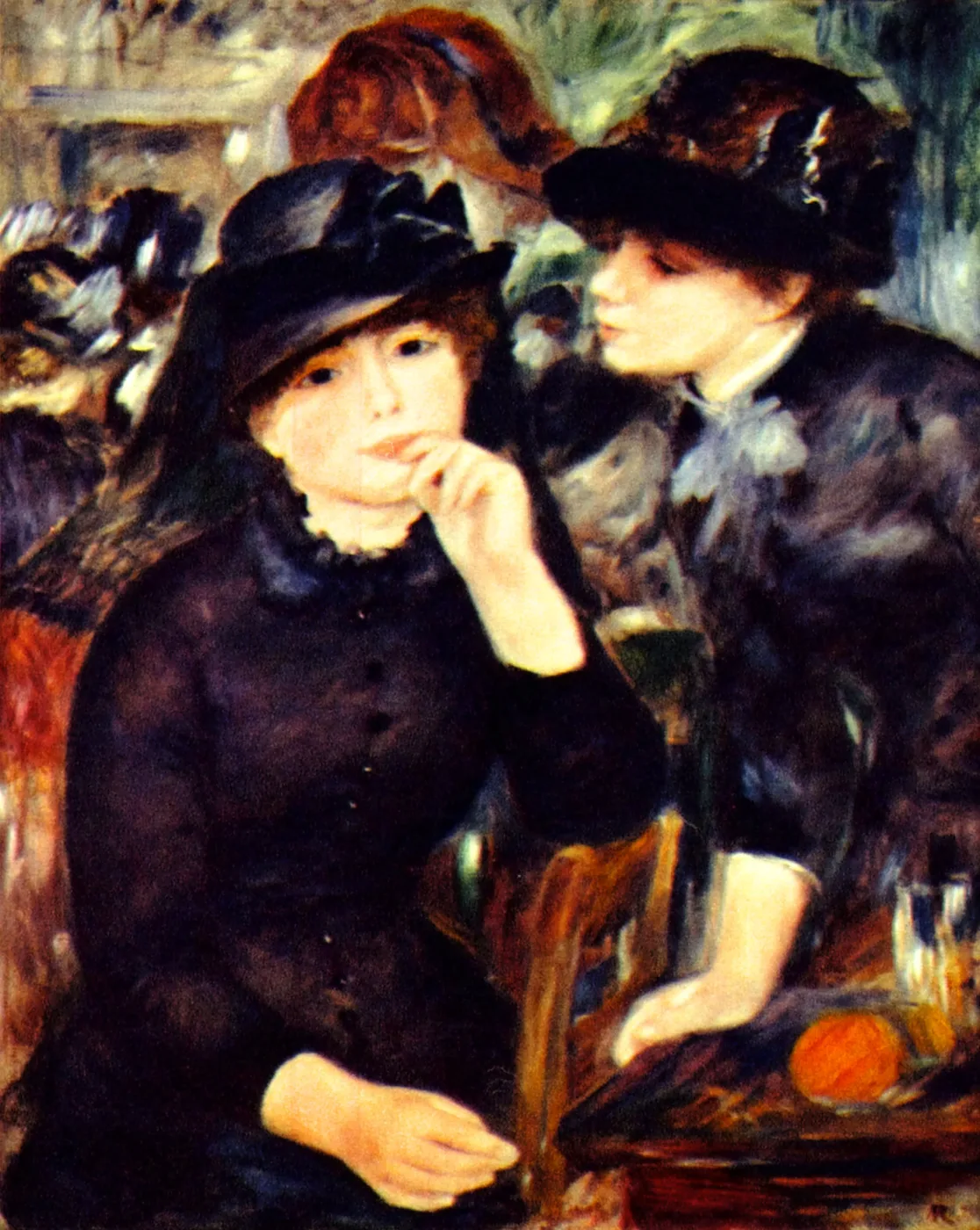
The title describes exactly what is in front of the viewer: two young women dressed in black, their outfits cut in the fashionable, tightly fitted style of late nineteenth-century Paris, with dark hats completing the ensemble. In the Paris of 1880, a well-cut black dress signalled elegance and modernity rather than mourning, and fashionable women wore it deliberately as a sophisticated alternative to bright colour.
Renoir uses that fact to set himself a technical problem: how to keep a canvas dominated by black and dark tones from feeling flat or lifeless. He answers it by working the black itself in a range of warmer and cooler blacks, blues and browns, so that the fabric reads as deep and varied rather than as a single flat shape.
Against all that darkness, the two faces and pairs of hands stand out in pale, warmly lit flesh tones, drawing the eye immediately to the sitters’ expressions rather than to the costume that surrounds them.
Two Figures, One Composition
The two young women are placed close together, their black-clad shoulders and hats overlapping slightly, so that the canvas reads first as a single dark mass before the eye separates it into two individual figures. This closeness gives the picture an intimate, companionable feeling, as though the two sitters had simply been caught mid-conversation.
Renoir varies their poses and the tilt of their heads enough that neither figure duplicates the other; one sitter’s gaze meets the viewer more directly while her companion’s attention drifts slightly to one side. That small difference keeps the pairing from feeling symmetrical or posed for effect.
It is a compositional device Renoir returned to often in these years, using two sitters rather than one to build a picture with more internal incident and comparison, even within the intimate scale of a half-length portrait.
Handling the Paint: Softness Inside the Dark
Up close, the black clothing is not painted as flat pigment straight from the tube but built from layered, visible brushstrokes of blue-black, brown-black and touches of violet, catching whatever light falls across the folds of fabric. The hats, too, carry soft highlights along their brims rather than reading as uniform dark shapes.
This attention to variation within a narrow tonal range shows the more disciplined, controlled side of Renoir’s technique in 1880, a contrast with the broader, more broken brushwork of his outdoor Impressionist landscapes from the same period.
Even the small amount of visible skin, at the wrists and throat, is handled with the same warm, mixed colour Renoir applied to faces, tying the few pale passages of the canvas together across the darker expanse of clothing.
The Painting in Moscow
Young Girls in Black is held today in the Pushkin Museum of Fine Arts in Moscow, part of that museum’s substantial holding of French nineteenth-century painting. It offers visitors a quieter, more intimate counterpart to Renoir’s larger and more famous figure compositions.
Seen in person, the painting’s darkness is far from flat or heavy; it shifts and breathes as the light in the gallery changes, and the two faces at its centre keep pulling attention back from the costume to the people wearing it. It is a picture built on restraint, proving that Renoir’s feeling for colour and light did not depend on a bright palette to hold a viewer’s attention.
Next to Renoir’s sunlit garden scenes and riverside pictures from the same years, Young Girls in Black is a reminder that his eye for colour worked just as well within a deliberately narrow, sombre range as it did in his brighter, more famous outdoor work.
Sizes and materials for Young Girls in Black are listed on its product page.