Woman in Black
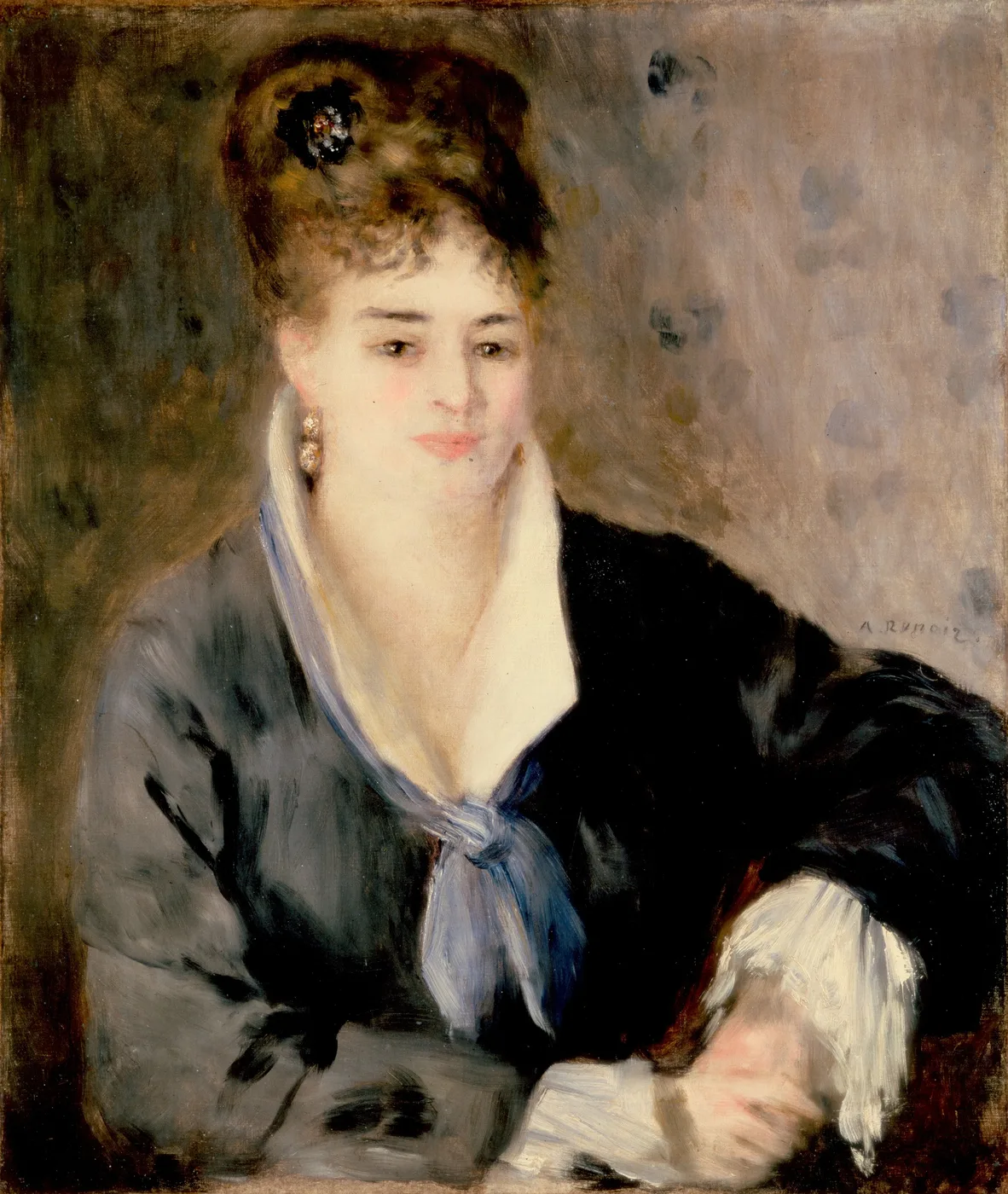
A Portrait from the Heart of Impressionism’s First Decade
In 1876, Pierre-Auguste Renoir was thirty-five years old and deep in the company of the painters who would soon be called the Impressionists. He was showing his work alongside Monet, Degas, Pissarro and Berthe Morisot at the second group exhibition that spring, a display that critics mocked as unfinished daubs. Woman in Black belongs to this restless, argumentative moment, when Renoir was still working out how far he could push a portrait away from the polish the Salon expected.
Renoir supported himself largely through portrait commissions during these years, painting Parisians who wanted a fashionable likeness rather than a manifesto. Woman in Black reads as one of these private commissions, a study of a young woman rendered with the loose, breathing brushwork Renoir was developing for his exhibition pictures. It sits at the crossing point between his commercial work and his more experimental Impressionist canvases.
Black as a Colour, Not an Absence
The Impressionists had a well-known suspicion of black paint. Monet and his circle preferred to build shadow out of blues, violets and greens, treating pure black as a colour that had no place in daylight. Renoir’s Woman in Black takes the opposite dare, letting black dominate the canvas and asking what light does to it rather than avoiding it.
Painted with attention, the black in this portrait is never flat. Renoir works it in layers, so that the sitter’s dress and hat read as deep, warm black in the shadowed passages and cooler, almost blue black where the light catches the fabric. The effect keeps the picture alive rather than letting the dark clothing swallow the composition.
Reading the Canvas
The composition is close and direct: a young woman is shown from around the waist upward, her dark clothing filling most of the canvas and pushing her pale face and throat forward as the picture’s clear point of focus. Renoir gives her a plain, softly brushed background, so that nothing competes with the meeting of black cloth and pale skin.
Her face is handled with the warm pinks and creams typical of Renoir’s flesh tones, applied in small, confident strokes that leave the surface visibly worked rather than smoothed away. A touch of pale colour at the collar breaks the expanse of black and draws the eye back up towards her face, a simple device that keeps the portrait from feeling heavy.
The brushwork throughout is quick without being careless. Renoir lets individual strokes stay visible in the clothing, building the sense of fabric and shadow through touch rather than through careful outline, which was exactly the kind of handling that irritated Salon critics and excited his fellow Impressionists.
From a Paris Studio to the Hermitage Museum
Woman in Black eventually entered one of the great collections of Impressionist painting assembled by Russian collectors before the First World War, and the picture is now held in the Hermitage, in the Hermitage Museum, Saint Petersburg.
The painting’s presence in Saint Petersburg puts it among an exceptional gathering of French nineteenth-century painting. Visitors today come to the Hermitage Museum mainly for its imperial history, and many encounter the Impressionist rooms only once already inside.
Living with the Portrait
A portrait built almost entirely from black and pale skin behaves differently from Renoir’s sunlit garden parties and river scenes. It asks for quieter light, the kind that lets the layered darks separate out rather than collapsing into a single block of shadow.
In direct sun the blacks can look flat and heavy; in softer, indirect light, the blues and warm browns Renoir folded into the dress begin to show themselves, and the picture opens up. That variability rewards a viewer who returns to it more than once.
The sitter’s gaze is calm rather than theatrical, which keeps the portrait from ever feeling like a performance. She holds her own space on the canvas without demanding attention through expression or gesture, letting the contrast of black and skin do the work instead.
Renoir would return to dark-clad sitters again later in his career, but rarely with quite this concentration on black itself as a subject. The painting stands as a record of an Impressionist testing a colour his circle had largely agreed to avoid.
Seen today, Woman in Black feels less like an exercise in fashion and more like a study of restraint, of how much Renoir could say with a narrow range of tone. It is a quieter picture than the bright dance-hall and boating scenes for which he is best remembered, and that quietness is precisely its interest.
Sizes and materials for Woman in Black are listed on its product page.