Portrait of Ambroise Vollard in a Red Headscarf
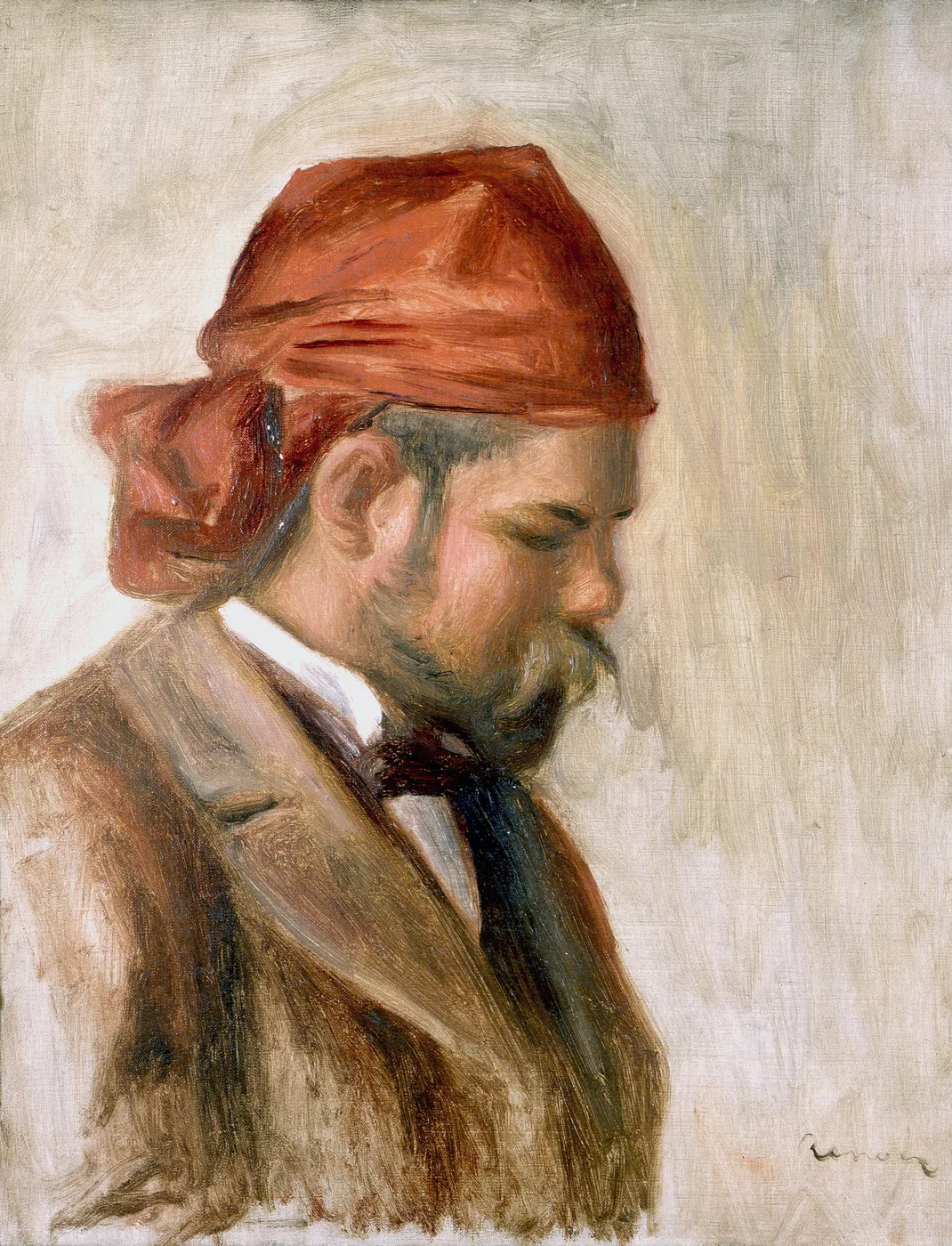
Ambroise Vollard, Dealer to the Impressionists
By 1900 Ambroise Vollard was already one of the most consequential art dealers in Paris, a man whose small gallery on the Rue Laffitte had given early and crucial support to painters the wider public still found difficult, Paul Cézanne chief among them. Vollard had staged Cézanne’s first significant solo exhibition in 1895, and he would go on to champion Van Gogh, Gauguin and, before long, the young Pablo Picasso.
Renoir knew Vollard well through this world of dealers, collectors and fellow painters, and Vollard in turn bought and sold Renoir’s work over many years. Their relationship produced several painted portraits, of which this one, showing Vollard wearing a red headscarf, is among the earliest.
Vollard was an unusual subject for a portrait, more used to appraising other artists’ pictures than sitting for his own. Renoir’s decision to paint him suggests both personal friendship and Renoir’s evident interest in a face that was already, by reputation, shrewd and watchful.
Unlike the fashionable society women and children Renoir often painted for money in these years, Vollard represented the art world’s working machinery. He was the person who bought, priced and placed paintings such as this one into circulation.
Paris in 1900: A City Building Its Own Palaces
The year 1900 was a landmark one for Paris, host to the great Exposition Universelle that drew visitors from across the world and left behind grand new buildings, including the Petit Palais itself, constructed for the fair and later converted into the city’s museum of fine arts. Renoir, by then in his late fifties, was an established figure whose reputation, though still debated in conservative circles, was no longer in serious doubt.
Renoir did not need Vollard’s patronage in the way younger, less established artists did, but their friendship continued regardless. Both men moved within a broader circle of painters, writers and dealers who passed between studios, galleries and cafés in these years.
Vollard’s own gallery, meanwhile, was becoming a meeting point for the next generation of radical painting. That role stood in some contrast to Renoir’s by-then well-established position within the Impressionist story.
Portraiture of this kind, an informal picture of a friend rather than a paid commission, gave Renoir freedom that grander society portraits did not always allow. He could choose the pose, the colours and the mood without needing to flatter a client.
A Portrait in Red: Colour, Pose and Paint
Renoir shows Vollard from roughly the chest upward, a red headscarf wound around his head giving the portrait its immediate identity and its strongest note of colour. Against Vollard’s darker clothing and a loosely brushed, muted background, that band of red draws the eye first, before it settles on the sitter’s watchful, faintly amused expression.
The paint handling is warm and fluid, typical of Renoir’s portraiture at the turn of the century, with soft transitions between light and shadow across Vollard’s face rather than any hard outline. Renoir was less interested here in a precise likeness of costume than in capturing something of the sitter’s character through colour and touch.
Renoir painted Vollard more than once over the years, in different guises and settings, but this earlier picture has a directness that later, more elaborate versions do not share. There is no elaborate prop beyond the headscarf itself, just a friend’s face rendered with evident warmth.
The red of the headscarf against Vollard’s pale skin and dark coat gives the whole picture its structure. It is an example of how Renoir, even in a fairly modest, intimate portrait, still built his composition around a single dominant note of colour.
Vollard’s Renoir at the Petit Palais Today
The painting now belongs to the Petit Palais in Paris, the very museum whose building rose from the same Exposition Universelle that defined the year this portrait was painted. It is a fitting home for a picture of a man who did so much to shape how Impressionist and Post-Impressionist art reached the public in the decades that followed.
Visitors who know Vollard chiefly through his later, more famous portraits by Cézanne or Picasso encounter here an earlier, comparatively unguarded image. It was painted by a friend rather than by an artist seeking the dealer’s approval or patronage.
The picture’s presence in a major Paris museum also closes a kind of circle. A dealer who spent his career placing paintings into private and public collections is himself preserved there, seen through the eyes of one of the painters whose reputation he helped build.
On a wall, the portrait’s single note of red keeps it alive under almost any light, a warm accent that a viewer’s eye returns to before settling on the quieter, more thoughtful face beneath it. In dimmer light the red deepens toward maroon; in bright daylight it sharpens, so the sitter’s expression seems to shift subtly along with it.
Sizes and materials for Portrait of Ambroise Vollard in a Red Headscarf are listed on its product page.