Parisian Women in Algerian Costume
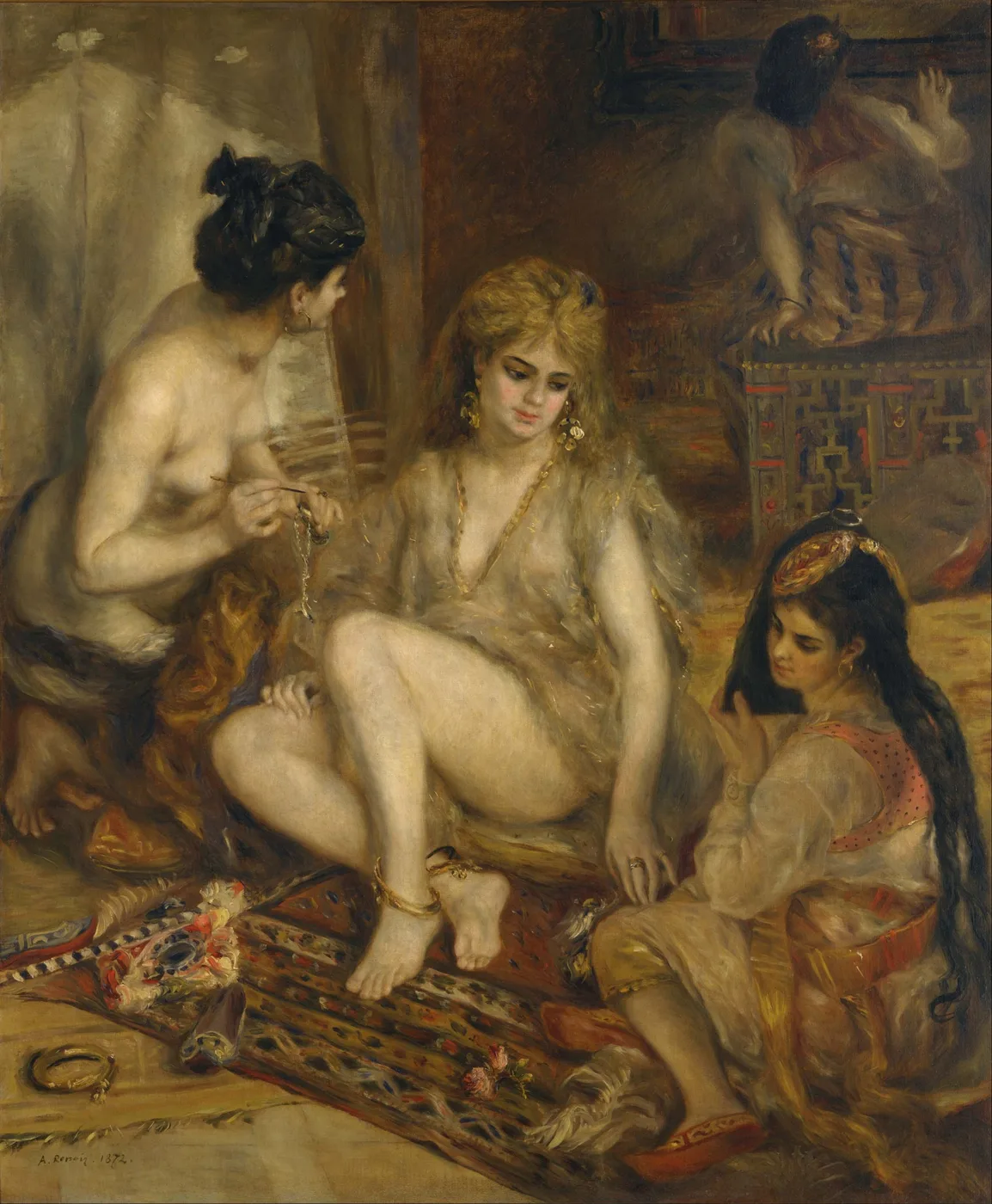
A Tribute Painted for the Salon of 1872
In 1872 Renoir was thirty-one years old and still working to establish himself in Paris, a city where recognition still meant one thing above all: acceptance into the annual Salon. That year he set aside the smaller, quicker Impressionist scenes he was becoming known for and attempted something far more ambitious, a large multi-figure composition built explicitly as homage to Eugène Delacroix.
The painting he produced took its cue directly from Delacroix’s Women of Algiers in their Apartment, a canvas Renoir had admired since his student years and returned to study repeatedly at the Louvre. He had not yet set foot in North Africa himself; his first documented visit to Algeria came nearly a decade later, in 1881.
Renoir submitted the finished canvas to the Salon jury in 1872, hoping the scale and evident debt to a revered master would win him a place on the walls. The jury rejected it, one among a run of disappointments that fed the frustration pushing Renoir and his friends toward organising an exhibition of their own, a plan that eventually became the first Impressionist exhibition in 1874.
Parisian Models, Not Algerian Life
The title matters more than it first appears. These are Parisian women dressed as Algerians, not a record of anything Renoir had witnessed abroad. The scene is a studio invention, built from borrowed costumes, imported textiles, and models willing to sit for hours in unfamiliar dress.
This distinction places the painting inside a much wider fashion in French art for imagined “Oriental” subjects, a vogue that Delacroix himself had helped set off decades earlier after his own travels to Morocco and Algeria in 1832. Many Parisian painters who never left France produced such scenes using props kept in their studios for exactly this purpose.
Renoir’s version is best read as an act of admiration and ambition combined, a young painter proving to himself and to a Salon jury that he could handle a crowded, theatrical composition on a scale his usual subjects rarely demanded.
A Crowded, Lamplit Interior
The canvas is dominated by a group of women gathered in a shadowed interior, their bodies arranged in a loose arc across the lower half of the picture. One figure reclines across a low, cushion-strewn divan in the foreground, her pose echoing the languid poses Delacroix gave his own Algerian women.
Around her, other women sit or lean close, some in conversation, one turned so that only her profile catches the light. Their garments are layered and patterned: striped and floral fabrics in white, rose, and ochre, loose trousers gathered at the ankle, headscarves knotted over dark hair, bracelets and earrings picked out in quick touches of paint.
Little in the room is drawn with hard outline. Renoir suggests cushions, hangings, and floor coverings through broad passages of colour rather than careful description, so the eye reads the setting as warmth and pattern before it reads any single object.
Colour Borrowed and Softened
Renoir leans on the same warm register Delacroix favoured: reds, oranges, and warm whites set against passages of deep shadow. But where Delacroix built form with firm contour and controlled glazes, Renoir’s paint is looser and more fluid, especially in the fabrics, where strokes of colour stand for pattern rather than tracing it exactly.
Light in the picture is diffuse rather than directional, as though filtered through a curtained window or a lamp somewhere outside the frame. It falls most strongly on the reclining woman at the centre, her pale garment catching the brightest passages of white and rose in the whole canvas.
The darker background, by contrast, is handled with broad, economical strokes, giving the sense of a deep interior without describing its walls or furniture in any detail. This contrast between a brightly lit foreground figure and a receding, shadowed room is one of the painting’s most effective devices.
The Painting Now, in Tokyo
The canvas today belongs to the National Museum of Western Art in Tokyo, part of a collection built substantially around French nineteenth-century painting. Its scale, close to a metre and a half in height, means it commands a wall in a way most of Renoir’s Impressionist street scenes never attempt.
Standing in front of it, the eye is drawn first to the reclining figure and her pale drapery, then works outward through the smaller figures toward the darker edges of the room, following the same loose arc Renoir built into the composition.
It is not a picture that settles quietly into a corner of the mind. The crowded figures, the warmth of the palette, and the theatrical staging all ask for sustained attention, rewarding a viewer willing to trace how a young, ambitious painter tried to answer Delacroix on his own terms, finding in the attempt some of the freedom of paint-handling that would carry into his mature Impressionist work.
Sizes and materials for Parisian Women in Algerian Costume are listed on its product page.