La Balançoire
A Garden Behind the Studio on Rue Cortot
Renoir painted La Balançoire in 1876, working in the garden behind the house he had rented on the rue Cortot in Montmartre, the same garden and the same summer that produced several of his other major outdoor figure paintings of the period, including the large dance scene set nearby at the Moulin de la Galette.
The garden’s dappled, semi-wild character, overgrown enough to let sunlight break unevenly through the leaves, suited the effect Renoir was chasing that year: figures caught in real outdoor light rather than posed under the even illumination of a studio.
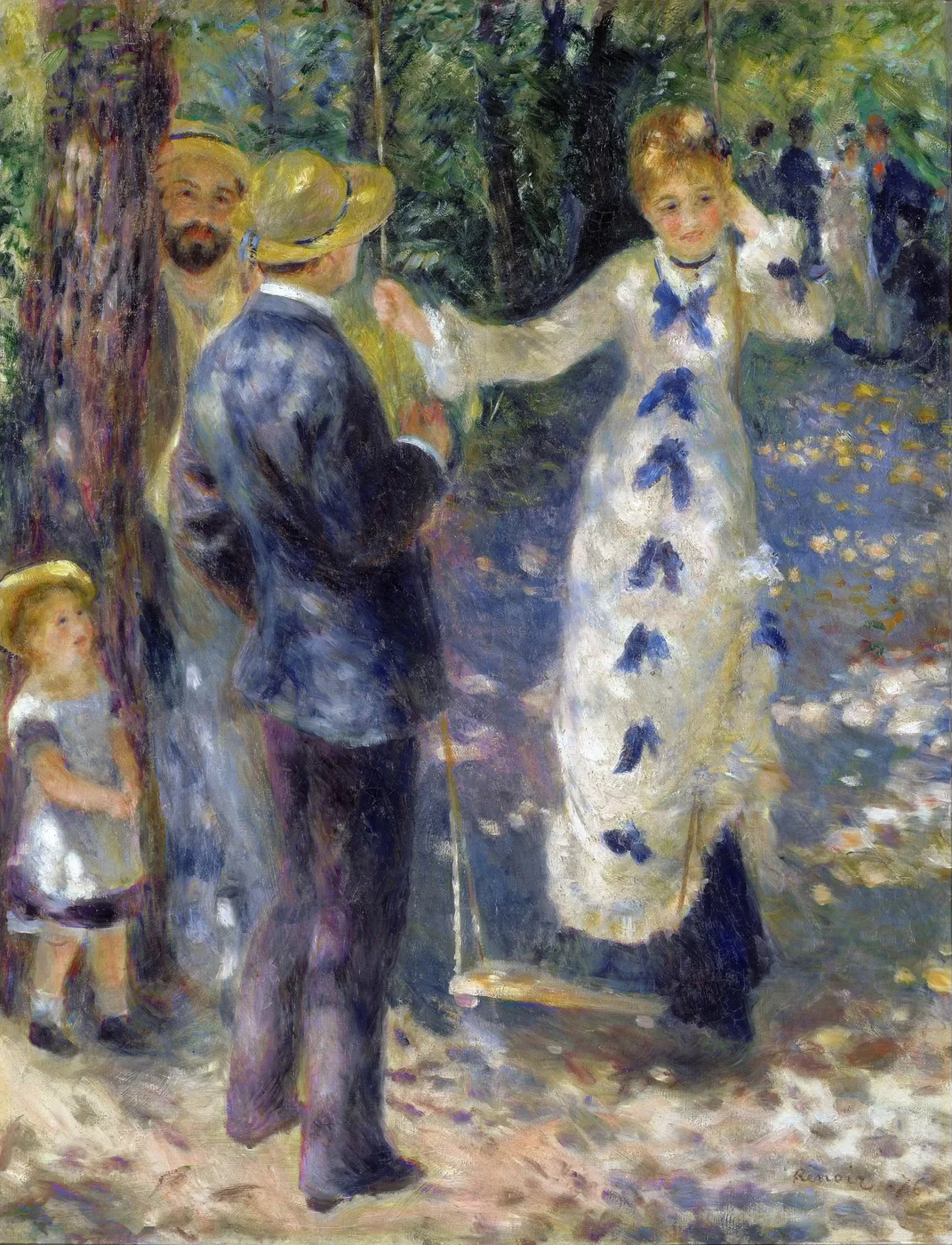
He set up a simple wooden swing among the trees and arranged a small group of figures around it, a young woman pausing mid swing, a man leaning against a tree trunk in conversation with her, and a child watching from behind. The scene reads as an ordinary, unremarkable moment of leisure rather than a staged tableau.
The painting was shown at the third Impressionist exhibition in 1877, alongside the Moulin de la Galette, and the two works together are often discussed as a pair, since both were painted in the same garden during the same months and share the same fractured, sun-struck light.
Blue Ribbons Against Green Shade
The young woman on the swing stands at the centre of the composition in a white dress patterned with soft blue bows, one hand resting on the swing’s rope, her gaze turned down and slightly away from the man beside her. Sunlight catches the dress and the gravel path beneath her feet in bright, almost bleached patches, while the surrounding foliage stays a cooler, deeper green.
The man leaning against the tree wears a pale suit and is turned toward the woman, his posture relaxed and slightly informal, as though the two have paused their conversation only briefly. A small girl stands further back in the shadows, watching the pair with the plain, unposed curiosity of a child included almost as an afterthought.
What distinguishes the picture is how the sunlight falls in isolated round patches across the ground and the figures’ clothing, rather than in one continuous wash. These patches of light, blue-tinted where they mix with the surrounding shadow, are one of the most distinctive effects Renoir achieved during this period.
The composition places the swing itself slightly off centre, its ropes cutting diagonally through the upper half of the canvas and anchoring the otherwise loose, informal grouping of figures beneath it.
Colour Used to Suggest Heat and Shade
Renoir builds the picture from a fairly narrow range of colours: soft blues in the shadows and in the dress’s pattern, warm ochre in the gravel and sunlit skin, and a deep, slightly muted green in the foliage that never becomes flatly decorative. This restraint keeps the eye focused on the interplay between light and shade.
Brushwork throughout is loose and visible, particularly in the leaves and the gravel path, where individual strokes remain distinct rather than blending into a smooth surface. On the woman’s dress the paint is applied slightly more carefully, enough to keep the bows and the fall of the fabric legible against the surrounding blur of foliage.
The overall effect is of light itself as the true subject, with the figures acting almost as a pretext for studying how sunlight breaks apart when it passes through moving leaves onto a static scene below.
A Quiet Scene That Holds Its Light
Unlike the crowded, sociable energy of the Moulin de la Galette, painted in the same garden that summer, La Balançoire is a small, quiet scene built around only four figures and a great deal of empty green shade. That relative stillness gives it a different character, less immediately busy, more contemplative.
The picture’s dappled light effect shifts noticeably depending on how a room is lit; bright daylight tends to intensify the contrast between the sunstruck patches and the green shadow, while softer indoor light lets the blues in the dress and the shadows come forward instead.
Renoir returned to the subject of a woman on a swing later in his career in smaller, less exacting versions, but this original canvas, now in the Musée d’Orsay, remains the clearest and most fully worked statement of the idea.
The child watching from the shadows is easy to overlook on a first glance, yet her presence changes the reading of the scene from a private moment between two adults into something more like a family outing observed in passing. Almost a century and a half later, the painting still communicates an ordinary afternoon’s warmth with unusual precision.
Sizes and materials for The Swing are listed on its product page.