Girl with a Fan
Renoir’s Search for Firmer Form in the 1880s
By 1885 Renoir was deep into what he later called his crisis with Impressionism, a period in which he pulled back from the broken brushwork of the 1870s in favour of clearer outlines and more solid modelling. He wanted his figures to feel weightier on the canvas.
He had spent time studying earlier art, including the work of Ingres, whose precise draughtsmanship offered a counterweight to the loose handling Renoir felt he had pushed as far as it could go. This study left a visible mark on his technique.
Girl with a Fan belongs to this period of reassessment. It is a single-figure portrait built with far more attention to line and volume than his Impressionist figures of a decade earlier.
Renoir worked through this new discipline slowly, testing it repeatedly on close-up single figures before applying it to the larger, more ambitious compositions he was planning at the same time. Girl with a Fan is one of the clearer results of that testing process.
Critics and collectors were divided about this new direction when they encountered it, some praising the return to clearer drawing and others missing the spontaneity of his earlier work. Renoir held to the change for several years regardless.
A Young Woman Poised with an Open Fan
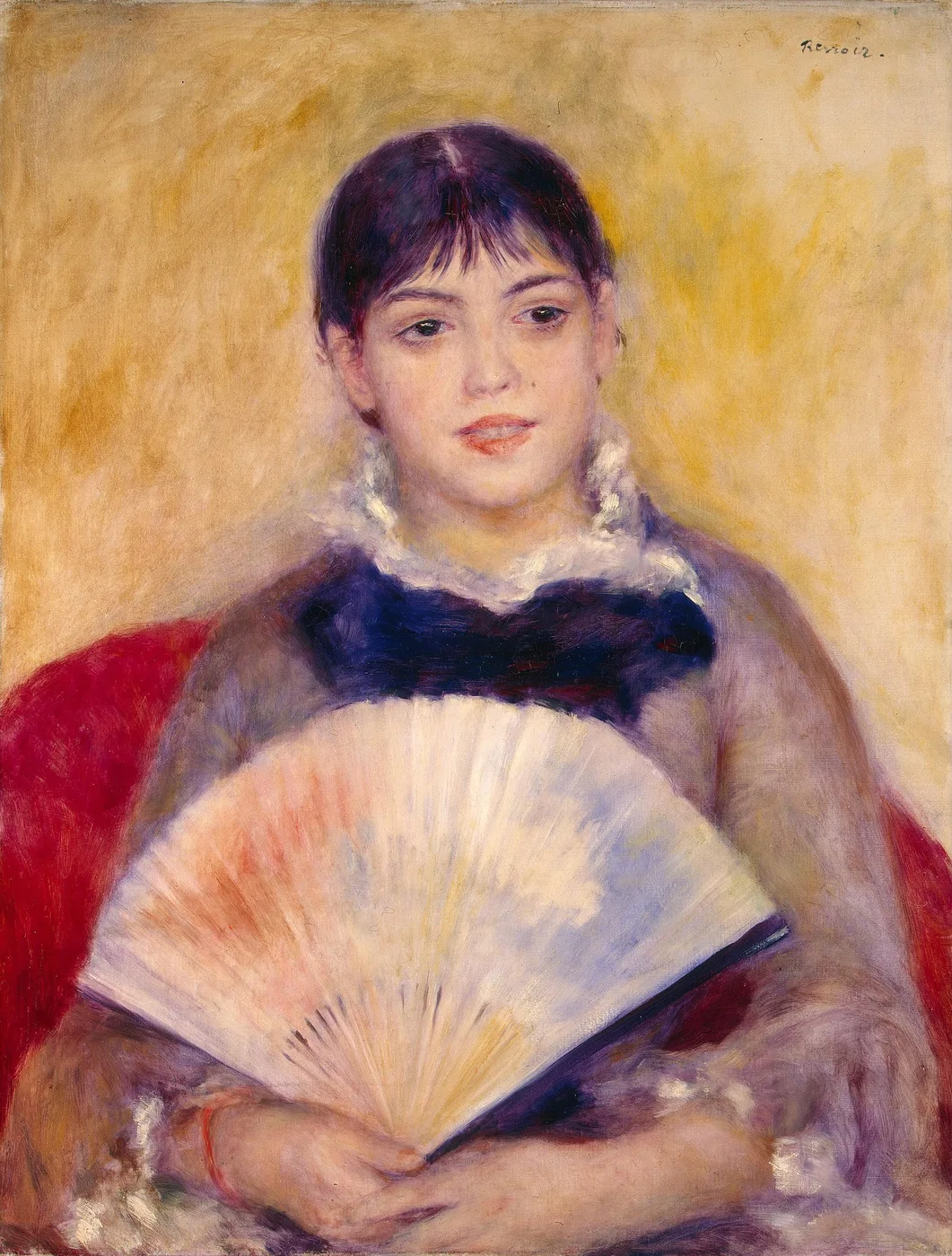
The picture shows a young woman seen close up, turned slightly away from the viewer, holding an open fan in front of her with both hands. The fan becomes the focal object of the composition.
Her expression is calm and self-possessed, her gaze directed off to one side rather than meeting the viewer. This gives the picture a sense of quiet reserve rather than direct address.
The fan itself becomes a small stage for pattern and light, its ribs and painted surface catching brighter touches of colour against the darker clothing around it. It draws the eye almost as much as her face does.
Fans were a common accessory in portraits of this period, but Renoir uses this one as more than decoration. Its curved edge echoes the curve of the sitter’s shoulder, tying the figure and the object into a single unified shape.
Modelling Restored: Skin, Cloth and Shadow
Renoir builds the face and hands with smooth, carefully blended paint, a marked change from the broken, flickering strokes of his mid-1870s work. The surface here looks far more controlled.
Shadows fall clearly across the cheek and neck, giving the head a rounded, sculptural solidity that Renoir had deliberately been working to recover. Light and shade are stated with unusual clarity for his work of this decade.
The clothing is handled with similar care, its folds and creases described with enough precision to suggest weight and texture rather than simply colour and light. Even small details, like the fold of a sleeve, are given real attention.
A Dark Ground That Holds the Figure Still
Behind the figure, Renoir uses a dark, largely undefined background, a departure from the sunlit gardens and interiors of his earlier Impressionist portraits. It leaves almost nothing to distract from the sitter.
This darkness has the effect of pushing the woman and her fan forward, concentrating attention on the modelling of her face and hands rather than on any surrounding setting. The picture reads almost like a study in isolation.
Warm flesh tones and the pale fan stand out clearly against this ground, giving the whole composition a stillness that suits its quieter, more studied technique. Nothing in the picture competes with that stillness for attention.
Living with Girl with a Fan
The painting is held today at the Hermitage Museum in Saint Petersburg, where it represents Renoir’s turn toward a more classical, controlled style in the mid-1880s. It sits among a strong holding of French nineteenth-century painting there.
In changing light, the dark background stays largely constant while the pale fan and lit side of the face pick up whatever brightness is available, keeping the figure legible even in a dim room. This makes the portrait unusually forgiving of gallery conditions.
It is a picture built for close, patient looking. Its calm surface offers a deliberate contrast to the restless brushwork Renoir had spent the previous decade perfecting.
Returning to it after seeing Renoir’s brighter, sunlit crowds elsewhere, a viewer notices how deliberately quiet this single figure has been made to feel. The quietness reads as intentional rather than accidental.
Sizes and materials for Girl with a Fan are listed on its product page.