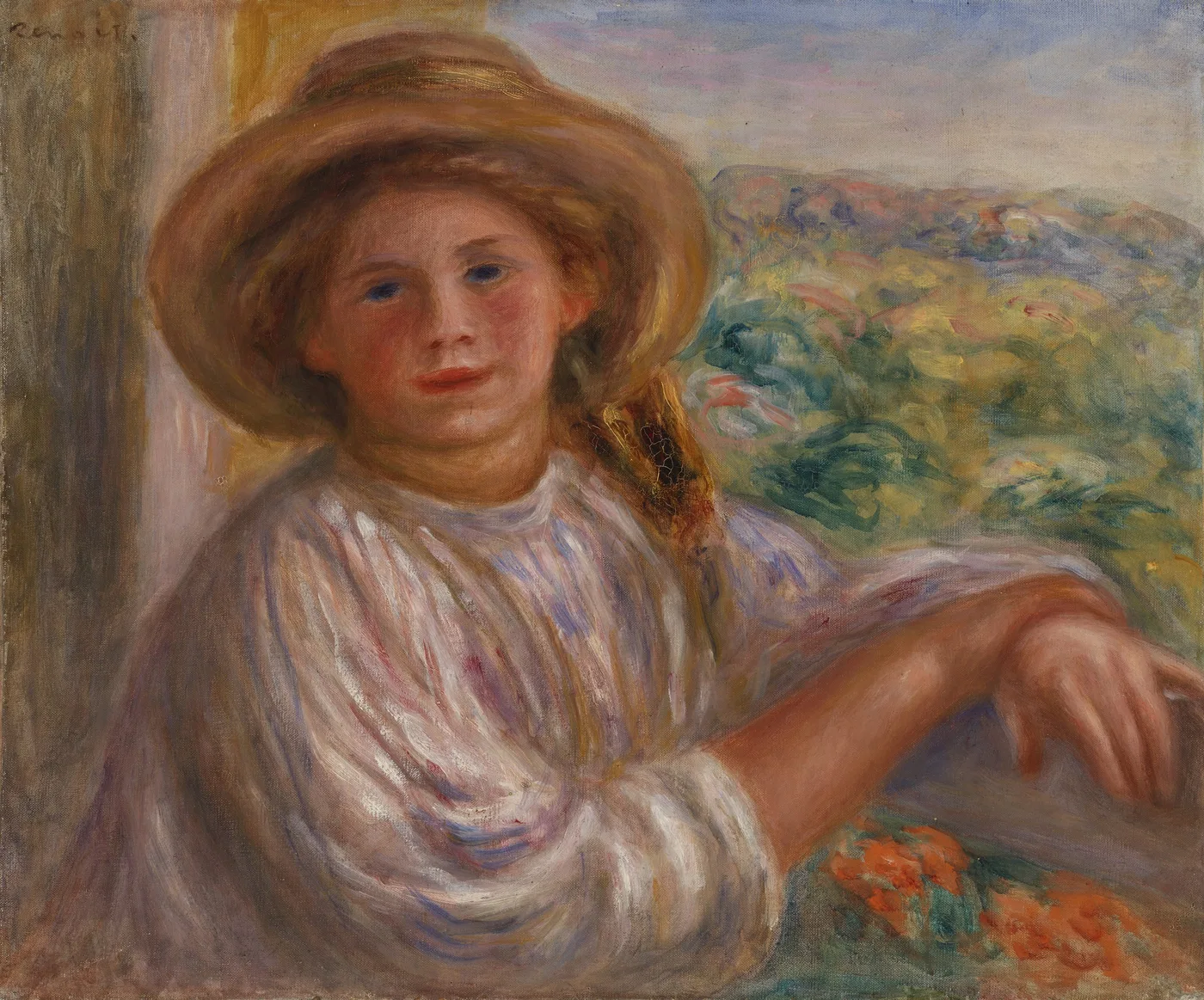
Gabrielle with Open Blouse
Gabrielle Renard, From Nursemaid to Muse
By 1907 Pierre-Auguste Renoir was well into his sixties, his hands increasingly stiffened by rheumatoid arthritis, and his working life had settled into a quieter, more domestic rhythm than the café society scenes of his youth. Gabrielle with Open Blouse belongs to this later period, when Renoir painted mostly at home, surrounded by family and a handful of trusted models rather than the wider social world of Montmartre.
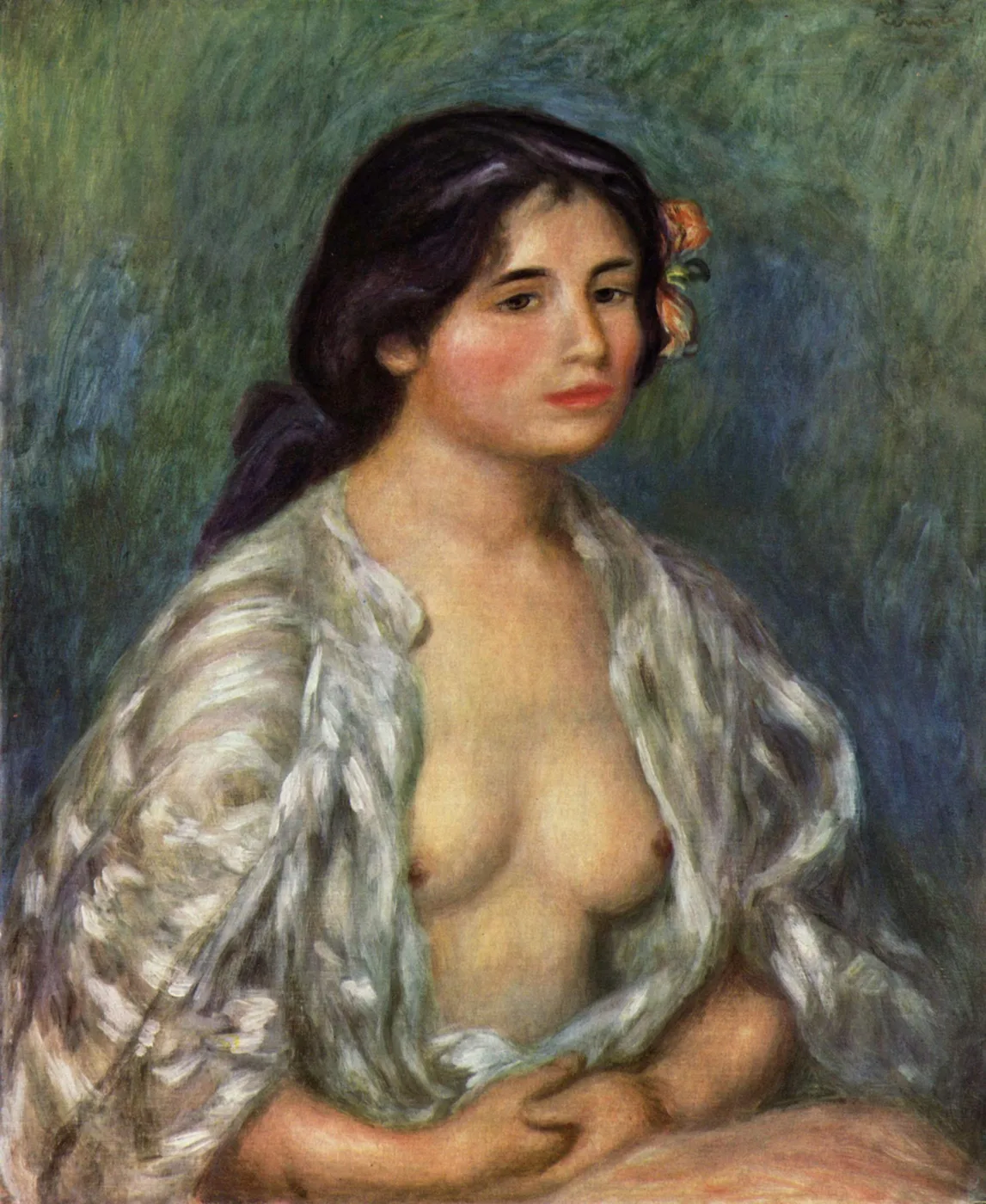
The title describes the picture plainly: a woman shown from the waist up, her blouse falling open at the front, painted with the warmth and softness of flesh that increasingly preoccupied Renoir in these years. There is no incident or story attached to the image, only sustained attention to a familiar sitter.
The sitter was Gabrielle Renard, a cousin of Renoir’s wife Aline who joined the household in 1894 as a nursemaid for the couple’s young sons. Within a few years she had become far more than a household employee, sitting for Renoir again and again as he explored the female form in dozens of canvases from the late 1890s into the First World War.
Gabrielle’s familiarity with the artist mattered as much as her appearance. She could be summoned to sit whenever the light was right or Renoir’s mood called for it, without the formality that a paid professional model or a society patron would have required.
A Household Resettled on the Riviera
By the time this picture was painted, Renoir and his family were spending increasing amounts of time in the south of France, drawn by a warmer climate that eased his arthritic pain. Within a year or two of this painting, they would settle permanently at Les Collettes, a farm near Cagnes-sur-Mer that Renoir bought partly to protect its ancient olive trees from being felled.
Life in the south meant a smaller, more enclosed circle of models and subjects. Renoir no longer needed to seek out Parisian dance halls or boating parties for material; his own household, garden and models such as Gabrielle supplied everything he wanted to paint.
This shift also freed Renoir from narrative altogether. Where his earlier career had included crowded social scenes with stories to tell, his later work, this picture among them, concentrates on a single figure studied for its own sake, with no anecdote attached.
Renoir’s admiration for earlier masters of the nude, particularly Titian and Rubens, deepened in these years, partly through paintings he had studied on a trip to Italy in the early 1880s. Gabrielle with Open Blouse carries something of that inheritance in its frank, unhurried attention to the body.
Flesh, Fabric and the Late Renoir Touch
The painting shows Gabrielle from roughly the waist upward, her dark hair gathered loosely, her blouse slipping open to expose her chest and shoulder. There is no dramatic gesture; she simply sits, turned slightly toward the viewer, her expression calm rather than performed.
Renoir’s palette here is dominated by warm pinks, soft reds and creamy ochres, the colours he increasingly favoured for skin in his later work. These tones are set against a comparatively plain, loosely brushed background, so the eye lands immediately on the glowing warmth of the figure.
The brushwork is broad and confident, built from loaded, visible strokes rather than smooth, blended finish. Fabric and flesh are painted with a similar looseness, so the open blouse and the skin beneath it seem to merge into a single rhythm of warm colour rather than being sharply separated.
The face receives slightly more careful attention than the rest of the picture, its features more clearly resolved even as the surrounding paint stays loose. That contrast, a settled face amid freely handled fabric and shadow, is typical of how Renoir worked in his last two decades.
A Renoir Painting’s Long Journey to Tehran
Gabrielle with Open Blouse now hangs far from either Paris or the French Riviera, in the Tehran Museum of Contemporary Art. The museum was built in the 1970s to house a remarkable collection of nineteenth and twentieth-century European and American art assembled for Iran during the final years of the Pahlavi monarchy.
That collection, which includes other Impressionist and modern works alongside Renoir’s, has had an unusual history since 1979, at times displayed and at other times kept largely out of public view. In recent years, however, pieces from the collection, including works by French painters of Renoir’s generation, have been shown more openly.
Seeing an intimate, domestic image like this one in that particular setting adds an unexpected layer to its story. A private sitting between an ageing painter and a woman he had known for over a decade now sits within a museum built for entirely different, and much later, political and cultural purposes.
On a wall, the painting rewards slow looking rather than a single glance. Its warm pinks and ochres shift gently with the light in a room, glowing under a lamp in the evening and appearing softer, cooler under daylight, so the same quiet, unguarded moment between artist and model keeps revealing slightly different warmth depending on the hour.
Sizes and materials for Gabrielle with Open Blouse are listed on its product page.