Gabrielle and Jean
A Nursery Turned Studio
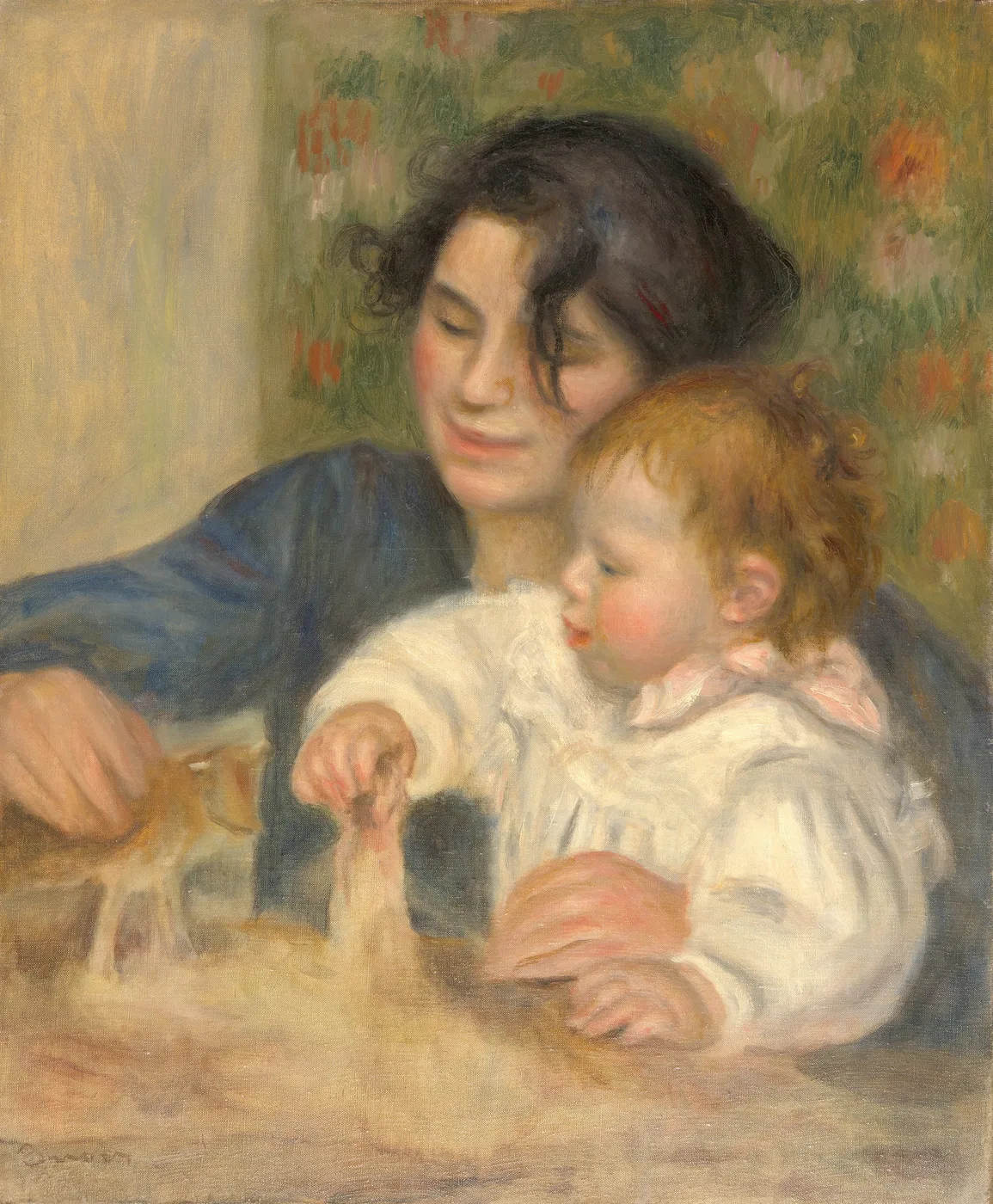
By 1895, Renoir’s family life had settled into the pattern that would occupy much of his later painting: his wife Aline, their young son Jean, and Gabrielle Renard, a cousin of Aline’s who had come to help care for the children. Gabrielle and Jean captures a small, unremarkable moment between the two of them, the kind of domestic scene Renoir returned to again and again in these years.
Jean, born in 1894, would have been little more than a toddler when this picture was painted. He sits or plays on the floor while Gabrielle watches over him, her attention half on the child and half turned toward the viewer.
There is no grand narrative here, no allegory or historical reference. Renoir was painting the life immediately around him, in the rooms he lived in, with the people who shared his household.
Gabrielle Renard, More Than a Nanny
Gabrielle Renard arrived in the Renoir household as a young woman and quickly became far more than a domestic helper. She cared for Jean and his brothers, ran errands, and posed for Renoir constantly through the final decades of his life, appearing in dozens of his paintings.
Her relationship with the family was close enough that Jean Renoir, once grown into one of France’s most celebrated film directors, would later write warmly of her in his own memoirs of his father. She was, in effect, a fixture of the household rather than a passing employee.
In this painting, Gabrielle’s role as caretaker is made visible without sentimentality. She is simply present, attentive, and comfortable in the domestic space, exactly as Renoir would have seen her on any ordinary day.
Renoir’s Late Palette of Reds and Roses
By the mid-1890s, Renoir’s brushwork had softened considerably from the broken, feathery touch of his high Impressionist years. Forms in Gabrielle and Jean are rounder and more fully modelled, the edges less fragmented than in his paintings of the 1870s.
Warm reds and pinks dominate the canvas, in Gabrielle’s clothing and in the flushed tones of Jean’s skin. This warmth is characteristic of Renoir’s later palette, which increasingly favoured a rich, saturated range of reds over the cooler blues and violets he had used earlier in his career.
Light in the painting is gentle and diffuse, suggesting an interior rather than the outdoor sunlight of his earlier bathing and boating scenes. The absence of harsh shadow gives the whole composition a soft, enveloping quality.
Jean’s toys are rendered with quick, loose touches, enough to suggest their shapes without fussy detail. Renoir was more interested in the overall mood of the scene than in cataloguing every object within it.
A Domestic Scene at the Orangerie
Gabrielle and Jean now hangs at the Musée de l’Orangerie in Paris, part of a substantial collection of Renoir’s work assembled by the dealer Paul Guillaume and later given to the French state. The Orangerie holds numerous paintings from Renoir’s later career, making it one of the best places to trace how his style evolved after the 1880s.
Seeing the painting there, among other domestic and figure scenes from the same decades, helps place it within Renoir’s broader late-career interest in intimate, everyday subjects rather than grand public statements.
The painting’s small scale and quiet subject mean it does not shout for attention in a room. It rewards a viewer who is willing to sit with it, to notice the tenderness in how Gabrielle’s hand rests near the child and how the light settles across the two figures.
In softer daylight, the pinks and reds of the composition seem to glow gently rather than assert themselves; under warmer artificial light in the evening, those same tones can deepen, making the scene feel even more enclosed and domestic.
There is an intimacy to the picture that has little to do with grandeur. It is a father’s observation of his own household, caught in a moment so ordinary that its details, a scattered toy, a woman’s watchful glance, might otherwise have gone unrecorded.
That ordinariness is precisely what gives the painting its staying power. It asks nothing more of the viewer than the same quiet attention Gabrielle gives to Jean, a small, sustained act of noticing.
Sizes and materials for Gabrielle and Jean are listed on its product page.