Dance in the Country
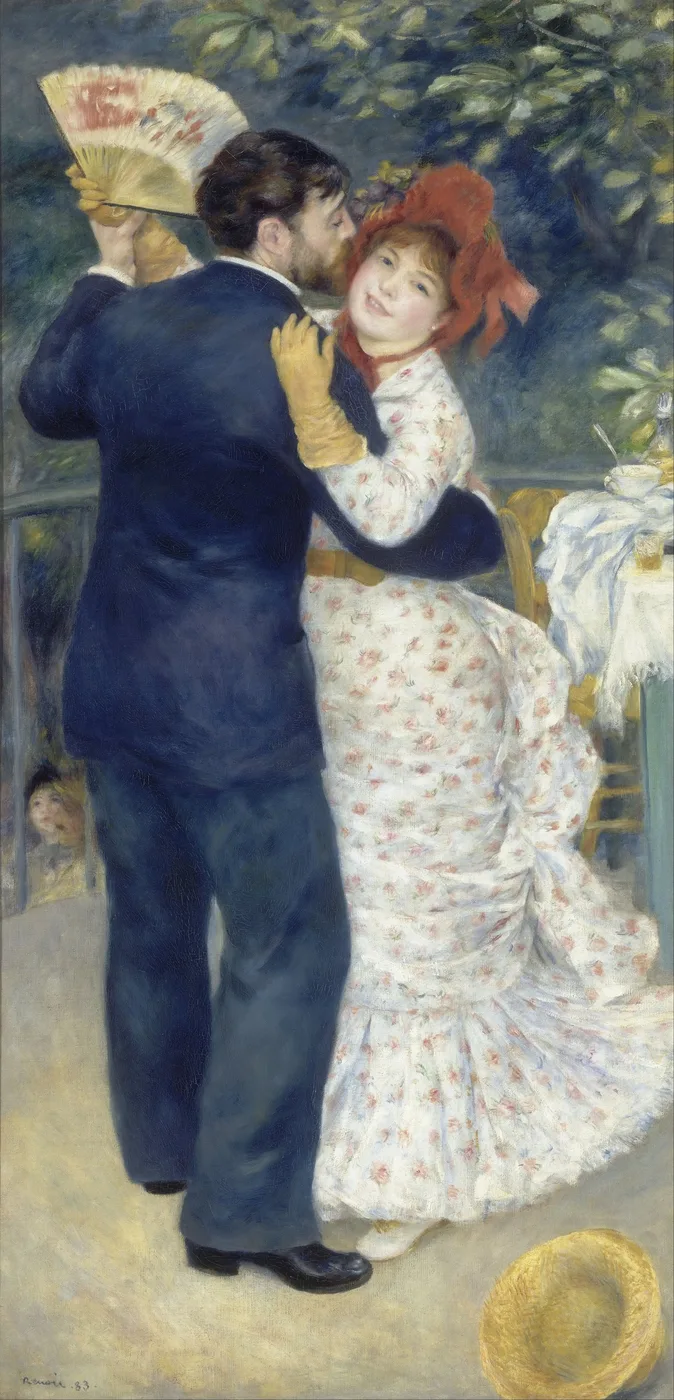
Aline Charigot Takes the Floor
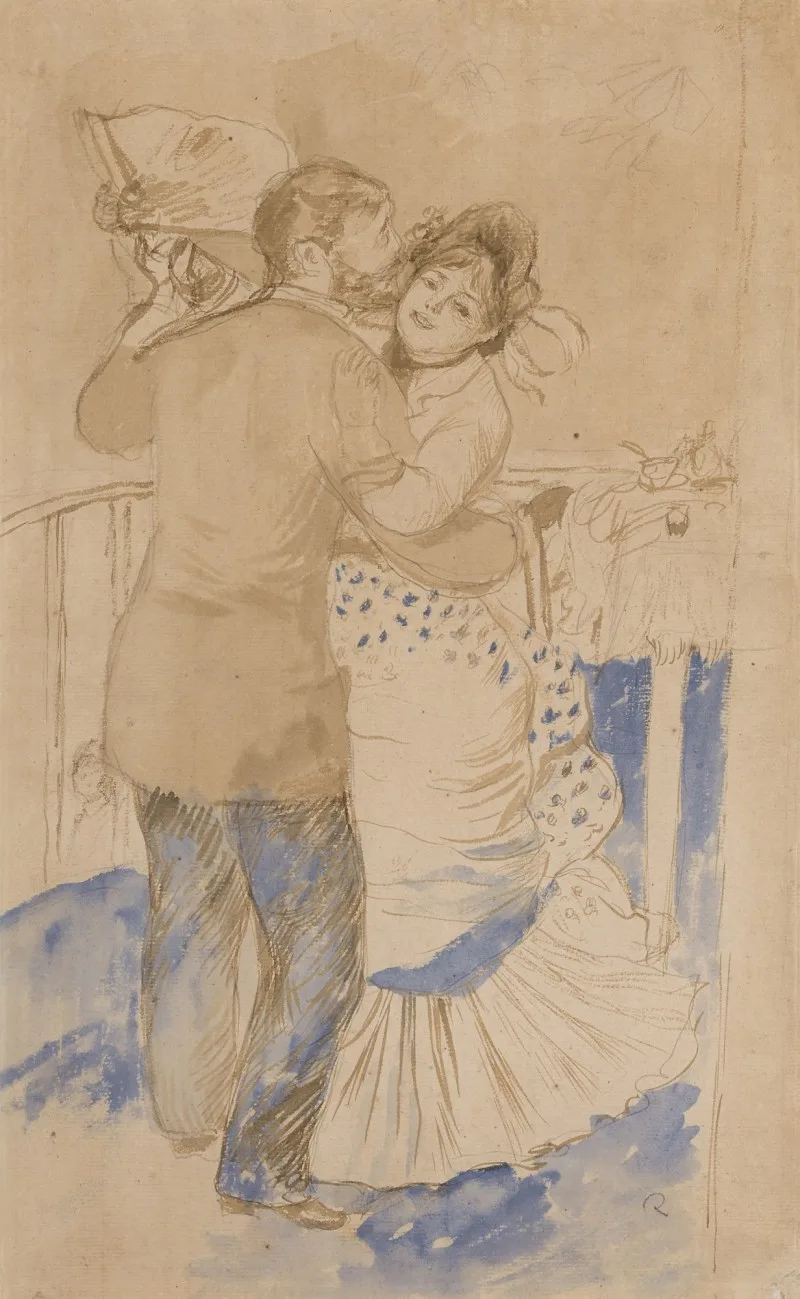
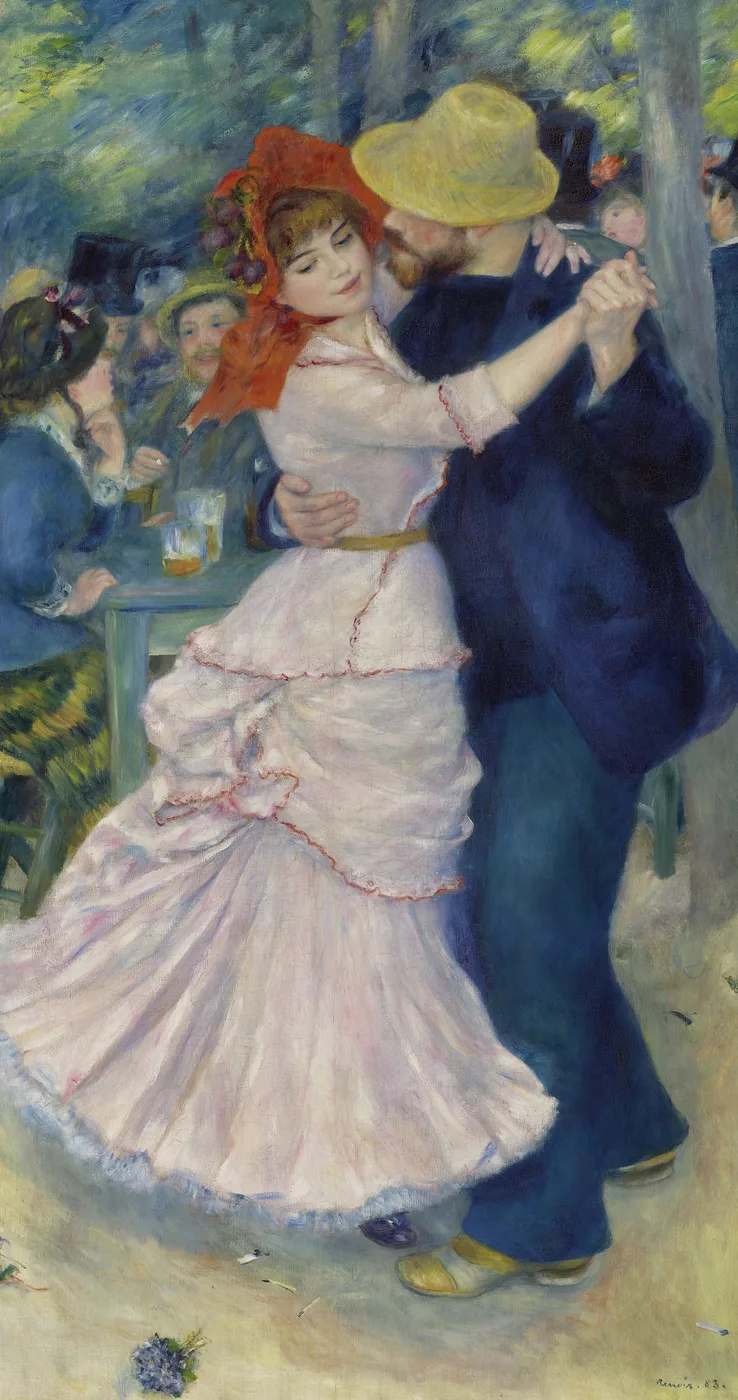
Renoir painted Dance in the Country in 1883 as the warm, informal counterpart to Dance in the City, a picture he conceived at the same time and on a similar scale. Where the city scene stayed cool and composed, this canvas was built around movement, laughter and the loose atmosphere of an outdoor dance.
His model for the woman was Aline Charigot, a young seamstress he had met a few years earlier and who would later become his wife and the mother of his three sons. Her partner in the picture was again Paul Lhote, the same friend who posed as the man in the companion painting.
Renoir set the couple outdoors, beneath trees, at what appears to be one of the informal open-air dance venues that dotted the villages along the Seine west of Paris, the kind of setting he had already painted in earlier crowd scenes from the same stretch of river.
Painted as a pair, the two dance pictures were meant to be read against each other, yet Dance in the Country carries its own complete mood of pleasure and abandon that needs no companion canvas to make its point.
Renoir gave this outdoor picture roughly the same dimensions as its formal companion, so the two could be hung and compared as equals, even though the two canvases have since sometimes travelled and been shown apart from one another.
A Red Bonnet Spinning Through the Air
The woman wears a red bonnet and a pink dress, both rendered in loose, energetic strokes that seem to move with her body as her partner swings her round. Her face, turned back over her shoulder with a broad, open smile, is the warmest and most animated expression Renoir gave either of the two dance pictures.
Her partner holds her close, his body angled into the turn, his own hat pushed back and his face lit with evident enjoyment. Unlike the formal distance kept by the couple in the companion picture, these two dancers are pressed together, caught mid-movement rather than posed.
On the ground near their feet, Renoir scattered a straw hat, a fan and what appears to be a discarded glass, small props suggesting the dance has been going on for some time and that decorum has already been set aside. These details give the scene the feel of a real afternoon rather than a staged tableau.
Around the couple, other dancers and onlookers are suggested only in loose, sketchy strokes at the edges of the canvas, kept deliberately vague so the eye never leaves the central pair.
Warm Colour and a Looser Hand
Where Dance in the City relies on pale creams and black, this picture is built from warm pinks, reds and greens, applied with a far looser and more visibly worked brush. Renoir let individual strokes remain distinct in the woman’s dress and in the dappled foliage overhead, closer to the Impressionist handling of his earlier decade.
Sunlight breaks through the trees above the dancers in patches, scattering warm light and cooler shadow across the ground and across the couple’s clothing. That dappled light is one of the clearest signs that Renoir, even while experimenting with firmer drawing elsewhere in his work of these years, had not abandoned outdoor light entirely.
The brushwork in the woman’s spinning skirt is especially loose, built from short, curling strokes that seem to record the fabric’s movement rather than its fixed shape, an effect entirely suited to a picture about motion and pleasure.
Even the man’s dark jacket, which could easily have become a flat block of shadow, is broken up with small strokes of green and blue reflected from the leaves overhead, keeping the whole figure part of the same sunlit air as his partner.
A Picture Built for Warmth in Any Room
Dance in the Country now hangs in the Musée d’Orsay in Paris, usually shown close to its companion piece so the contrast between the two can be felt directly. Even without that comparison, the picture’s warmth and energy are immediately legible on their own terms.
On a wall at home, its reds, pinks and dappled greens tend to hold their glow even in fairly low light, and the couple’s spinning movement gives the eye somewhere active to travel across the canvas rather than settling on a single fixed point. Morning light tends to bring out the cooler greens of the foliage; evening light warms the pinks of the woman’s dress.
What the picture offers, above all, is a sense of an afternoon that has not yet ended, two dancers caught at the height of their pleasure with no sign that the music is about to stop.
Sizes and materials for Dance in the Country are listed on its product page.