Bather with a Griffon Dog
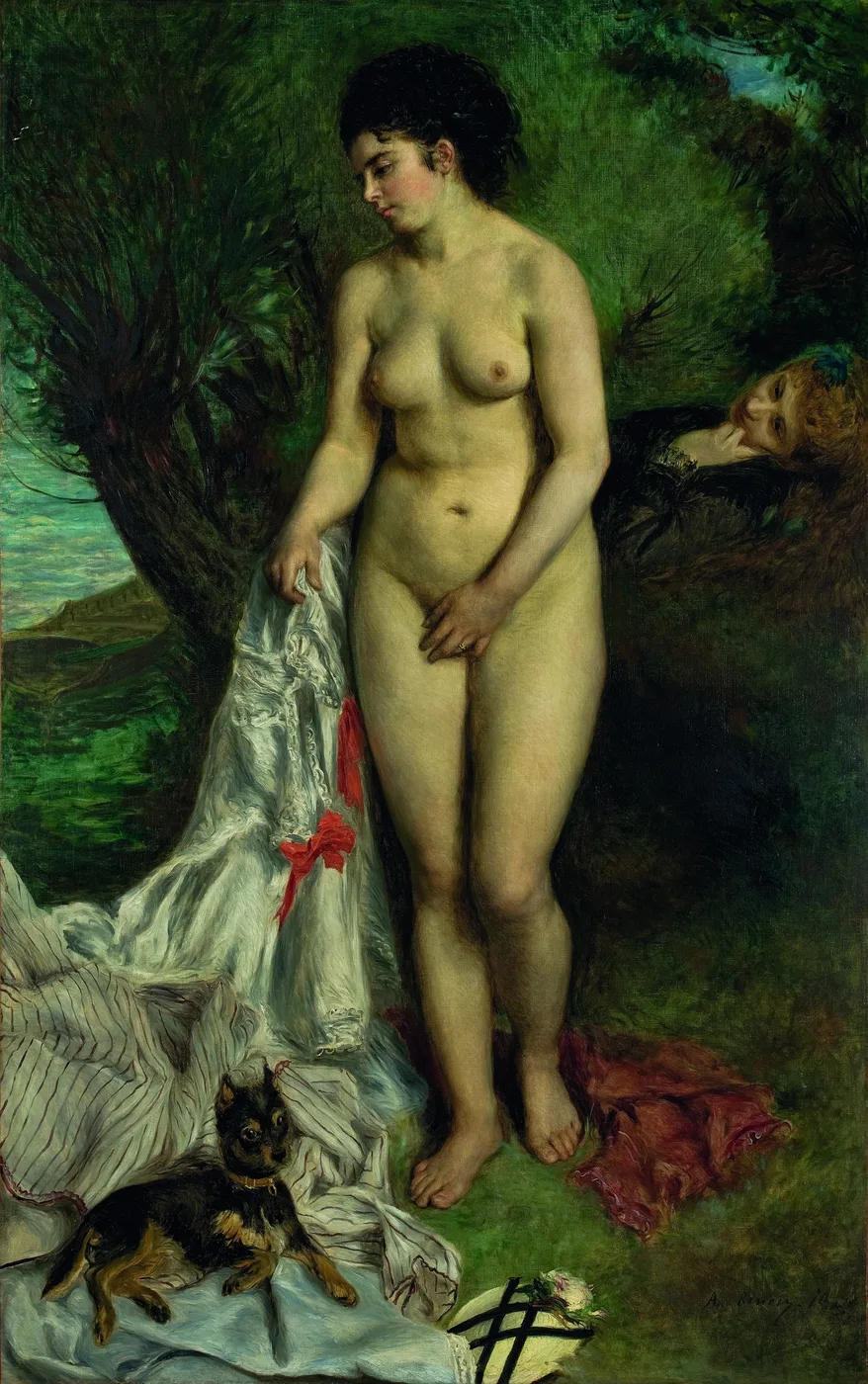
Lise Tréhot Steps to the Water’s Edge
In 1870, Renoir was still several years from the exhibitions that would define Impressionism, and he was working hard to establish himself through the official Paris Salon. Bather with a Griffon Dog was one of the ambitious figure paintings he sent that year, a life-size nude intended to catch the eye of jurors and critics alike.
The model was Lise Tréhot, who appears in a number of Renoir’s paintings from this period and was his companion through much of the 1860s. Her presence gives the painting a continuity with other works from these years, even as the setting and pose here are entirely its own.
Renoir needed the Salon’s approval if he was to build a public reputation, and a large nude, painted with evident technical control, was one of the surest ways to be taken seriously by the jury.
The Salon of 1870 and a Painter’s Ambition
The painting was accepted and shown at the Salon of 1870, a rare success for Renoir at a moment when official recognition was hard won. Only months later, the Franco-Prussian War would upend Parisian artistic life and scatter the circle of painters Renoir had been working alongside.
Seen in that light, the picture marks a kind of high point for Renoir’s engagement with Salon painting on its own terms, before the group later known as the Impressionists began organising exhibitions independent of the official system.
The scale of the canvas, close to life size, reflects Salon convention. Renoir was working within an established genre, the outdoor bather, while trying to bring his own sense of touch and colour to a subject that many other painters had treated before him.
Flesh, Fabric and a Small Dog’s Alertness
At the centre of the composition stands the bather, her body turned in a gentle contrapposto, weight settled on one leg. Her clothing lies discarded on the rocks beside her, painted with quick, textured strokes that contrast with the smoother handling of her skin.
A small griffon dog sits at her feet, alert and watchful, its wiry coat rendered in short, dry touches of paint. The dog’s presence softens what might otherwise be a purely formal nude study, introducing a note of everyday companionship into the scene.
Light falls across the figure from the side, modelling the body in warm flesh tones set against the cooler greens and greys of the riverbank. Renoir’s brushwork here is tighter and more descriptive than in his later Impressionist canvases, still governed by the demands of Salon finish.
The background is loosely suggested rather than fully resolved, with trees and water sketched in broader strokes that recede behind the sharply observed figure. This contrast between a carefully finished foreground and a looser setting was already a hallmark of Renoir’s approach to outdoor bathing scenes.
From a Paris Studio to São Paulo
Bather with a Griffon Dog eventually entered the collection of the São Paulo Museum of Art, where it remains one of the institution’s significant nineteenth-century French paintings. Its journey from a Paris Salon wall to a museum in Brazil reflects the wider twentieth-century movement of major European paintings into collections around the world.
At the São Paulo Museum of Art, the painting is seen alongside other European works that trace the development of modern painting, offering a South American audience direct access to a picture that once hung in the heart of official Parisian art life.
For viewers today, the painting offers a chance to see Renoir before his palette lightened and his brushwork loosened into the broken colour of the 1870s and 1880s. The tonal range is darker, the modelling more deliberate, closer to Courbet than to the Renoir of his later dance-hall scenes.
Living with a reproduction of this painting on a wall means living with its quiet, watchful mood. The bather’s calm stance and the dog’s alert gaze create a stillness that holds attention without demanding it.
Depending on the light in a room, the warm flesh tones can seem to advance or recede against the darker background, the contrast between figure and setting shifting subtly through the day. That interplay of warmth and shadow is part of what gives the painting its lasting presence.
It is a painting rooted firmly in a specific moment, a young painter’s bid for Salon success just before history intervened, yet its careful observation of a body and a dog at the water’s edge still feels immediate a century and a half later.
Sizes and materials for Bather with a Griffon Dog are listed on its product page.