At the Theatre (La Première Sortie)
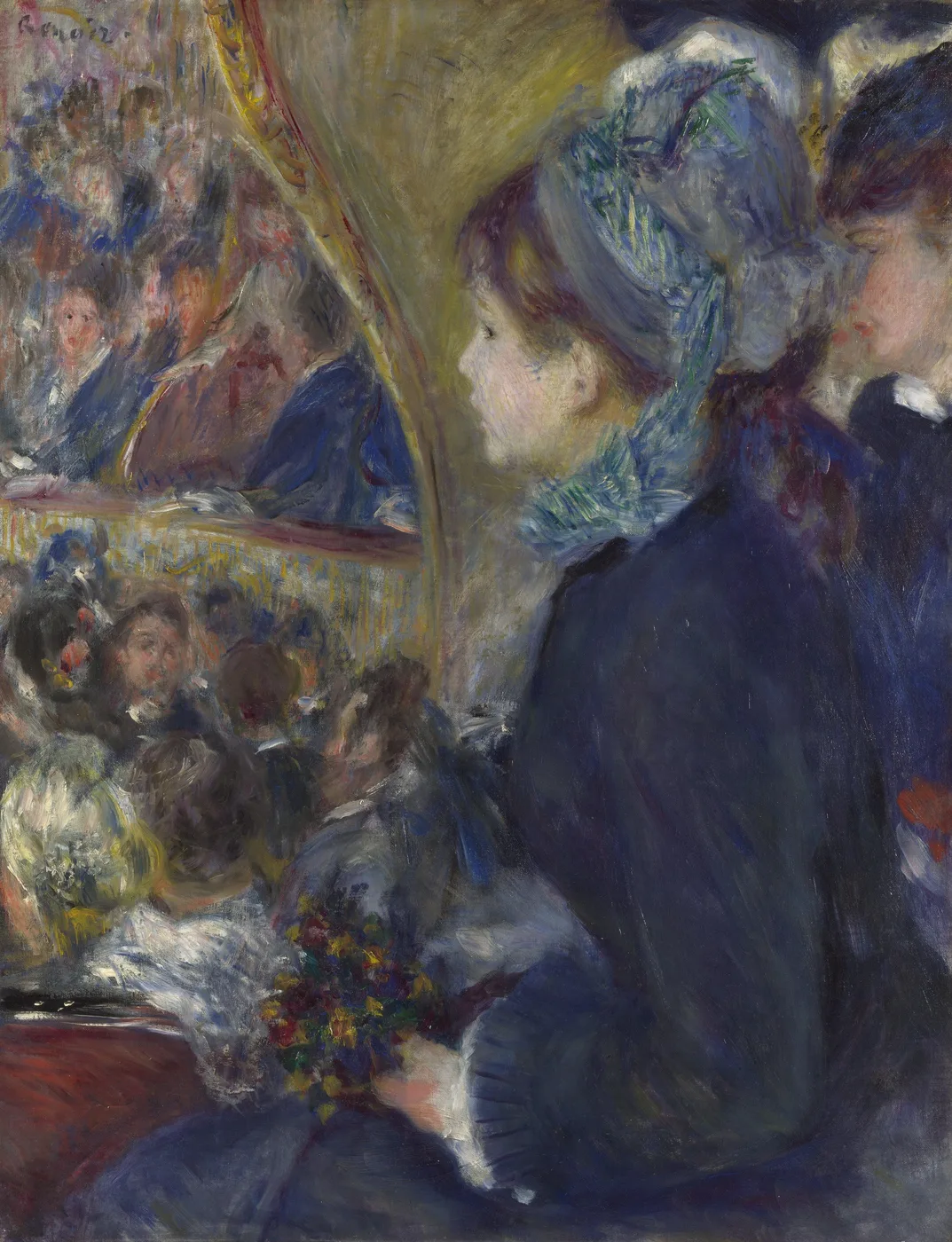
A Debut Evening at the Paris Theatre
In the mid-1870s Renoir was a regular visitor to the theatres of Paris. He was drawn less by the plays themselves than by the audience: the boxes, the balconies, and the ritual of being seen as much as seeing.
At the Theatre, also known by its French title La Première Sortie, or the first outing, imagines a young girl attending the theatre for what appears to be one of her earliest visits. She sits at the front of a box, dressed carefully for the occasion.
An older woman, presumably a chaperone, waits just behind her in the shadow. The picture captures a rite of passage rather than any specific performance taking place on stage.
Renoir was one of several Impressionist painters drawn to theatre boxes as a subject in these years, since the loges offered a ready-made stage for studying artificial light and a crowd arranged for view. He returned to the theme more than once.
A Girl on the Edge of Her Seat
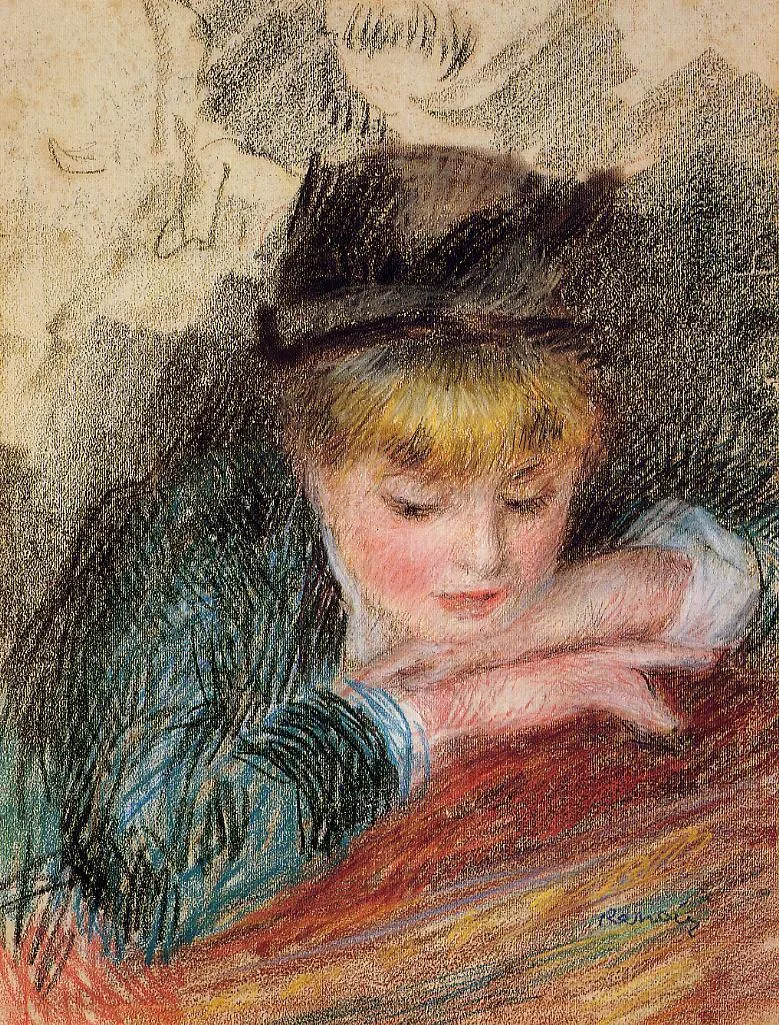
Renoir places the girl close to the picture surface, cropped tightly so that she seems to lean slightly forward, out of the box and toward the viewer. Her posture suggests both excitement and self-consciousness.
Her expression is watchful and a little uncertain, cheeks touched with pink, eyes wide beneath a hat trimmed with flowers. She holds herself carefully, as though aware of being on display in a room full of strangers.
Behind her, the chaperone is painted more loosely and kept in shadow. It is a quiet reminder that the girl is not yet fully on her own in this adult world, even if she is beginning to feel that she is.
Her gloved hands rest near a folded fan, a prop that marks the evening as a special occasion rather than an everyday outing. Renoir sketches it quickly, with just enough definition to be read at a glance.
The Loges Dissolve into Colour
Beyond the two central figures, the theatre itself dissolves into a haze of gold, red and blue. Other boxes and their occupants are suggested with a handful of quick strokes rather than drawn in any detail.
Renoir was not interested in describing the architecture of the theatre precisely. What matters is the sensation of a crowded, glowing interior seen at a glance, the way a real spectator’s eye would skim past dozens of other faces before settling on one.
This blurring of the background against the sharper handling of the girl’s face and dress draws the whole composition toward her. She becomes the single point of focus in a restless, crowded room.
Theatre interiors offered painters a different kind of light from the outdoor scenes more commonly associated with Impressionism, since the glow came from gaslight and candlelight rather than the sun. Renoir had to find a different vocabulary of colour to capture it convincingly.
Blue Against Gold: Renoir’s Palette of Nerves
The girl’s dress is painted in a cool, saturated blue that stands apart from the warm golds and browns surrounding her. This contrast is the picture’s main structural device, pulling the eye straight to her the moment one looks at the canvas.
Small red accents in her hair and at her chaperone’s collar keep the blue from feeling isolated. They thread a little warmth back through the cooler passages of paint.
The handling throughout is fluid and rapid, wet paint dragged over wet. It gives the impression that the whole scene was set down quickly, before the mood of the moment could pass.
Renoir’s confidence with a loaded brush is on full display here, in the certainty of a few strokes that stand in for an entire crowd. Little is overworked, and nothing feels laboured.
Living with La Première Sortie
The painting hangs today at the National Gallery in London, where its small scale and glowing colour make it easy to miss in a large room and rewarding to find. Visitors often come across it almost by accident.
Under gallery lighting, the blue of the dress holds its intensity even as the background browns and golds seem to recede and flicker. The effect recalls how a real theatre interior might look from a seat near the front.
What lingers afterwards is not the theatre at all but the girl’s expression. Caught between excitement and nerves, it is the kind of look that Renoir rarely painted with such directness.
The painting’s French title, meaning first outing, points to a theme Renoir returned to elsewhere in his work: the small rituals through which a child is gradually introduced to adult social life. A visit to the theatre was one of the more formal of these rites.
Sizes and materials for At the Theatre (La Première Sortie) are listed on its product page.