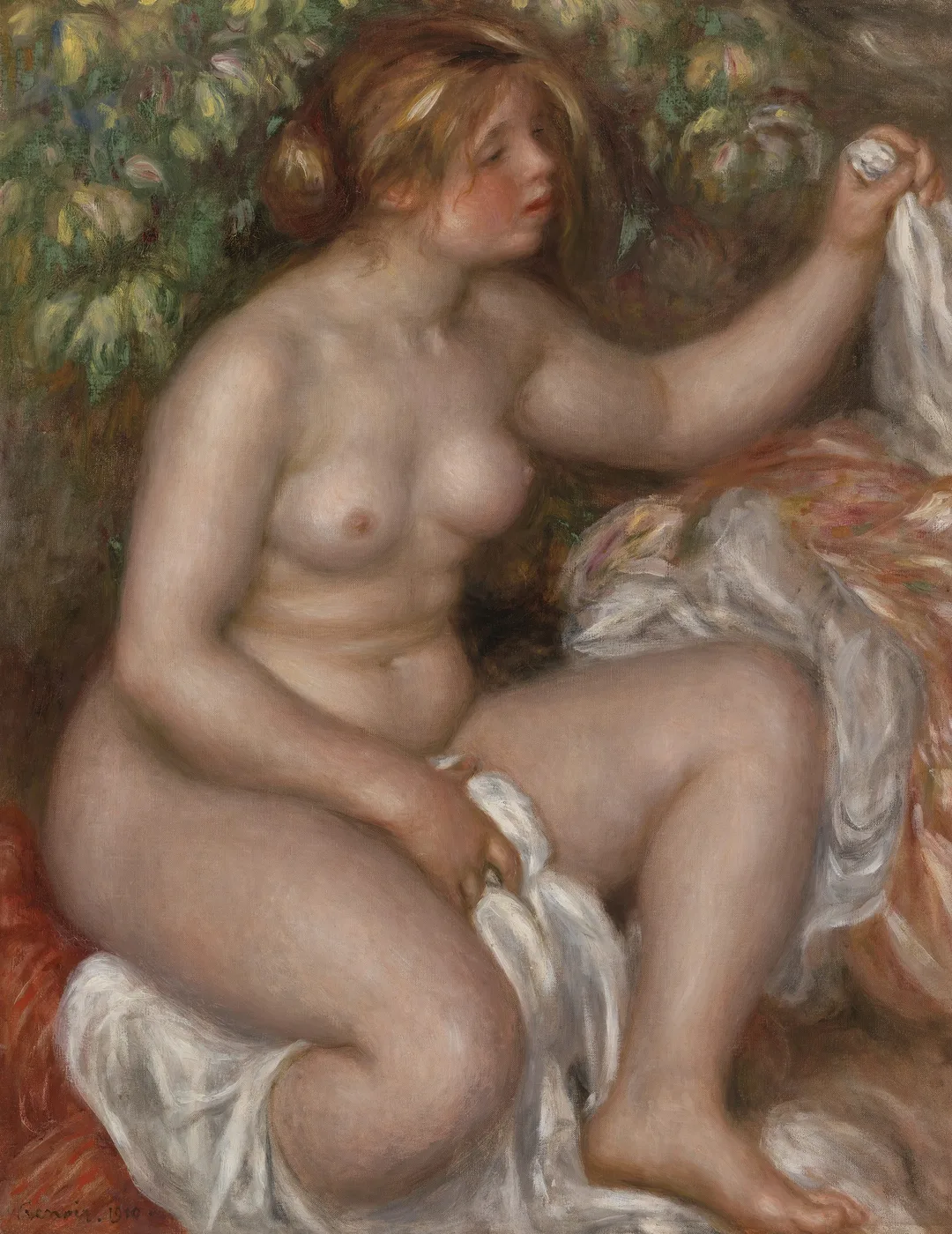
After the Bath (La Sortie du bain)
Painting Through Pain at Cagnes
By 1910 Renoir’s hands were badly deformed by rheumatoid arthritis, and he worked from a wheelchair at his house at Cagnes-sur-Mer on the Mediterranean coast, sometimes with a brush strapped to his fingers when he could no longer hold one unaided. Despite this he was painting more nudes than at almost any other point in his career, drawn back again and again to the female bather as his central subject.
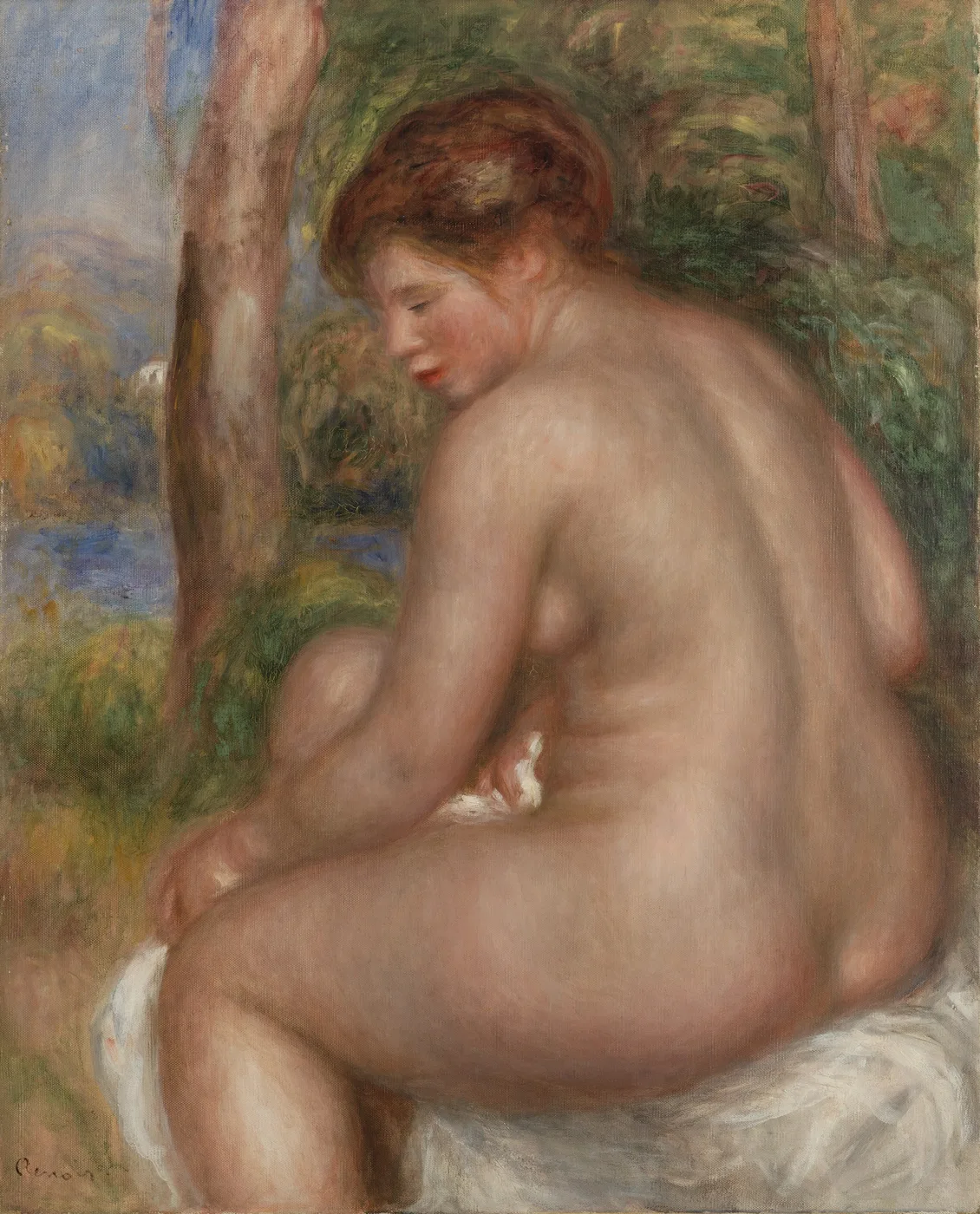
After the Bath, also known by its French title La Sortie du bain, belongs to this late period. It shows none of the physical difficulty behind its making; the picture is as fluent and confident in its handling of paint as anything Renoir produced in his prime.
A Body Caught Mid-Movement
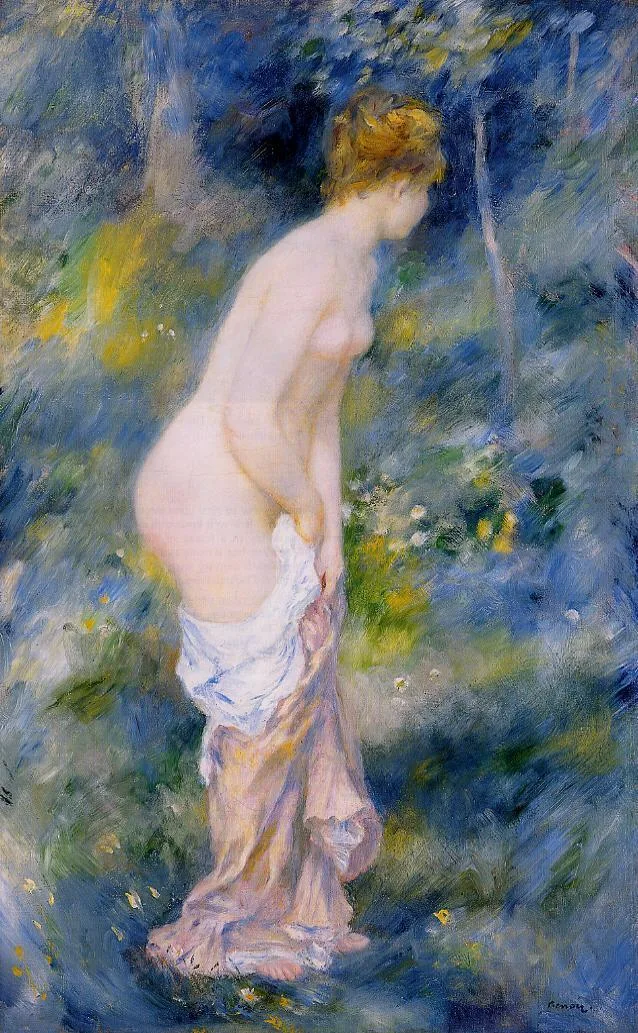
The painting shows a nude woman in the moment of leaving her bath, her body turned and caught between one posture and the next rather than posed formally for the viewer. Renoir gives her the full, rounded forms that mark all his late nudes, heavy through the hip and thigh, with none of the leaner idealised proportions favoured by academic painters of the previous generation.
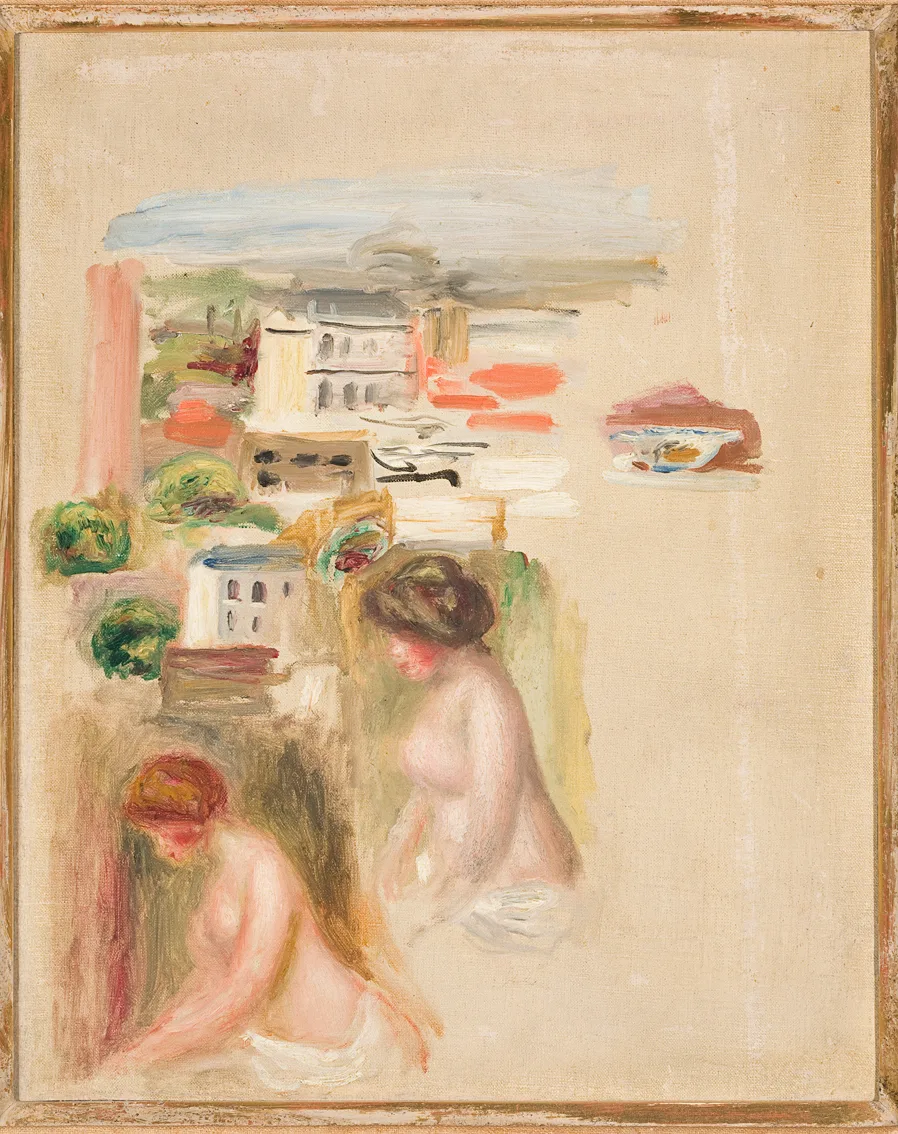
A second figure, likely a servant or companion attending to the bather, appears close by, her presence built from looser, less finished strokes than the main figure so that attention stays fixed on the central nude. The setting around them is suggested rather than described, a warm, indistinct space of drapery and shadow rather than a fully furnished room.
Light falls warmly across the central figure’s back and shoulder, picked out in touches of near-white and pale rose against a surrounding field of deeper red and orange. There is very little cool colour anywhere in the picture; even the shadows carry warmth.
The Late Palette: Red, Orange and Flesh
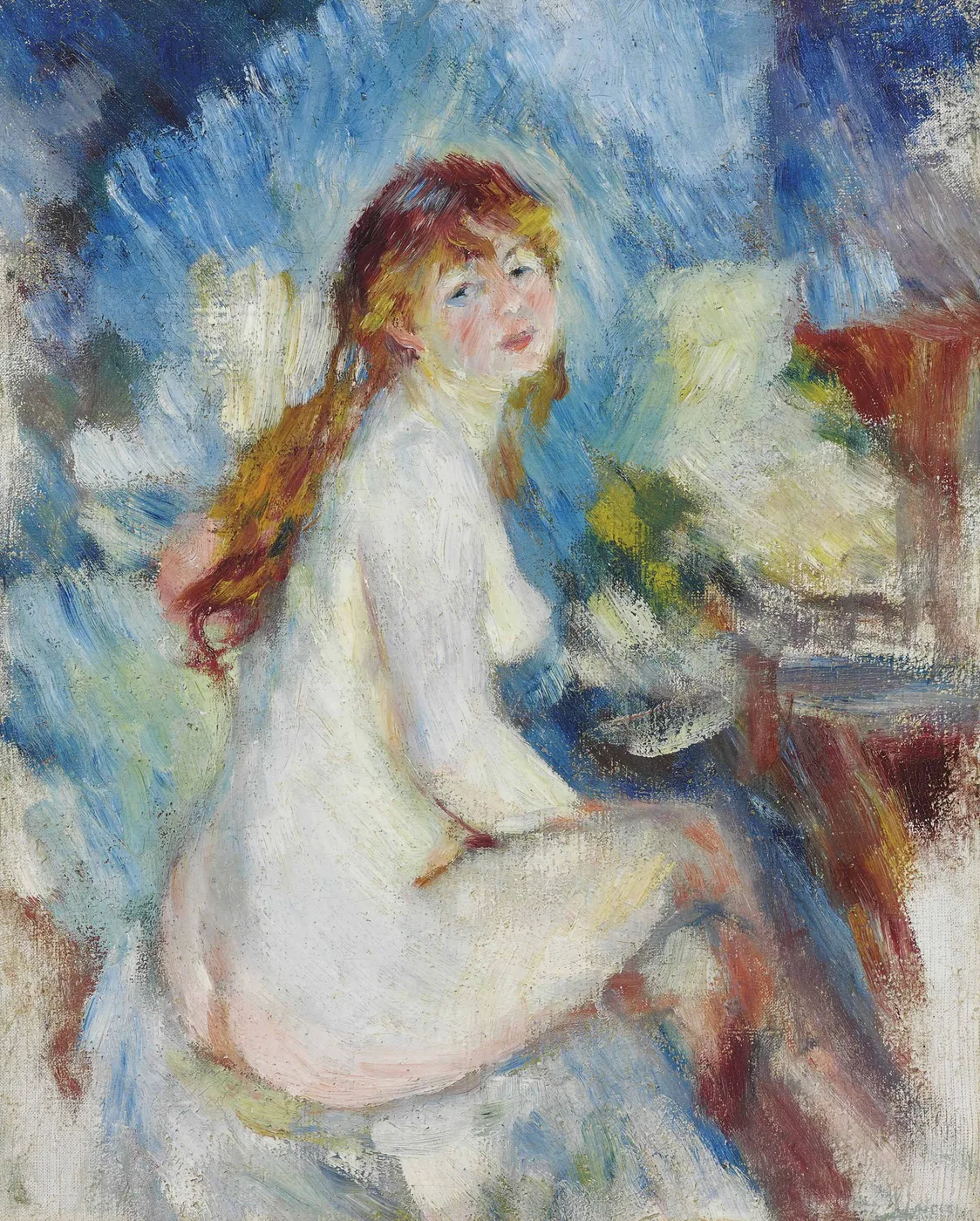
Renoir’s late paintings are often described by the shorthand of their dominant colour, a hot range of reds running from vermilion to deep madder, applied so that flesh, drapery and background all seem to share the same warm undercurrent. After the Bath is a clear example of that palette at its most concentrated.
The brushwork is loose and confident, laid on in broad, loaded strokes that build volume through colour rather than through careful drawing. This is a long way from the tighter, more linear manner Renoir had practised in the 1880s; by 1910 he had returned fully to paint handled as paint, form emerging from colour rather than colour filling in a drawn outline.
After the Bath carries that intention in every stroke, the paint surface soft and unbroken despite the physical difficulty of applying it with hands that arthritis had already begun to stiffen.
Albert Barnes and a Collection Built Around Renoir
The painting now belongs to the Barnes Foundation, the Pennsylvania institution built around the collection of the pharmaceutical magnate Albert C. Barnes, who bought Renoir’s work in enormous quantity across dozens of canvases. His holdings trace Renoir’s development from the 1870s through to these final, monumental nudes.
Seen among so many other Renoirs at the Barnes Foundation, After the Bath is easy to place within the long arc of the artist’s late style, one of many variations he painted on the same theme of a woman bathing, each one a further attempt to get at the particular warmth and weight of flesh in light.
A Warm Canvas for a Room
A painting this saturated with red and orange changes character noticeably with the light around it. Under warm lamplight the whole surface can seem to glow, the boundary between figure and background almost dissolving; in cooler daylight the drawing beneath the colour becomes easier to trace.
There is nothing restrained about the picture, and it does not try to be. It belongs to an artist in his late sixties, in constant physical pain, insisting through his brush on an art of pleasure, warmth and uncomplicated physical presence.
Long looking rewards attention to the edges of the figure, where Renoir lets the paint stay open and unresolved, colour bleeding gently from body into surrounding space rather than stopping at a hard line. It is this softness, more than any single detail, that gives the picture its particular warmth.
After the Bath is not a quiet picture to live alongside. It asserts itself in any room, a deliberate late statement from a painter who, even as his body failed him, kept insisting that the female body in warm light remained the subject worth returning to above all others.
Whatever else changed in Renoir’s long career, from the dark-toned realism of his twenties to the broken colour of Impressionism to the linear discipline of his middle years, After the Bath shows where he finally arrived: a painter trusting colour and touch completely, and asking the same of anyone who spends time in front of the canvas.
Sizes and materials for After the Bath (La Sortie du bain) are listed on its product page.