Young Woman with a Blue Choker
The Ingres Years
By 1888 Renoir had spent several years working his way out of what he later called a crisis in his art. A trip to Italy in 1881 and 1882, and above all his study of Raphael’s frescoes in Rome, had left him dissatisfied with the loose, broken brushwork of his Impressionist canvases of the 1870s; he wanted firmer drawing and a more clearly modelled surface, and he began looking hard at the French painter Jean-Auguste-Dominique Ingres for a way to get it.
Young Woman with a Blue Choker dates from near the end of that phase, sometimes called Renoir’s Ingres period or, less kindly, his sour period. The picture shows the discipline of those years applied to a single, close-up portrait head rather than to the ambitious multi-figure compositions he had also been attempting.
A Face Held Close
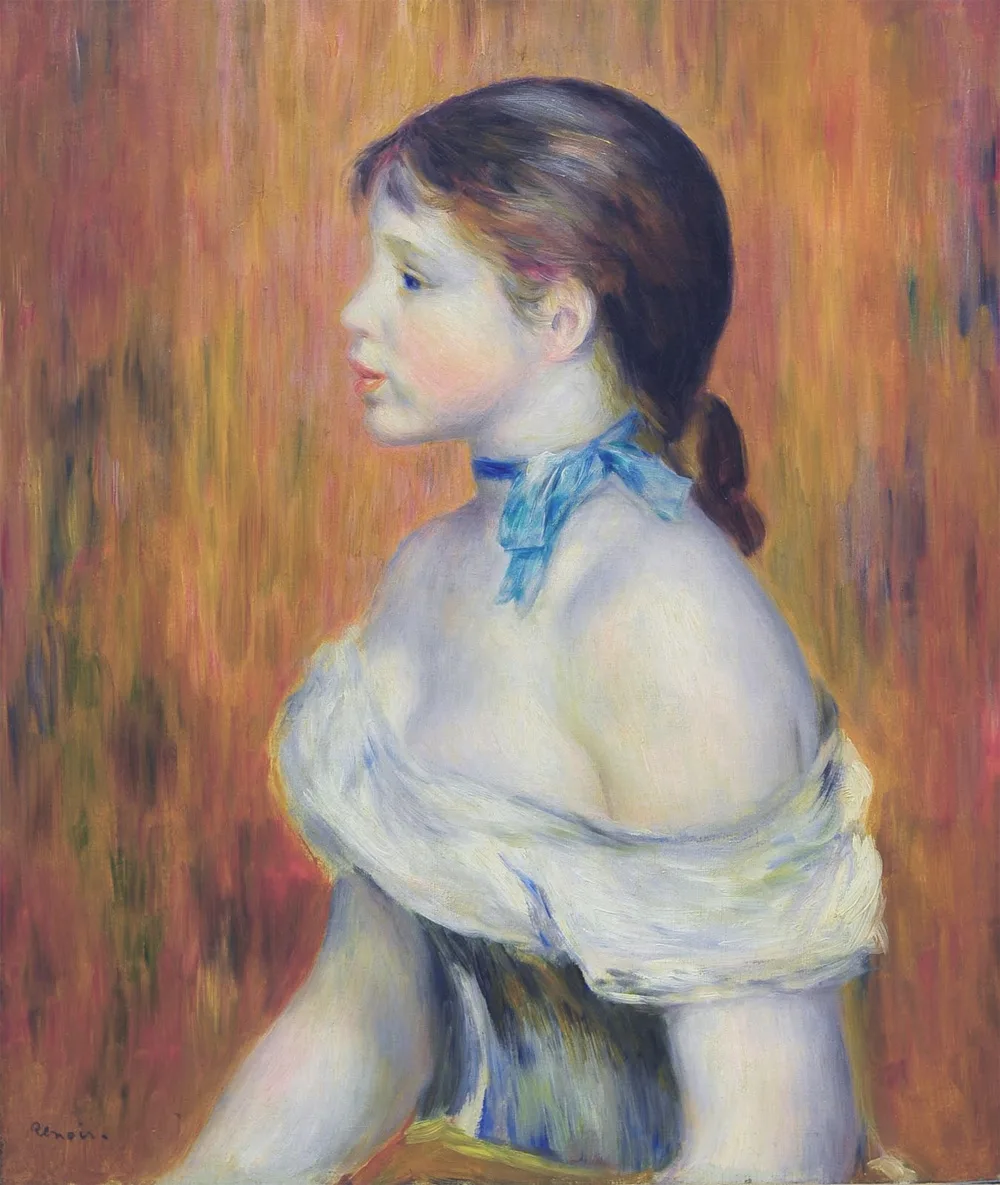
The painting is a bust-length portrait, the young woman shown from the shoulders up, her body turned slightly so that the face is caught close to full view. There is little around her to distract from that face; Renoir gives almost no background detail, letting a plain, softly toned field stand in for any setting.
A narrow blue ribbon is tied at her throat, sitting against pale skin, and it is the sharpest note of colour in the whole picture. Everything else, hair, skin, the fall of a collar or blouse, is kept in a narrower, warmer range, so that the eye is drawn back again and again to that single band of blue.
Renoir draws the features with more precision than he allowed himself in most of his 1870s work. The line of the nose, the set of the mouth and the edge of the jaw are all more clearly defined, closer to drawing than to the soft, colour-built forms of his earlier portraits.
Linear Discipline, Warmer Colour
The brushwork here is tighter and smoother than in Renoir’s Impressionist canvases, the paint laid on in thin, controlled layers rather than the broken dabs he had used through the 1870s. Critics and even Renoir’s own dealer found some of the paintings from this period cold or dry, too close to academic portraiture for a painter identified with spontaneity.
Even so, the colour keeps a warmth that pure academic portraiture usually lacks. Renoir has not abandoned the sense of living, breathing skin that marks all his figure painting; he has simply asked it to sit within a firmer, more considered outline.
The blue choker plays a structural role as much as a decorative one. It marks the base of the composition, gives the pale, warm-toned face something cool to contrast against, and stops the picture from reading as a uniform wash of flesh tones.
A Lyon Portrait
Young Woman with a Blue Choker is held today by the Museum of Fine Arts of Lyon, which has assembled one of the strongest holdings of nineteenth-century French portraiture outside Paris. Seen there alongside other Impressionist and Post-Impressionist work, it stands out for its restraint.
The sitter is not identified by name in any secure record, and the picture works, as many of Renoir’s single-figure portraits of this decade do, as a study of a type rather than an individual likeness, an exercise in capturing a particular kind of youthful, unguarded expression.
A Small Picture to Live With
Portraits this close and this quiet reward slow looking rather than a single glance. There is no anecdote in the picture, no setting to explain, only a face and the blue thread at its throat, and that simplicity is part of its appeal on a wall where it will be seen every day rather than once.
In gentle, indirect light the skin tones read as warm and soft; under a harder light the more careful drawing of the features becomes easier to see, and the picture starts to look closer to the disciplined portraits Renoir had been studying in Italy a few years earlier.
The blue choker itself barely changes with the light, staying a firm, cool anchor whatever the hour, which is perhaps why it remains the detail most viewers remember afterwards.
It is a picture without incident, but not without tension: the pull between Renoir’s instinct for warm, living colour and the firmer drawing he was forcing himself to practise gives even this small, quiet head a quiet argument going on beneath its calm surface.
The result is a portrait that feels closer to drawing than to the loose brushwork most visitors associate with Renoir’s name, and it is worth pausing over precisely because it shows an artist deliberately working against his own natural instincts.
Sizes and materials for Young Woman with a Blue Choker are listed on its product page.