Two Sisters
An Afternoon Above the Seine at Chatou
In the summer of 1881, Renoir was working along the Seine at Chatou, a town west of Paris where boating parties, riverside restaurants and hazy summer light had already given him the subject of several canvases. That same year he was also at work on his large group scene of a boating-party lunch nearby.
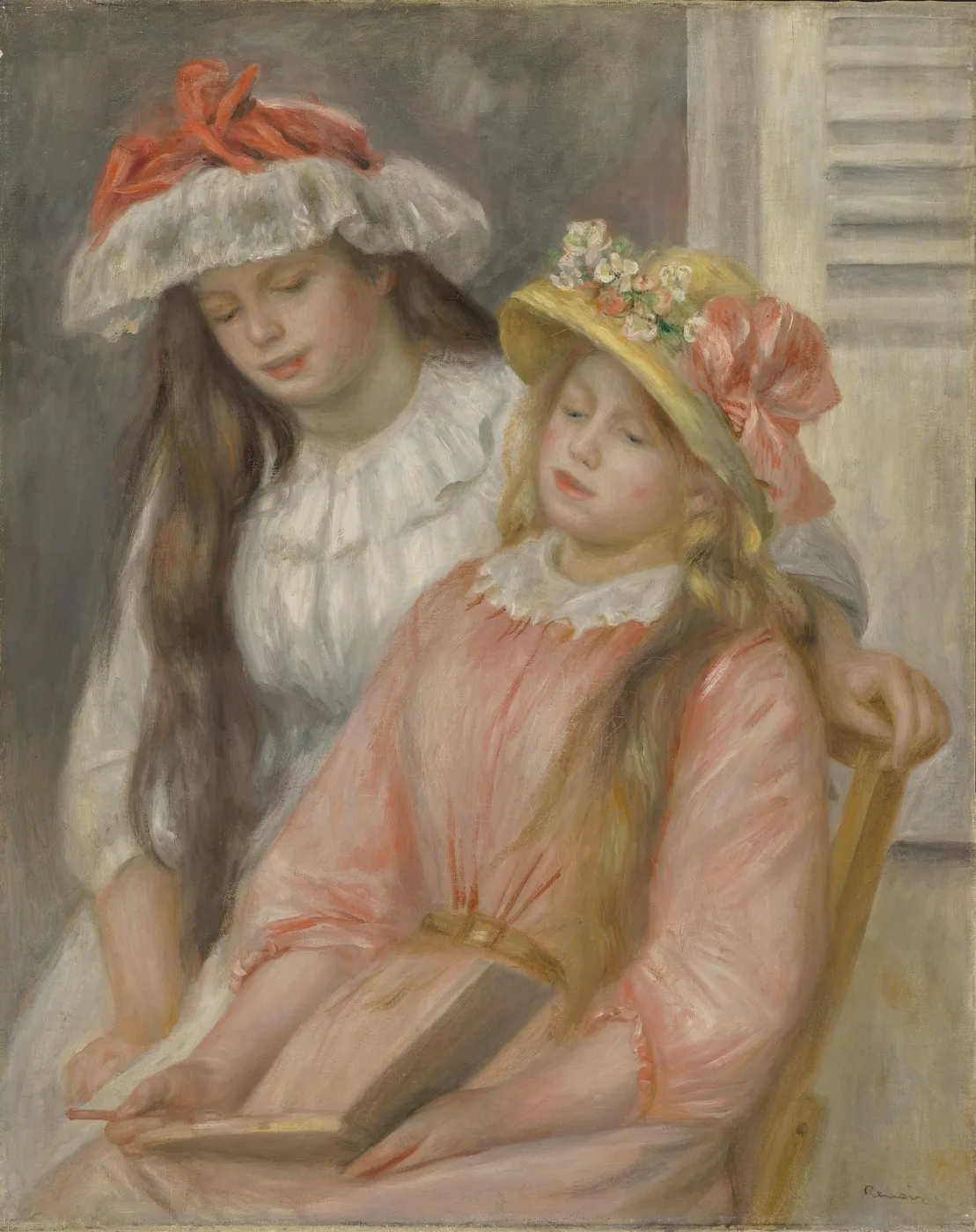
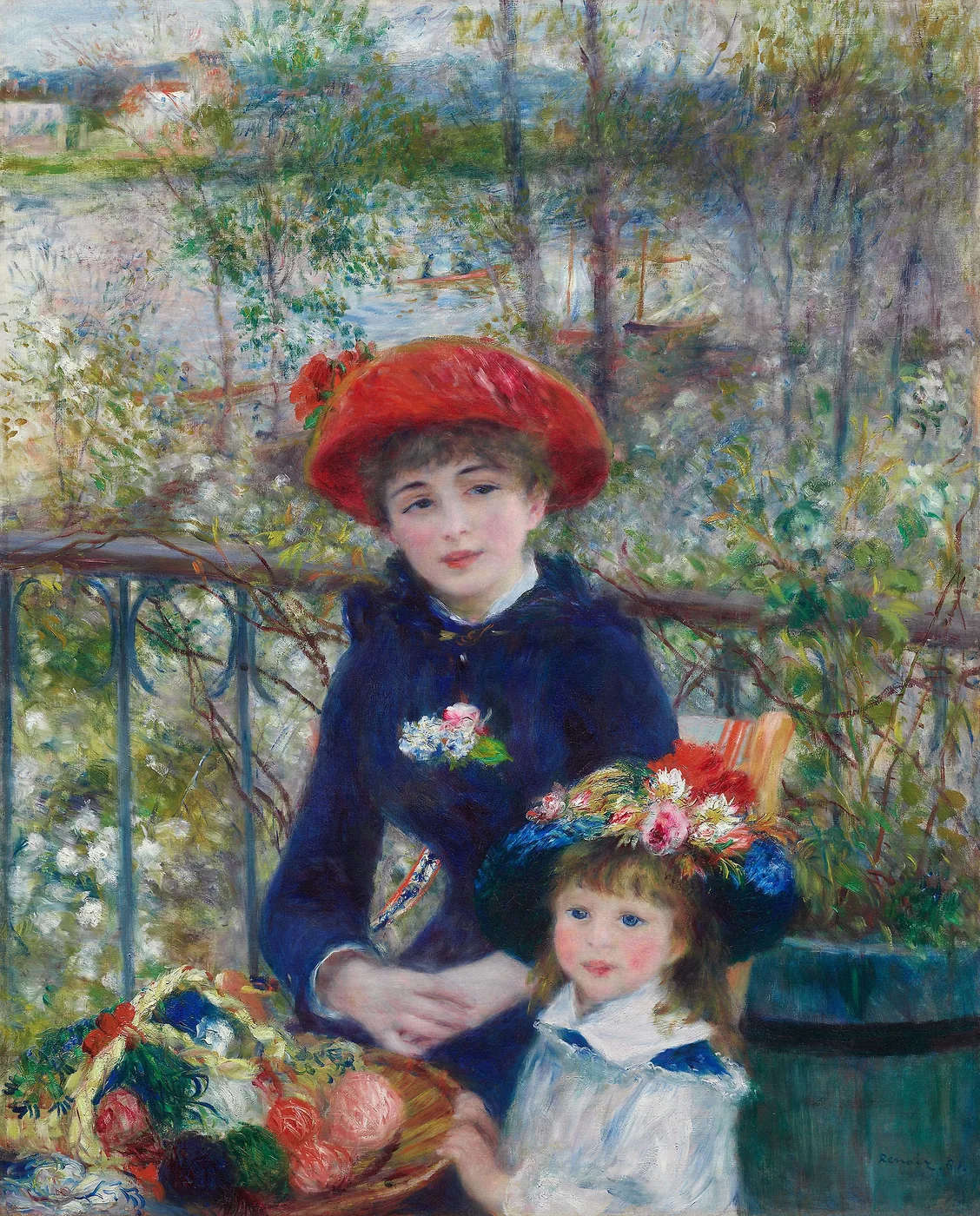
For this smaller picture he posed two models on a stone terrace overlooking the river, a young woman seated in front and a girl standing just behind her shoulder. Despite the title by which the painting later became known, there is no firm evidence the two sitters were actually related; their identities have never been established with certainty.
Renoir sold the picture to the dealer Paul Durand-Ruel not long after finishing it, and the title Two Sisters, also recorded as On the Terrace, became attached to the work over the years that followed. Whatever the true relationship between the two models, the picture presents them as a single, closely bound unit.
It belongs to a run of pictures from these years in which Renoir set fashionable young Parisian women against the loose, sunlit landscape of the river towns west of the city, using the contrast between crisp modern dress and blurred natural background to give the figures their presence.
A Wide-Brimmed Hat and a Basket of Wool
The older of the two sitters dominates the foreground, seated with her body turned slightly towards the viewer and her face caught in a calm, direct gaze. She wears a wide straw hat trimmed with blue ribbon and a scatter of small red flowers, over a fitted blue jacket and pale skirt.
Beside her, resting on the stone balustrade, sits a basket holding balls of wool in orange, green and blue, the kind of needlework a respectable young woman might bring outdoors to occupy her hands. Renoir painted the wool in thick, bright dabs of pure colour, a small still life tucked into the corner of a larger scene.
The girl standing behind wears a plainer straw hat and a dark blue dress, her hands clasped loosely and her expression more guarded than the woman’s. She is set slightly higher and further back in the composition, so the eye reads the two figures as a pair without mistaking one for a copy of the other.
Both figures are painted with considerably more finish and precision than the landscape behind them, their faces and clothes rendered in clean, readable strokes while the background dissolves into loosely brushed colour.
A River Landscape Gone Soft with Distance
Behind the two figures, the terrace gives way to a hazy view of the Seine, sailing boats and the far riverbank rendered in soft greens, blues and touches of white. Renoir kept this background loose almost to the point of abstraction, so specific detail dissolves the further the eye travels from the two women.
This contrast between sharply observed figures and a dissolving landscape was one of Renoir’s favourite devices in these years, and it does double duty here: it holds the viewer’s attention on the sitters while still supplying the sense of a warm, bright afternoon by the water behind them.
Sunlight falls across the terrace from the upper left, catching the woman’s hat and the pale fabric of her sleeve, and leaving the girl a little more in shadow. Small flecks of red and orange, in the flowers on the hat and the wool in the basket, punctuate an otherwise cool palette of blues and greens.
Even the stone balustrade itself is barely more than a suggestion, a pale horizontal band that separates the two women from the drop to the water without ever being described in any real detail.
A Terrace That Has Travelled to Chicago
Two Sisters now belongs to the Art Institute of Chicago, where it hangs among the museum’s substantial holdings of French Impressionist painting. Its warm, sunlit subject and confident brushwork have made it one of the more frequently reproduced pictures from Renoir’s work of the early 1880s.
On a wall at home, the picture’s balance of a crisply painted foreground against a softly blurred background tends to reward exactly the kind of casual, repeated looking a domestic setting allows. In brighter light the wool basket’s oranges and greens jump forward; in dimmer light the two faces hold the attention instead.
What lingers longest is the quiet, unhurried mood Renoir gave the scene: two figures paused on a stone terrace on an ordinary warm afternoon, with a whole soft, glittering river world spread out behind them and no particular story being told.
Sizes and materials for Two Sisters are listed on its product page.