The Grands Boulevards
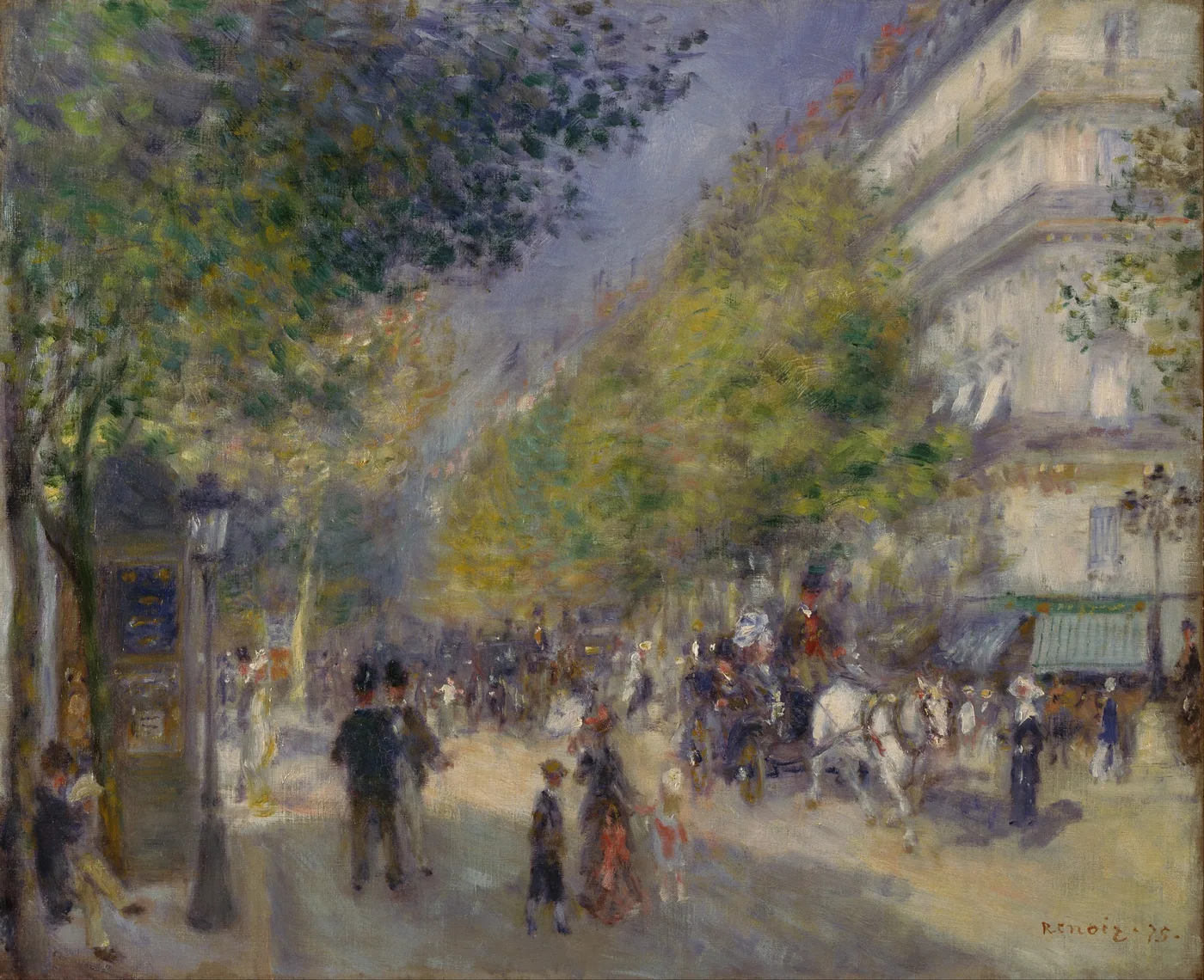
Paris Observed from Above, 1875
By 1875 Renoir had exhibited with Monet, Degas, Pissarro, and their circle at the independent show of 1874 that critics had mockingly dubbed “Impressionist,” and he was continuing to test how far paint could capture the ordinary rhythms of modern Paris. That same year he joined several of these friends in a poorly attended auction of their work at the Hôtel Drouot, a sale remembered today as one of the low points of the group’s early struggle for recognition.
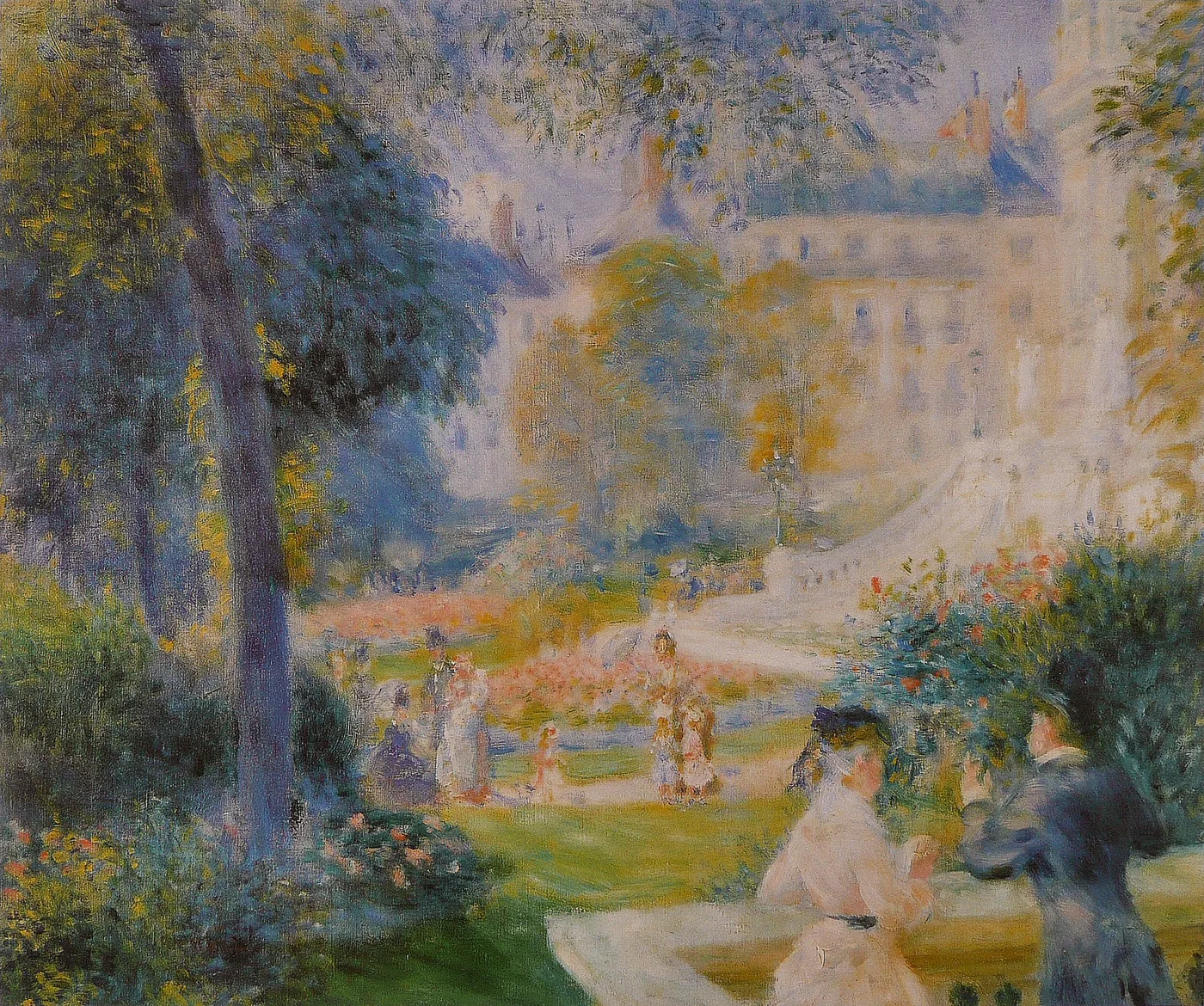
Against that backdrop of financial difficulty, Renoir kept painting the city as he found it, and The Grands Boulevards is one of the clearest results: a view down one of the wide avenues cut through central Paris a decade or so earlier under Baron Haussmann’s rebuilding of the city.
The boulevards themselves, still relatively new, had become the great public stage of Parisian life, lined with plane trees, cafés, and shopfronts, and filled from morning to evening with pedestrians, carriages, and the general traffic of a modern capital. It is precisely this everyday spectacle that Renoir set out to record.
A Street Full of Small, Moving Figures
Renoir paints the boulevard from a slightly elevated vantage point, looking along the pavement and roadway as they recede into the distance under a row of trees in full leaf. The high viewpoint lets him fit a great deal of street life into a single canvas without any one figure dominating the scene.
Pedestrians in dark coats and pale dresses move along the pavement in loose clusters, most reduced to a few economical strokes rather than individualised portraits. A carriage or two can be made out on the roadway, and the building facades along the boulevard’s edge are suggested through simplified blocks of warm stone colour rather than architectural detail.
Nothing in the composition is staged or posed. Figures overlap, face different directions, and vary in scale according to their distance from the viewer, giving the picture the loose, unplanned feel of a street glimpsed in passing rather than a scene arranged for the painter’s convenience.
Green Shade over Grey Stone
The dominant colour note is the fresh green of the plane trees, applied in dabbed, broken strokes that let light and shadow flicker through the foliage rather than reading as a single flat canopy. Beneath the trees, the paving and building fronts are kept in muted greys and warm creams, a quiet ground against which the moving figures and touches of darker clothing register clearly.
Renoir’s brushwork throughout is quick and varied: longer strokes for the receding pavement and building line, shorter dabs for foliage and figures, so that the surface of the canvas itself seems to vibrate the way a real street does under moving light.
There is no single strong shadow or highlight to anchor the eye; instead light is distributed evenly across the scene, consistent with an overcast or high, diffused daylight rather than a sharp, raking sun.
An Impressionist Answer to City Life
Paintings like this one placed Renoir alongside Monet, Pissarro, and Caillebotte in a shared project: finding a way to paint the boulevards, bridges, and railway stations that defined the newly rebuilt Paris of the 1860s and 1870s, subjects earlier academic painting had largely ignored in favour of history and myth.
Where Monet often chose a high window for such views, giving an almost abstract pattern of moving crowds, Renoir keeps his figures a touch more legible as individuals even while the paint handling stays loose, a balance between documentary interest in the street and his enduring preference for human presence within any scene.
The Boulevard in Philadelphia
The painting now hangs in the Philadelphia Museum of Art, part of a substantial holding of French Impressionist painting built up by the museum over the twentieth century.
Viewed today, the picture still carries the particular energy of a specific afternoon on a specific Parisian street, the greens of the trees and the soft greys of the stone shifting subtly as gallery light falls across the canvas at different times of day.
It rewards standing back to take in the whole sweep of the boulevard before moving closer to watch the crowd dissolve into individual, rapid strokes of paint, a shift in focus that mirrors exactly how a real street looks when eyes drift from the general scene to a single passer-by.
Sizes and materials for The Grands Boulevards are listed on its product page.