Portrait of Madame Charpentier: Gold Earrings and a Pale Collar
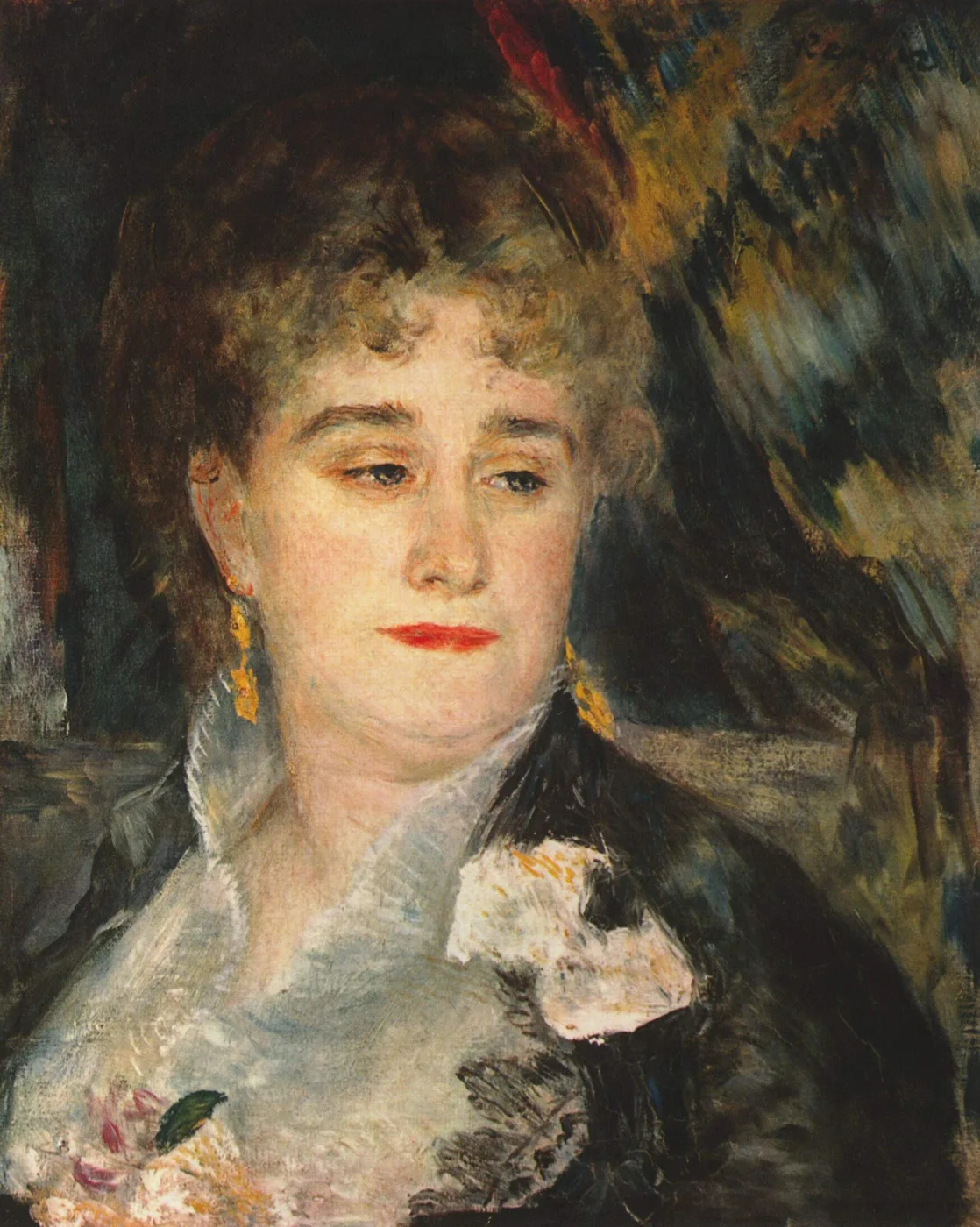
Marguerite Charpentier in Renoir’s Close Portrait
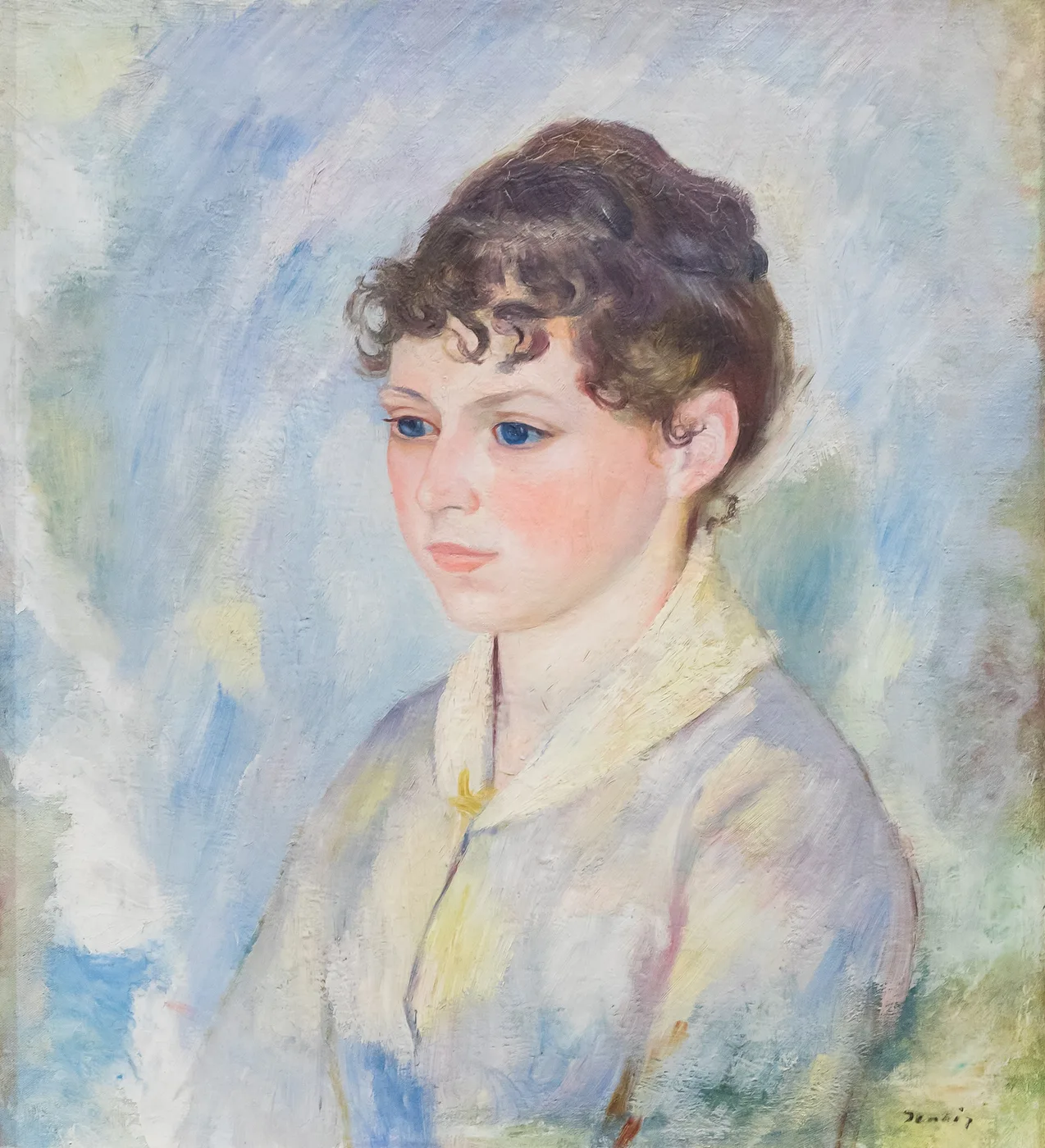
Renoir’s Portrait of Madame Charpentier brings the sitter close to the front of the canvas. Her head, shoulders and upper chest fill the image. Gold earrings flank her face, and a pale ruffled collar spreads over dark clothing. Her eyes look off to the right.
The Musée d’Orsay holds the original under the title Madame Georges Charpentier, inventory RF 2244. Its catalogue dates the oil on canvas between 1876 and 1877. The sitter is Marguerite Charpentier, the wife of the publisher Georges Charpentier.
The tight crop makes this portrait easy to distinguish from Renoir’s later picture of the same woman with her children. Here, no children, dog or domestic furniture compete with her face. The background occupies only the narrow spaces around her hair and shoulders.
That concentration gives the small canvas its character. The dark passages at the edges surround a face painted in pale pink, cream and muted brown. Looking first at those broad contrasts, then at the separate touches in the collar, reveals how much Renoir fits into this restricted view.
Gold Earrings, Pale Ruffles and the Dark Background
The face has softer transitions than the fabric below it. Pink spreads across the cheeks, while small brown and grey notes define the nose, eyelids and chin. The mouth is a compact red shape with a darker line between the lips. These marks describe features without a hard outline running around every edge.
Her hair blends into the dark area at the upper left. Near the forehead, lighter curls emerge in brown, grey and yellowish touches. The boundary between hair and background becomes clearer in some places and almost disappears in others, so the head feels surrounded by paint rather than cut out of it.
The earrings provide two strong yellow accents. Their shapes hang beside the jaw, standing out against the darker passages behind them. They help connect the warm notes in the hair with the pale skin, while the lower collar takes the eye in another direction.
White and grey strokes build the ruffled trim. Some run across the chest; others turn upwards around the neckline. Dark gaps separate folds and prevent the pale fabric from becoming one flat patch. Near the lower left, the pink flower and its green leaf add a small area of colour within the clothing.
On the right, diagonal green and brown strokes suggest drapery behind the sitter. A warmer red passage appears near the top. These broad marks contrast with the smaller touches around the eyes and mouth. Their direction also counters the more upright shape of the head.
What the Narrow Crop Leaves for the Viewer to Read
There are no visible hands in this bust portrait. The expression, earrings and neckline carry the information that a larger portrait might distribute between a face, a gesture and a room. The cut at the lower edge keeps the view close enough for the collar’s irregular marks to remain prominent.
Marguerite’s eyes do not meet the viewer straight on. Their slight turn to the right makes the composition feel less frontal, even though much of her face remains visible. Her closed mouth and steady head give the pose restraint. They do not establish what she was thinking during the sitting.
Renoir also leaves the surroundings difficult to specify. You can see dark areas and a patterned passage behind her; you cannot identify a particular room from this crop. The painting’s detail is concentrated in what she wears and how her features are painted, rather than in a record of the household’s interior.
The pale collar links those two kinds of detail. It frames the skin with brighter, more visibly separate strokes and gives the lower half of the image a shape of its own. Follow the collar from the shoulder towards the chest and the apparent formality of the portrait gives way to quite loose handling.
The Orsay Bust and the Later Charpentier Family Portrait
The Orsay collection record gives the original canvas as 46 cm high by 38 cm wide. This is a small upright painting, with very little space around the sitter. The dimensions identify the museum object; reproductions can be offered in other sizes.
A separate work, Madame Georges Charpentier and Her Children, was painted in 1878 and belongs to The Metropolitan Museum of Art in New York. That much larger composition shows the mother with her children and the family dog in an interior. The Met records Georges Charpentier as its commissioner and notes its success at the Paris Salon in 1879.
Comparing these portraits helps keep their details separate. The room and family arrangements belong to the later group portrait. The earlier Orsay canvas presents Marguerite alone, with the face and pale collar occupying most of the painted space.
To plan a visit, check the Musée d’Orsay’s current display information. Being in the museum’s collection does not establish that this particular canvas is on view on a given day.
Choosing a Surface for the Face and Ruffled Collar
The Portrait of Madame Charpentier product page offers a hand-painted oil reproduction and a canvas art print. The oil version interprets Renoir’s marks in paint on canvas. The print reproduces the image in ink, retaining the appearance of the pictured brushwork without recreating it as oil paint.
The distinction is especially useful here because the face and collar are handled differently. In an oil reproduction, the painter works with those softer passages of skin and the more separate fabric marks. In a print, both remain part of the same printed image. Choose the medium according to the surface you want to inspect at close range.
The upright crop gives the head a large share of any chosen format. Before ordering, measure the wall and look at how much width the shoulders need. Compare the size and finish options on the product page; the original’s small dimensions do not set the size of every reproduction.
Painting time is 2 to 4 weeks. Print production takes 2 to 4 business days. Delivery after shipping takes 5 to 7 business days. These are separate stages, so allow for the production time of the medium you select as well as its delivery.
Identifying This Version of Madame Charpentier
Is this the portrait with her children?
No. This is the close bust portrait held by the Musée d’Orsay. Renoir’s later Charpentier family portrait shows the mother with her children and a dog, and is held by the Metropolitan Museum of Art.
Why is the date given as a range?
The Musée d’Orsay dates its canvas between 1876 and 1877. That catalogue range is more precise about the available evidence than choosing a single year without qualification.
What details should I look at in a reproduction?
Look at the small dark marks around the eyes, the yellow earrings and the separate white and grey strokes in the collar. Those changes in handling are easier to compare up close than in a small thumbnail.
Are the offered products the original museum canvas?
No. The original is in the Musée d’Orsay collection. The shop offers a hand-painted oil reproduction and a canvas art print, with the available formats listed on the product page.