Portrait of Frédéric Bazille Painting
Two Painters Sharing a Paris Studio
In the mid-1860s, Pierre-Auguste Renoir and Frédéric Bazille shared studio space in Paris, at a time when neither man could afford a studio alone. Bazille, the son of a well-off family from Montpellier, often covered more of the rent, and in return the two painters kept each other company through long working days.
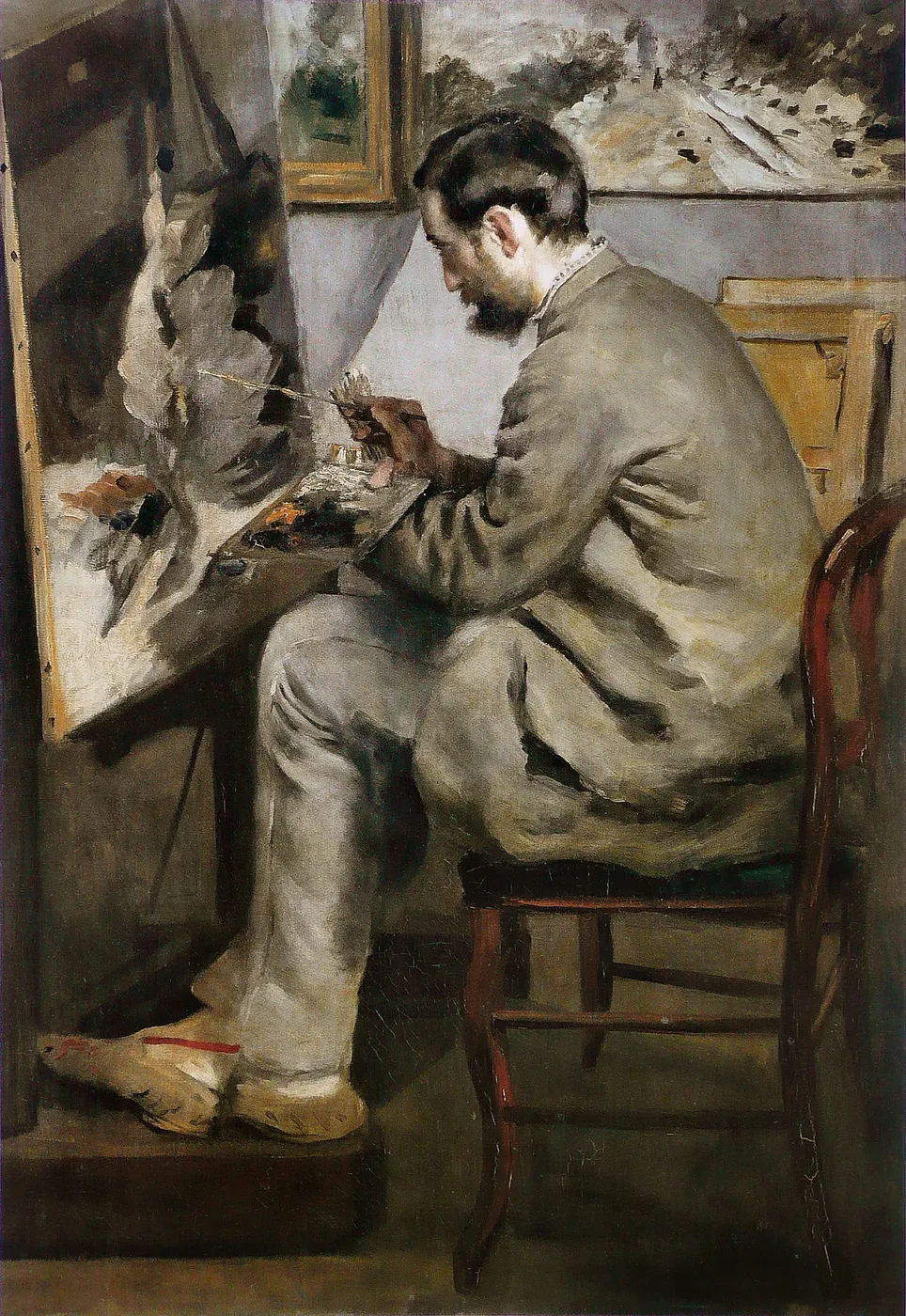
Renoir’s 1867 portrait of his friend captures exactly that arrangement: not a formal sitting, but Bazille caught in the middle of his own work, brush in hand, facing his easel rather than the viewer.
It is one of several pictures the two friends made of each other around this time, evidence of how closely the young painters associated with the future Impressionist group watched, painted and supported one another before any of them had a public reputation.
Bazille Caught Mid-Brushstroke
The composition places Bazille slightly off-centre, seen from an angle as he leans toward a canvas propped on an easel, his own painting visible only as a partial, blocked-in shape. He wears ordinary working clothes rather than anything formal, and his posture is unselfconscious, weight shifted onto one leg, arm extended toward the canvas.
Renoir gives real attention to the studio itself: the easel, the edge of a canvas, the tools of the trade scattered around the room. This is a portrait as much about a working environment as about a face.
The eye meets the raised arm and brush first, then follows the line of Bazille’s body back to his profile, turned toward his own picture rather than out at the viewer. It is a portrait of concentration rather than a portrait of likeness alone.
A Muted Palette for a Working Interior
Renoir kept the colour range restrained: browns, greys and muted ochres dominate the studio interior, with the brightest passages reserved for Bazille’s shirt and the pale ground of the canvas he is working on. This tonal restraint suits the subject, a working room rather than a scene of leisure.
The paint handling is looser and more confident than in Renoir’s earlier, more academic work, with visible brushstrokes describing the fall of light across Bazille’s clothing rather than smoothing it away. It shows Renoir, still in his twenties, moving toward the freer technique that would define his mature style.
There is little decorative incident in the room itself; Renoir’s interest clearly lies in the figure and the act of painting, not in furnishing a scene with detail for its own sake. Compared with the more polished official portraiture fashionable at the time, this restraint feels closer to a record of an ordinary working day than to a commissioned likeness.
A Friendship Cut Short
Bazille was killed in 1870, fighting in the Franco-Prussian War, only a few years after Renoir painted him at his easel. He was still in his twenties, and had barely begun to build the public career his talent suggested he might have had.
That short life gives this portrait a weight it would not otherwise carry: it is one of the clearest surviving records of what Bazille actually looked like at work, made by a friend who knew him well, before either painter had any inkling of how little time Bazille had left.
Renoir rarely spoke at length about the loss in later life, but the closeness visible in this and other portraits from the same circle makes clear how central Bazille had been to the group of painters gathering around Monet, Sisley and Renoir himself in the 1860s. Of that tightly knit circle, Bazille alone did not live to see Impressionism become a recognised movement.
The Portrait Today, at the Musée Fabre
The painting is now held at the Musée Fabre, in Bazille’s home city of Montpellier, a fitting home for a portrait of a painter who is himself remembered there with particular care.
Seen today, it reads less as a formal portrait than as a record of a specific working relationship: one painter watching another paint, in a shared room, on an ordinary day that neither of them had reason to think worth remembering especially.
On a wall, it is a quietly companionable picture, better suited to a study or a room used for work than to a grand reception space; its subdued palette and unforced composition reward the kind of attention a viewer gives to a picture seen often, rather than a single dramatic glance.
Sizes and materials for Portrait of Frédéric Bazille Painting are listed on its product page.