Nude
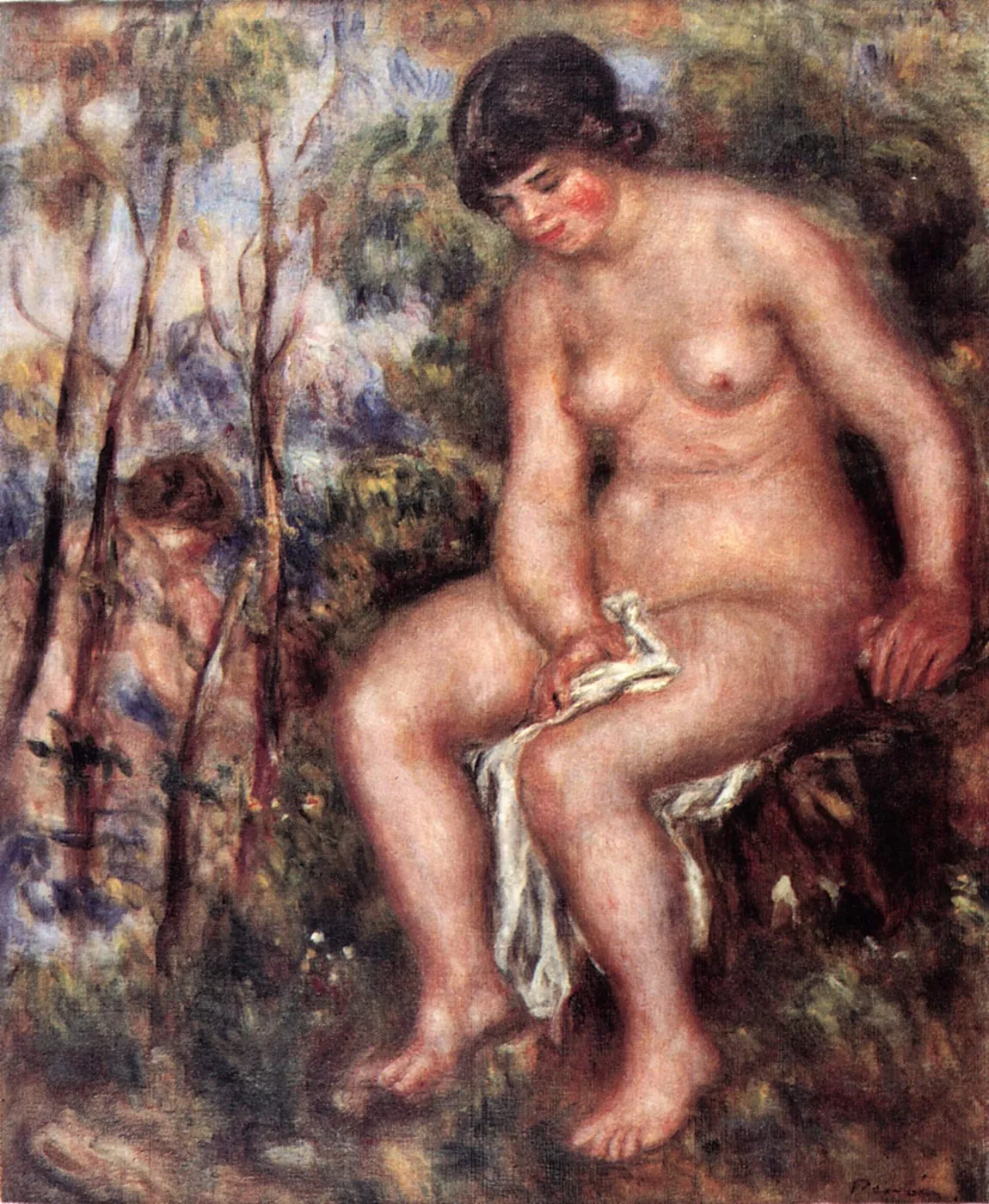
Renoir in 1910: Painting Through Pain
By 1910 Renoir’s rheumatoid arthritis had progressed to the point where holding a brush for long stretches caused him real difficulty, yet this was also one of the most productive periods of his career. Working mainly between his home at Cagnes-sur-Mer and the village of Essoyes in Champagne, he painted with an urgency that had little to do with pain and everything to do with a late, hard-won confidence in what he wanted a picture to do.
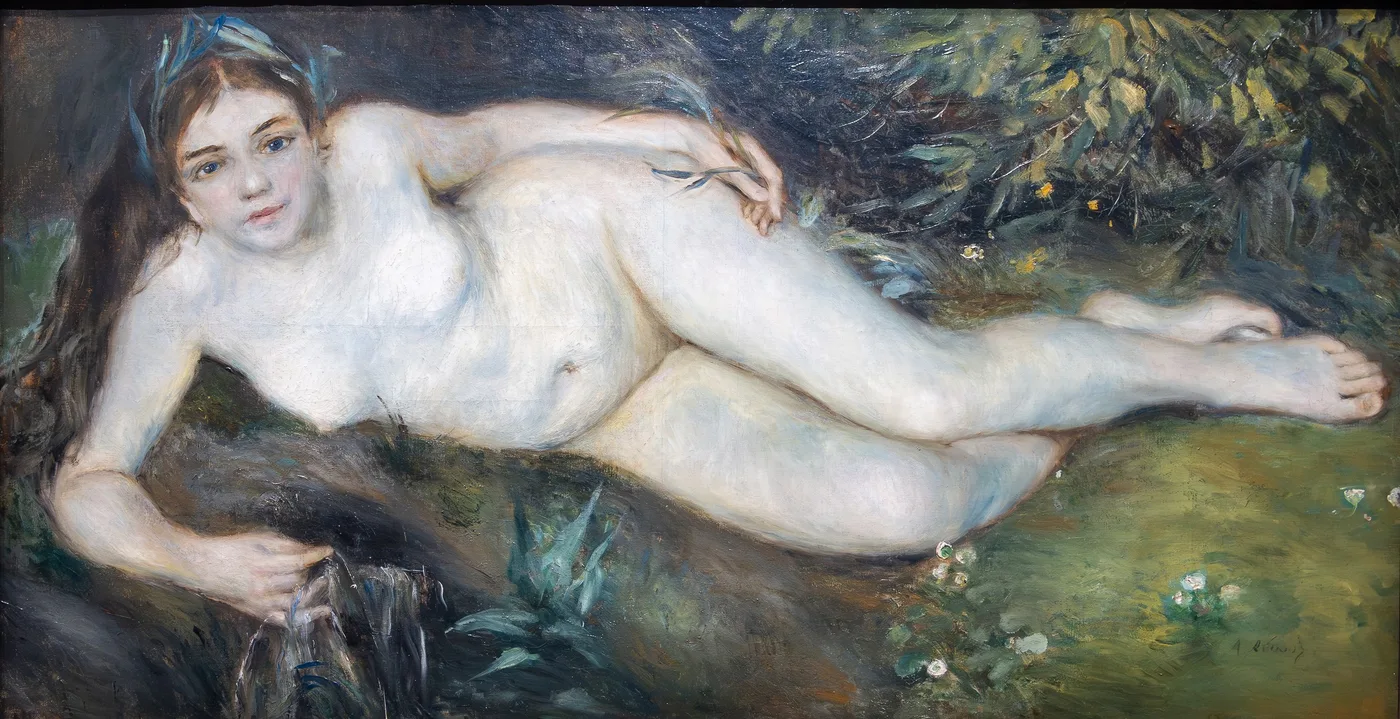
Nude belongs to this stretch of his career, when the female figure, painted without any surrounding story or setting, became one of his central subjects. Renoir was no longer interested in capturing a fashionable Parisian woman of a particular moment; he wanted something closer to a timeless study of the human body in paint.
His models in these years were mostly women close to the household, sitting for him repeatedly over months or years. That familiarity let Renoir work quickly and without formality, returning to the same poses and studies until he felt he had found the warmth and weight he was after.
What mattered to Renoir in this period, more than any setting, was the model herself. What counted was the play of light across skin, and how that light could be built up in layers of paint.
This attitude reflected a belief Renoir held throughout his later career: that a painting should give pleasure to look at, not weigh on the viewer with difficulty or gloom. His nudes of this period, Nude among them, can be read as a direct expression of that belief, offering warmth and ease rather than tension or drama.
A Body Built From Warm Colour
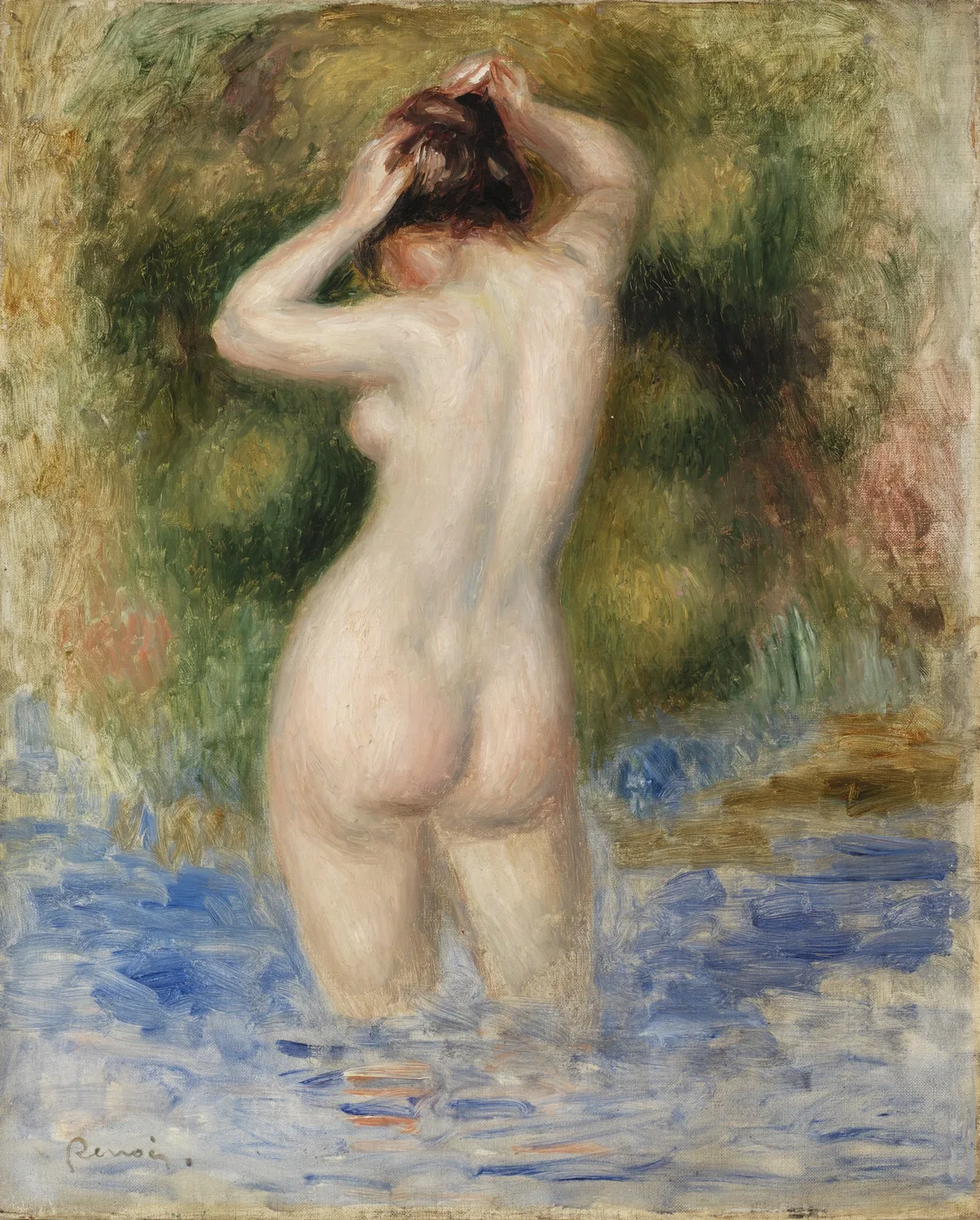
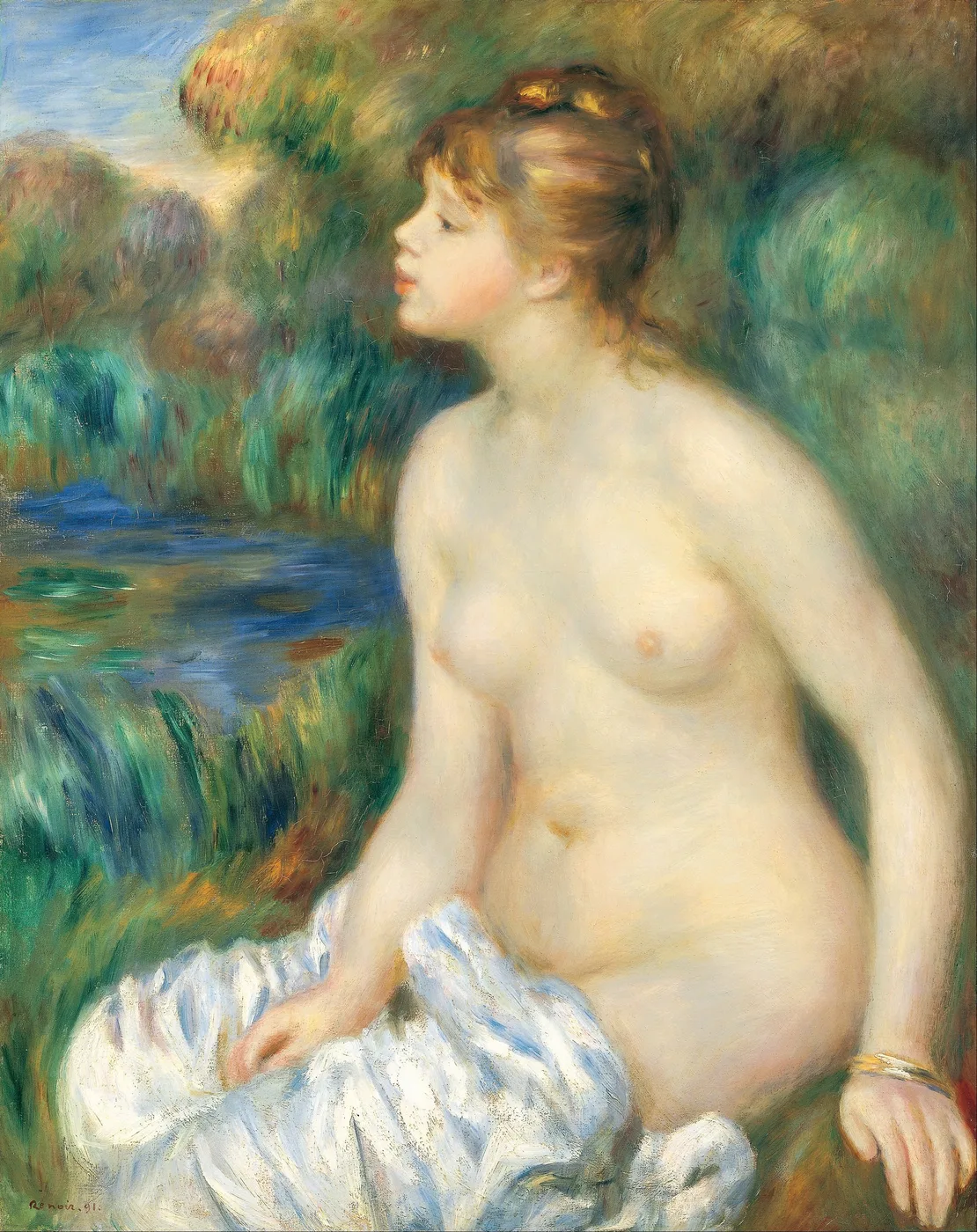
The painting presents a single female nude, her form filling most of the canvas, rendered with the soft, rounded fullness that had become Renoir’s signature by this date. There is no elaborate setting; whatever furniture or drapery surrounds the figure is treated as loosely brushed colour rather than described detail.
Renoir’s palette is built from warm pinks, creamy whites and soft ochres, occasionally set off by cooler greens or blues in the shadows and background. The effect is a body that seems to glow from within, its surface catching and holding the light rather than reflecting it sharply.
The brushwork is loose and richly loaded, applied in broad strokes that build volume through colour rather than through careful outline or precise anatomical drawing. Renoir was never a draughtsman in the academic sense during this period; he modelled form with warm and cool colour set side by side.
Nothing about the pose suggests a specific narrative or identity. The figure exists as a study of weight, warmth and roundness, closer in spirit to a life study repeated and refined than to a portrait of a particular sitter.
Renoir’s Late Nudes and the Old Masters
Renoir’s late nudes owe an obvious debt to painters he revered from earlier centuries, particularly Titian and Rubens, whose handling of flesh he had studied closely, including during a trip to Italy in the early 1880s. He spoke often in these years of wanting to paint bodies with the same fullness and life he admired in their work.
This ambition set him apart from younger painters of the early twentieth century who were moving toward abstraction and fracture. While Cubism was taking shape in Paris around this very time, Renoir pursued an almost opposite goal, deepening rather than breaking apart the traditions of figure painting he had inherited.
Critics and later historians have sometimes read these late nudes as old-fashioned for their moment, yet they also show a painter still testing what paint itself could do with colour and light, undistracted by fashionable new movements around him. That tension between old and new is part of what still holds attention in front of the canvas today.
A French Nude in Belgrade’s National Museum
This particular canvas is now held by the National Museum of Serbia in Belgrade, whose collection of French painting, though modest in size next to the great Parisian museums, includes work from across the nineteenth and early twentieth centuries. A late Renoir nude sits there among a broader survey of French art tracing the path from academic painting toward Impressionism and beyond.
For a visitor encountering the painting in Belgrade rather than Paris, there is something striking about finding this warm, unguarded study of a body so far from the artist’s usual haunts. It is a reminder of how widely Impressionist and post-Impressionist paintings travelled into museum collections across Europe over the twentieth century.
Hung on a wall, the painting behaves differently depending on the hour. Under strong daylight its pinks and creams can look almost sunlit; under softer evening light the same colours settle into something quieter and more intimate, the warmth of the body seeming to hold its own gentle glow regardless of what light falls on it.
Sizes and materials for Nude are listed on its product page.