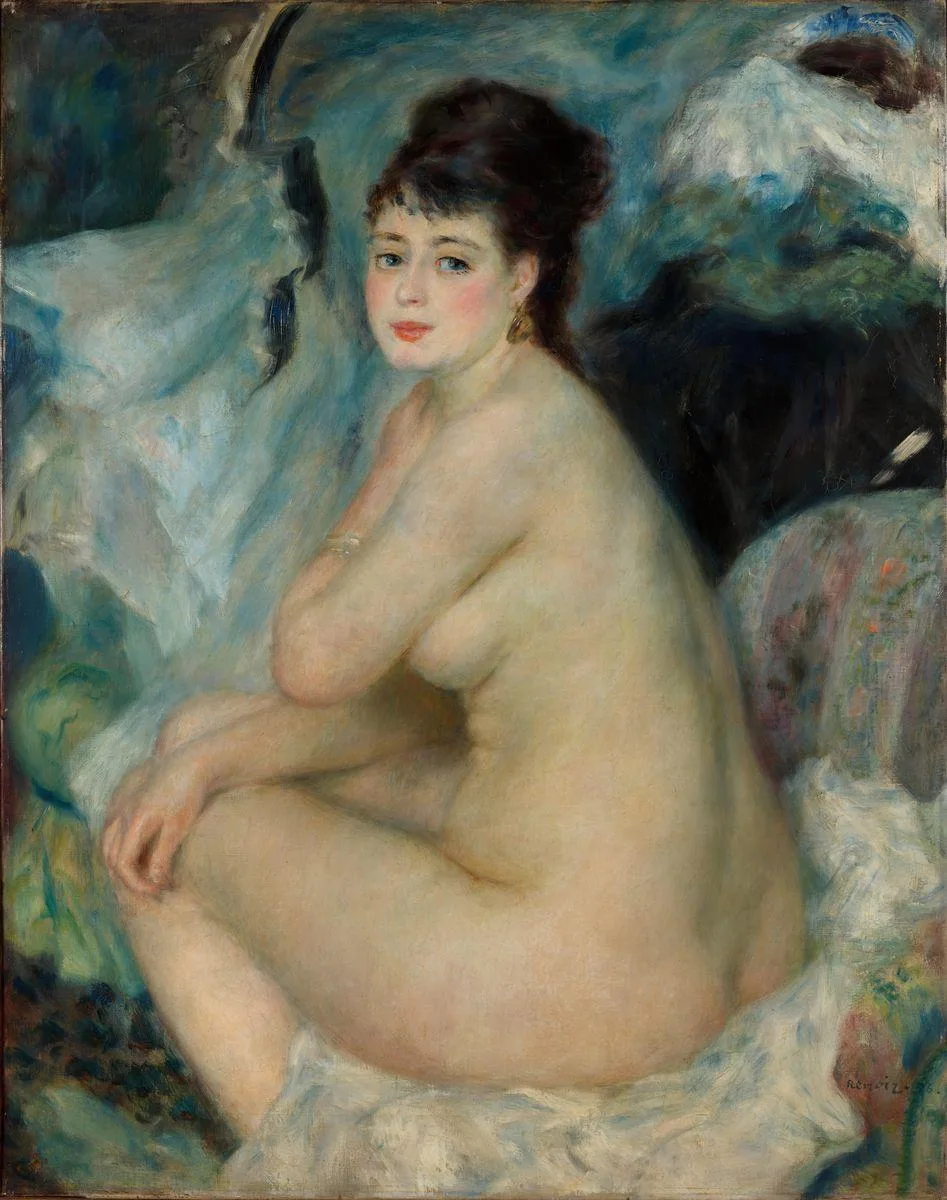
Nude Woman, Anna
Renoir’s Return to the Nude in the Mid-1870s
By the mid-1870s Renoir had made his name largely through scenes of Parisian leisure: dance halls, boating parties and river bathers. In 1876, the same year he worked on the crowded café-garden scene later known as the Moulin de la Galette, he also returned to a subject with a much longer history in European painting, the female nude studied alone, indoors, under natural light.
The model in this canvas is identified only by her first name, Anna, a common enough practice for the professional models who sat for Renoir and his circle. Little else about her is recorded; what survives is the painting itself, an unusually direct and unidealised study of a single figure.
Renoir was not working from classical plaster casts or academic convention here. He was looking at an actual body in an actual room, and trying to record exactly how daylight, whether direct or filtered through a window, breaks across skin.
A Body Read Through Patches of Colour
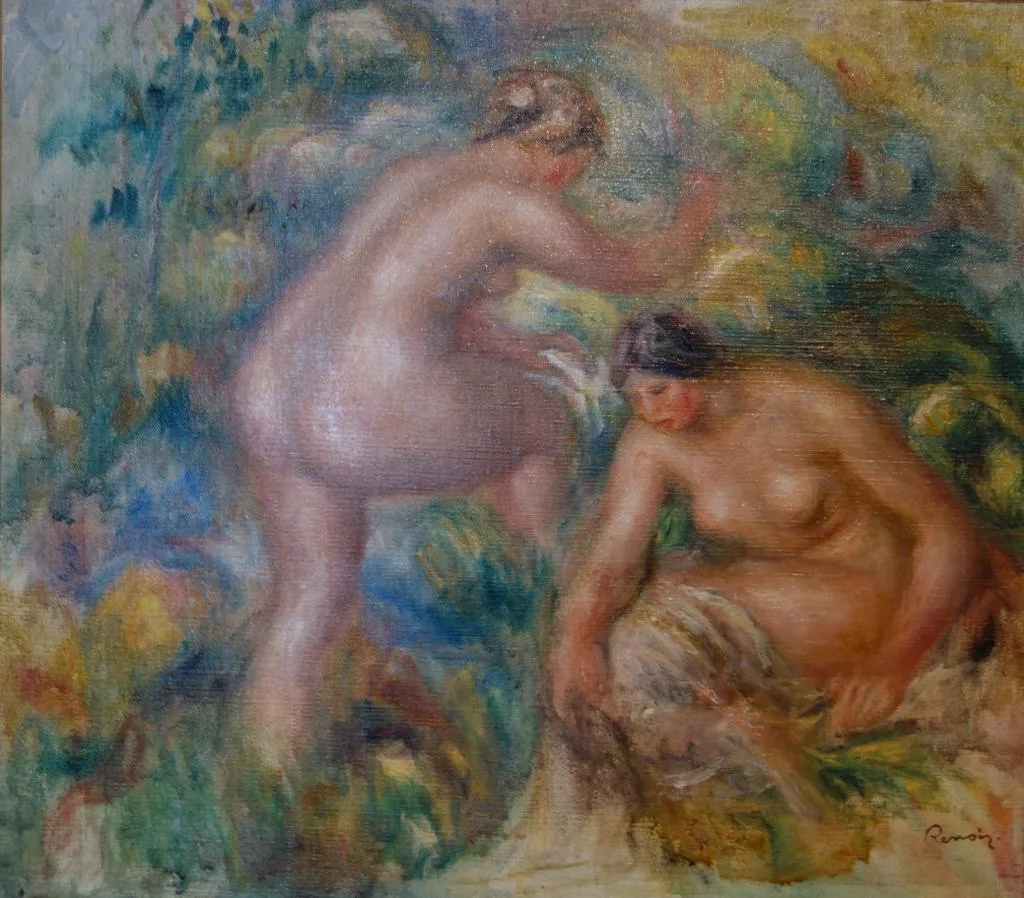
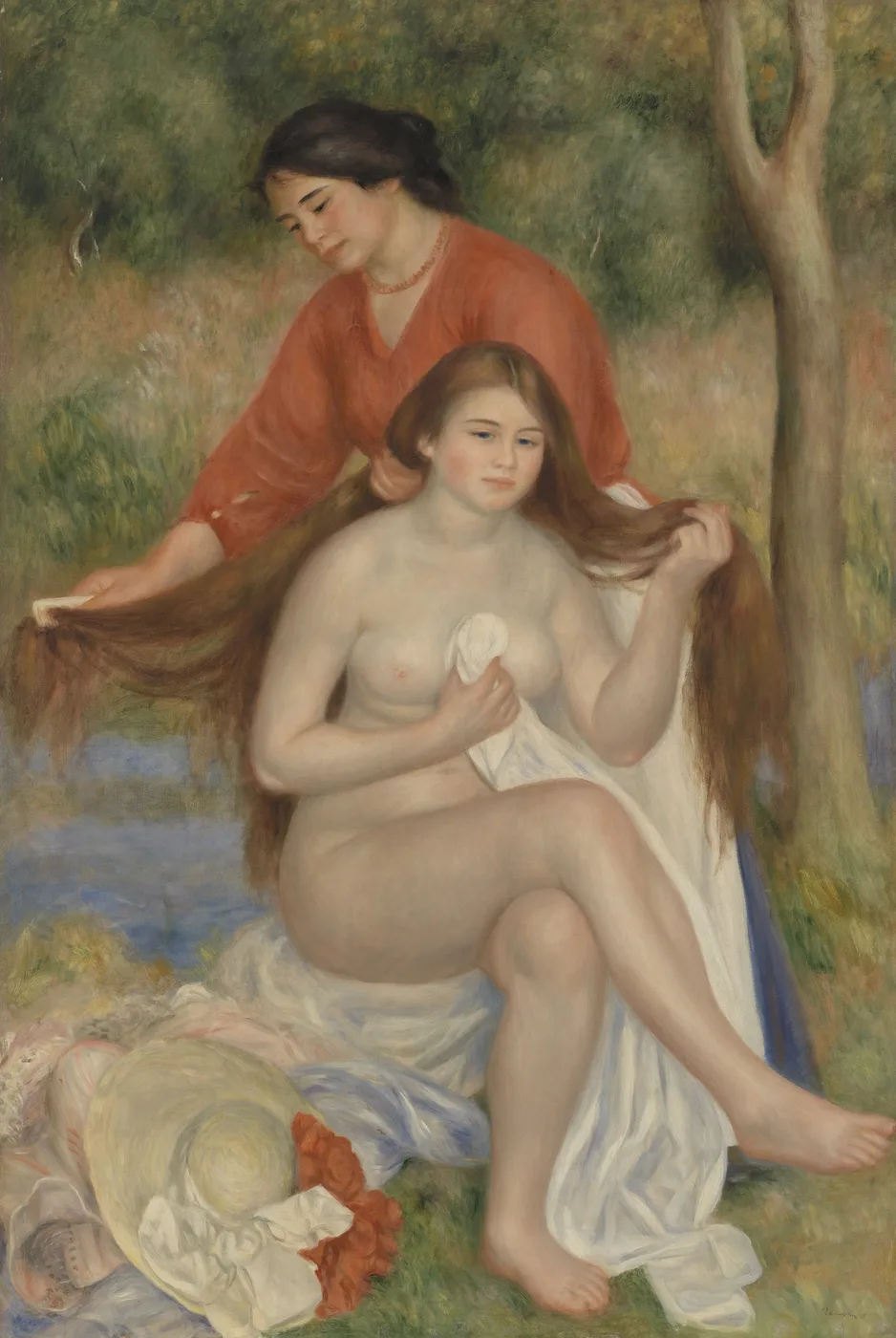
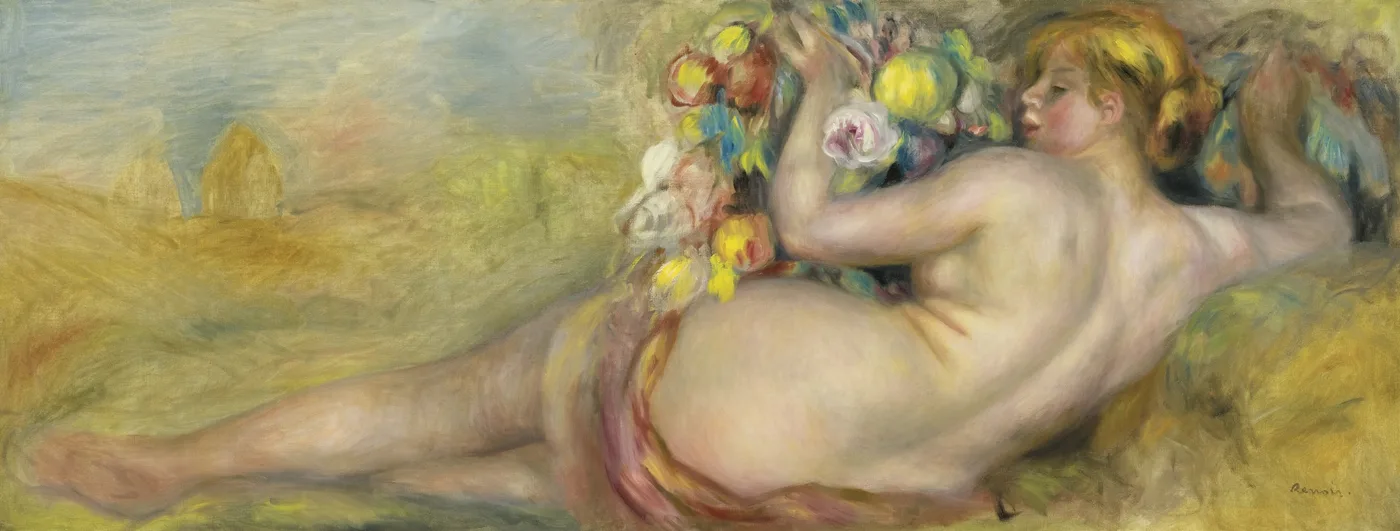
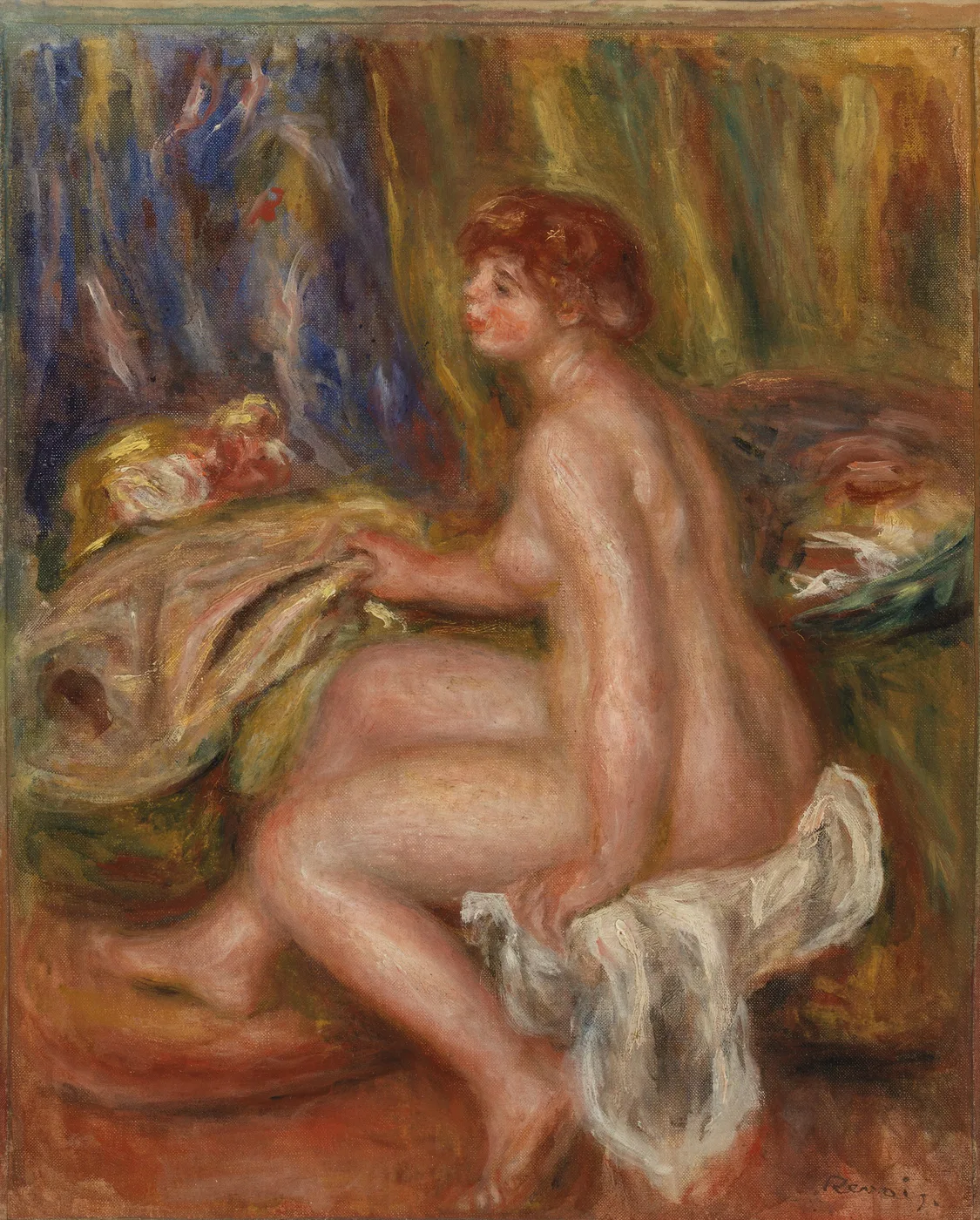
The composition is simple: a single female nude fills most of the canvas, seated or half reclining, with little in the way of narrative setting to distract from the figure itself. Renoir gives almost no attention to a detailed background, letting loosely brushed neutral tones stand in for a room or screen.
What commands attention is the skin itself, rendered not as an even, polished surface but as a mosaic of small, visible strokes in pink, cream, pale green and touches of violet. This was Renoir’s Impressionist answer to a very old problem, how to paint flesh so that it looks lit by real light rather than modelled by convention.
The face is comparatively lightly handled next to the body, which carries the weight of the picture’s interest. Renoir’s brush moves quickly but with control, building form through colour temperature rather than through careful outline or shading.
A Method That Unsettled Contemporary Taste
Nudes painted this way, with visible dabs of green and mauve sitting frankly on the skin, struck many of Renoir’s contemporaries as unfinished or even crude. Academic training taught painters to smooth such transitions away; Renoir instead left them visible, implying that this was closer to how the eye actually receives coloured light.
This willingness to let colour patches stand for shadow, rather than blending them into invisibility, is one of the clearest technical signatures of Impressionism applied to the human body. It is a more radical use of the method than in Renoir’s crowd scenes, precisely because there is nowhere for the eye to look except at the figure itself.
Later in his career Renoir would return to the nude again and again, gradually favouring smoother, more Rubens-influenced modelling. This mid-1870s treatment, with its frank patchwork of colour, belongs to a more experimental and less settled moment in that long development.
From Paris to the Pushkin Museum
The painting is now held at the Pushkin Museum of Fine Arts in Moscow, part of a broader holding of nineteenth-century French painting that gives Russian audiences an unusually rich view of Impressionism and its aftermath.
Seen alongside other Impressionist nudes from the same decade, it shows an artist working out a problem in full view, rather than presenting a finished, polished solution. The visible experimentation is part of what makes it interesting to look at closely, rather than at a glance.
It is a smaller, quieter picture than Renoir’s celebrated crowd scenes of the same years, but it addresses a harder technical question and answers it with equal conviction.
Living With a Study in Coloured Light
On a wall, this is not a picture that settles into the background. The patches of pink and green across the figure shift noticeably depending on the strength and colour of the light in the room, so the canvas looks subtly different by lamplight than it does by a window in the afternoon.
A north-facing room, with its cooler, steadier light, tends to bring out the violet and green undertones in the shadowed side of the body, while warmer artificial light in the evening pulls the pinks forward. Either way, the picture keeps drawing the eye back to work out how the colour was built.
It suits a room where a viewer has time to stand close and then step back, since the mosaic of strokes only resolves into a coherent, lit body from a certain distance, a small demonstration of the very optical trick Impressionism was built on.
Sizes and materials for Nude woman, Anna are listed on its product page.