Mother and Children
An Afternoon Outing in the Mid-1870s
By 1875 Pierre-Auguste Renoir had settled into the rhythms of Impressionist Paris. He was painting alongside Monet, Sisley and Pissarro, and had shown his work at the group’s first independent exhibition the year before.
Official recognition remained scarce and money was often tight, so Renoir turned frequently to the people around him for subjects. Friends, neighbours and ordinary Parisians caught mid errand became his most reliable models.
The wider Impressionist group faced hostile reviews throughout the decade, mocked for brushwork that critics considered unfinished and for subjects drawn from ordinary middle-class life rather than history or myth. Renoir kept working through this indifference regardless.
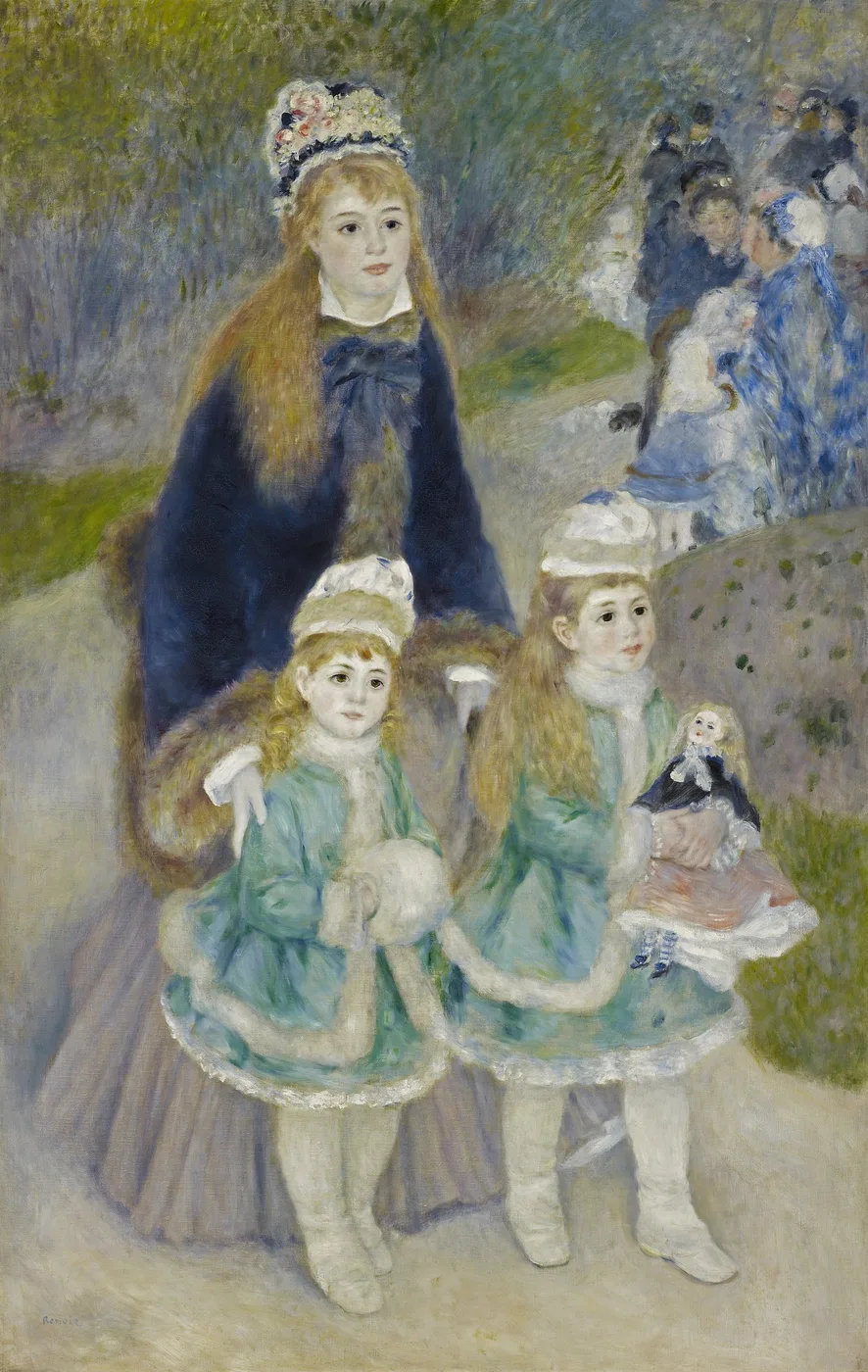
Mother and Children belongs to this world of the everyday. It shows a woman walking outdoors with two young girls, caught not posing for a formal portrait but moving through a park on an ordinary afternoon.
The sitters have never been firmly identified, which suits the picture’s mood. This is not a commissioned likeness of a named family, but a study of a gesture that any Parisian mother might have made that year.
The Choreography of Three Figures
Renoir arranges his three figures in a loose diagonal: the mother slightly taller and set back, the two children stepped in front of her at different heights. The eye is drawn first to the group as a whole before settling on any single figure.
One child wears white, catching the light against the darker clothing of the other two. From there the eye travels along the row of hands and shoulders, following the direction the group is walking.
There is no single dramatic gesture here. Instead Renoir offers the ordinary choreography of a walk: a hand resting on a shoulder, a skirt caught mid step, heads turned slightly toward one another.
The setting itself stays deliberately vague, a stretch of path and trees rather than any identifiable landmark. This keeps attention on the figures rather than on the place, which could be almost any park on the edge of Paris.
Brushwork Loosened to Catch the Light
The paint surface is broken and feathery throughout, built from short overlapping strokes rather than smooth, continuous colour. Foliage and ground dissolve into flickers of green, cream and grey.
Sunlight appears to fall unevenly across the group, as though filtered through leaves overhead. Renoir lets patches of warmer light settle on the faces and the white dress, while the surrounding background stays softer and less defined.
This treatment was still new enough in 1875 to unsettle more conservative critics, who expected finished contours and a smooth, polished surface. Renoir instead lets the brushwork itself carry the sensation of a bright, moving afternoon.
Even the fabric of the clothing is treated this way, with folds suggested by a few quick, confident strokes rather than carefully modelled shading. The effect is closer to a fleeting glimpse than to a studio likeness.
An Unidentified Family, A Universal Gesture
Because the sitters remain unnamed, the painting has often been read less as a portrait and more as a scene of modern life. It reads as a type rather than as three specific individuals.
Renoir painted many such groups of mothers and children in these years. He returned again and again to the theme of women shepherding young daughters through parks and gardens.
What holds the picture together is tenderness rather than incident. Nothing dramatic happens; the interest lies entirely in the closeness of the three figures and the light that binds them.
Such scenes of domestic life, watched rather than staged, were part of a wider Impressionist interest in the textures of contemporary leisure. Renoir treated them with the same seriousness he gave to grander subjects.
Living with Mother and Children
The painting now hangs at the Frick Collection in New York, where its intimate scale and soft palette reward a slow look rather than a passing glance. Visitors often find it tucked among grander portraits, easy to walk past and worth seeking out.
In changing light, the broken brushwork seems to shift. The white dress catches whatever glow is nearest, while the background greens deepen or lighten in turn.
Seen up close, the figures resolve into a haze of individual strokes. Seen from across a room, they settle back into three people walking together on an ordinary afternoon, exactly as Renoir intended.
It is the kind of picture that changes character depending on how near you stand to it, offering a different painting to the viewer who lingers than to the one who glances and moves on. That variability is part of its lasting appeal.
Sizes and materials for Mother and Children are listed on its product page.