Marriage of Sisley
A Friendship Forged at Gleyre’s Studio
In the early 1860s, Pierre-Auguste Renoir was one of a handful of young painters training in the Paris studio of Charles Gleyre, where strict academic method met restless ambition. Among his fellow students was Alfred Sisley, the son of a well-off English merchant family settled in France. The two men, along with Claude Monet and Frédéric Bazille, spent the rest of the decade testing how far they could push painting outdoors, in natural light, away from the studio.
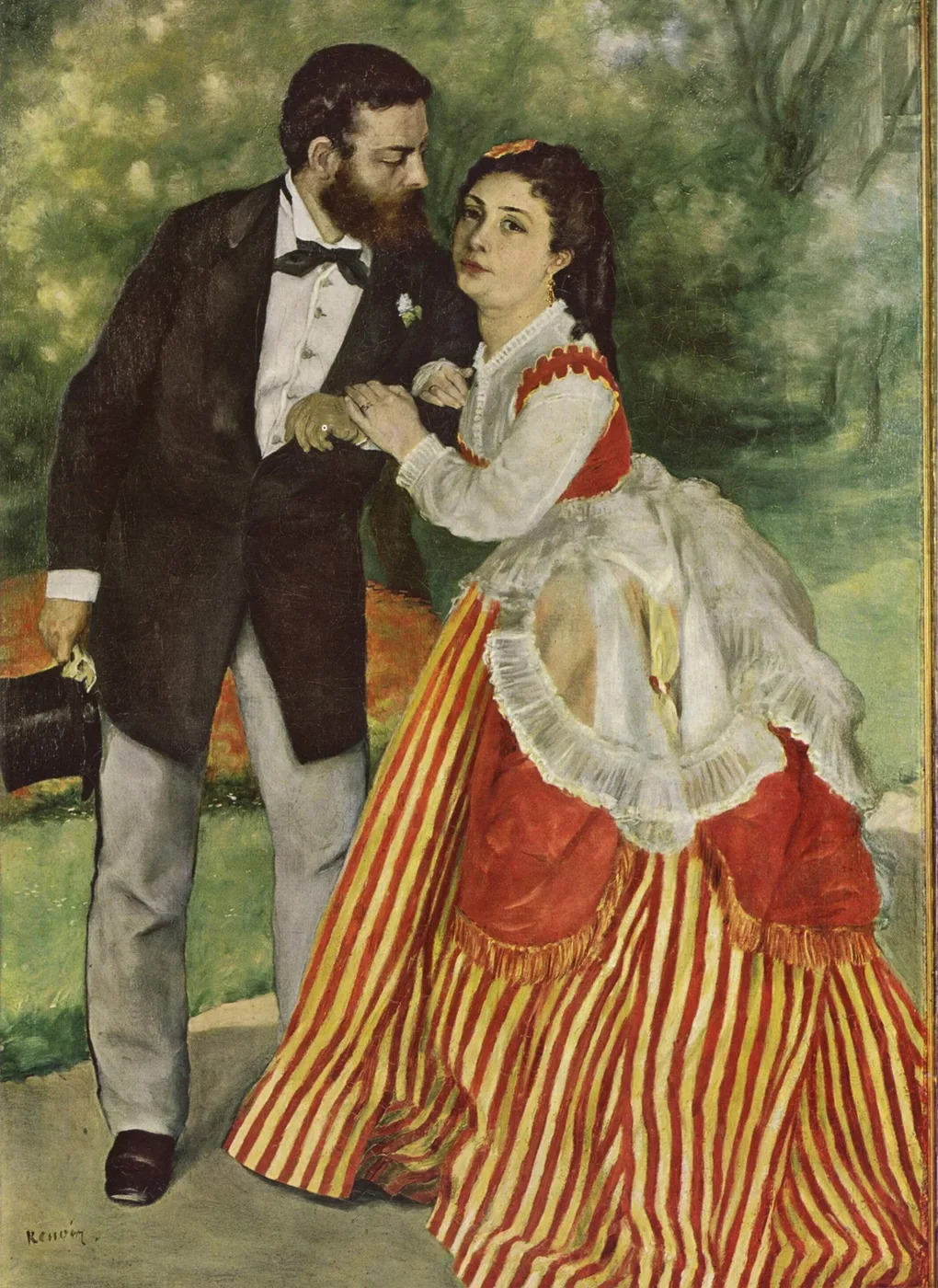
By 1868, when Renoir painted this large double portrait, Sisley had become a close companion rather than merely a classmate. Renoir’s picture shows him not as a struggling artist but as a fashionable young Parisian out walking with his companion, both dressed for the boulevard rather than the studio.
Renoir was still years from any financial security of his own. Painting a friend at full length, on a canvas of real ambition, was as much a demonstration of skill aimed at the Paris Salon as it was an act of friendship.
Two Figures Walking Through Dappled Shade
The canvas is dominated by a couple caught mid-stride, arms linked, moving through a shaded garden or park path. Sisley wears a grey frock coat and a tall hat, his stance upright and slightly formal, while his companion is dressed in a pale, patterned gown that catches the light differently at hem, waist and shoulder.
Renoir set the pair against a dark, loosely brushed background of foliage, so that their pale clothing and faces read as the brightest passage in the picture. The eye meets their joined arms first, then travels up to the two faces turned very slightly toward one another.
Light falls unevenly across the scene, as it does under real trees, breaking the woman’s dress into passages of warm cream and cooler grey shadow. This is Renoir already thinking hard about outdoor light on fabric, a concern that would occupy him for the rest of the decade.
Manet’s Shadow and Courbet’s Dark Ground
The picture’s dark, tonal background and its confident handling of black and grey clothing owe an obvious debt to Edouard Manet, whose portraits of fashionable Parisians Renoir and his friends studied closely. The influence of Gustave Courbet is felt too, in the density of the paint laid into the shadowed foliage behind the couple.
What separates this canvas from either older painter is the informality of the pose. There is nothing posed about the way the two figures lean toward each other; it reads as a moment caught rather than arranged, even though every fold of cloth was surely worked over at length in the studio.
Renoir had not yet arrived at the broken, feathery brushwork that would define his mature Impressionist manner. The paint here is denser and more descriptive, closer to the tradition he had trained in, even as the subject looks forward to the modern life scenes he and his friends were about to make their own.
From an Early Ambition to the Wallraf–Richartz Museum
This double portrait remained a private record of friendship long after the two men’s careers diverged; Sisley went on to paint landscapes in a purely Impressionist vein, while Renoir’s work grew warmer and more figurative. The painting eventually entered the collection of the Wallraf–Richartz Museum in Cologne, where it remains today.
Seen there now, it is easy to forget how uncertain both men’s prospects looked in 1868. Neither had sold much; neither had any reason to expect that a museum on the Rhine would one day hold the record of their friendship.
The painting is a useful reminder that Impressionism did not arrive fully formed. It grew out of ordinary friendships, shared studios and long afternoons spent painting people the artists actually knew.
Living With the Sisleys’ Quiet Afternoon
On a wall at home, this is a picture that rewards a second and third look rather than announcing itself immediately. The dark background recedes in low light, leaving the two pale figures almost suspended, while in brighter daylight the texture of the woman’s dress and the weave of Sisley’s coat become much more legible.
There is a stillness to the composition that suits a hallway or a reading room, somewhere a viewer passes at different times of day and catches the light shifting across the paint. Morning light tends to flatten the shadowed background; afternoon light picks out the warmer tones in the woman’s dress.
What stays with a viewer, more than the fashion or the setting, is the sense of two people simply walking together, unaware of being watched. It is an intimate picture built on a large scale, and that contrast between the modesty of the subject and the ambition of the canvas is part of what still holds attention on it today.
Sizes and materials for Marriage of Sisley are listed on its product page.