Lise with a Parasol
Lise Tréhot Steps Into the Light
In the summer of 1867 Renoir was twenty-six and still largely unknown, working in and around the forest of Fontainebleau with a small circle of friends who would later be called the Impressionists. His model was Lise Tréhot, then about nineteen, whom he had met through his friend Jules Le Coeur and who sat for him repeatedly over the following years.
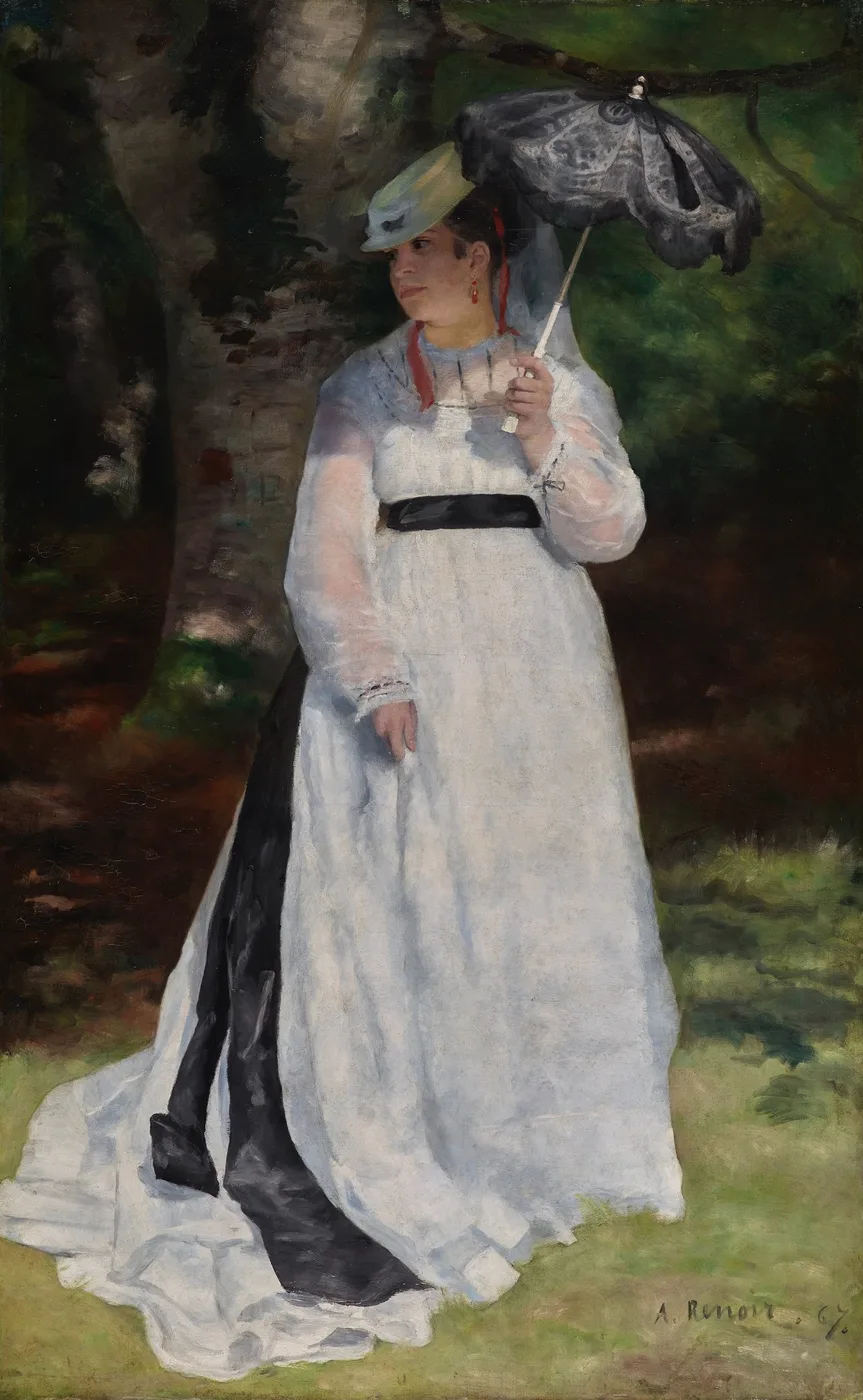
Lise with a Parasol is the most ambitious of these early paintings of her, a full-length figure set outdoors rather than a study confined to a studio. Renoir painted it with an eye on the Paris Salon, the official annual exhibition that still controlled a young artist’s chances of being seen and bought.
Landscape and plein-air painting were viewed with suspicion by the Salon jury, so a large, carefully staged figure painting, even one set in dappled outdoor light, was a way of meeting the institution halfway. The gamble paid off. The picture was accepted for the Salon of 1868, one of the first real successes of Renoir’s career and a rare moment of public recognition before Impressionism had a name.
A White Dress Between Sun and Shadow
Lise stands nearly life-size at the centre of the canvas, dressed in a long white summer dress with black accents at the waist and cuffs, a parasol held loosely at her side. She is set within a small clearing in the woods, surrounded by tall grass and undergrowth rendered in deep, varied greens.
Sunlight breaks through the tree canopy above her and lands in irregular patches across the dress, the ground, and her face, so that no single passage of the painting sits in flat, even light. This dappling is the picture’s central effect: white fabric that is never simply white, but a field of warm and cool touches shifting with the broken light.
Lise’s face is turned slightly away, her expression calm rather than posed for the viewer, which gives the picture some of the informality of a snapshot despite its considerable size and ambition. The dark ribbon at her throat and the black detailing on the dress provide the only strong accents against the whites and greens that otherwise dominate the canvas.
The Salon Notices Renoir
Among the critics who reviewed the Salon of 1868 was the young novelist and journalist Émile Zola, who was then building a reputation as a defender of painters who worked from modern life rather than historical or mythological subjects. Zola was among the young critics of these years arguing for exactly the kind of independent, observation-based painting that Lise with a Parasol represents, championing painters such as Manet and Courbet against the Salon’s more conservative juries.
That kind of attention mattered enormously to an artist as unestablished as Renoir was in 1868. It did not bring financial security, but it placed his name, briefly, alongside painters who were already provoking serious debate about the direction of French art.
The praise also marks a turning point in how Renoir approached the human figure outdoors. Lise with a Parasol treats a real, specific woman with the scale and seriousness usually reserved for Salon portraiture, while keeping the loose, light-struck handling that Salon painting normally avoided.
Dappled Paint, Not Polished Surface
Up close, the dress is built from broad, visible strokes of white, grey, and pale blue rather than smooth, blended paint, an approach closer to the sketch than to finished Salon technique. Renoir lets individual patches of light sit as separate touches of colour instead of merging them into a single even tone.
The greenery surrounding Lise is handled even more freely, with thick, loaded strokes standing for grass and leaves rather than describing each blade in turn. This is where Renoir’s outdoor practice with Monet and Sisley shows most clearly, in paint that records the sensation of a sunlit clearing rather than a botanically exact one.
Only Lise’s face and hands receive the smoother, more careful handling expected of a Salon picture. It was a compromise that let Renoir satisfy the jury’s expectations for a figure while indulging his growing interest in broken, atmospheric light everywhere else.
Lise with a Parasol in a Modern Room
Lise with a Parasol has belonged to the Museum Folkwang in Essen for many years, hanging among a strong collection of French nineteenth-century painting that the museum built up in the early twentieth century. Seen in person, the canvas is considerably larger and more physically present than reproductions suggest.
In a domestic setting, a painting built on this kind of dappled light responds constantly to the room’s own daylight. A bright, direct light tends to emphasise the whites of the dress, while softer, indirect light draws out the blues and violets Renoir mixed into the shadows.
What holds the picture together in any light is Lise herself, standing quietly at the centre of all that flickering paint. Her stillness is what makes the surrounding movement of light and leaves legible, rather than simply busy.
Sizes and materials for Lise with a Parasol are listed on its product page.