La Parisienne
Paris, 1874: An Exhibition Nobody Wanted to Host
In the spring of 1874, Renoir joined Monet, Degas, Pissarro, Berthe Morisot and others in mounting an independent exhibition of their own work, after years of rejection or grudging tolerance from the official Paris Salon. They rented rooms in the photographer Nadar’s former studio on the boulevard des Capucines and hung the show themselves.
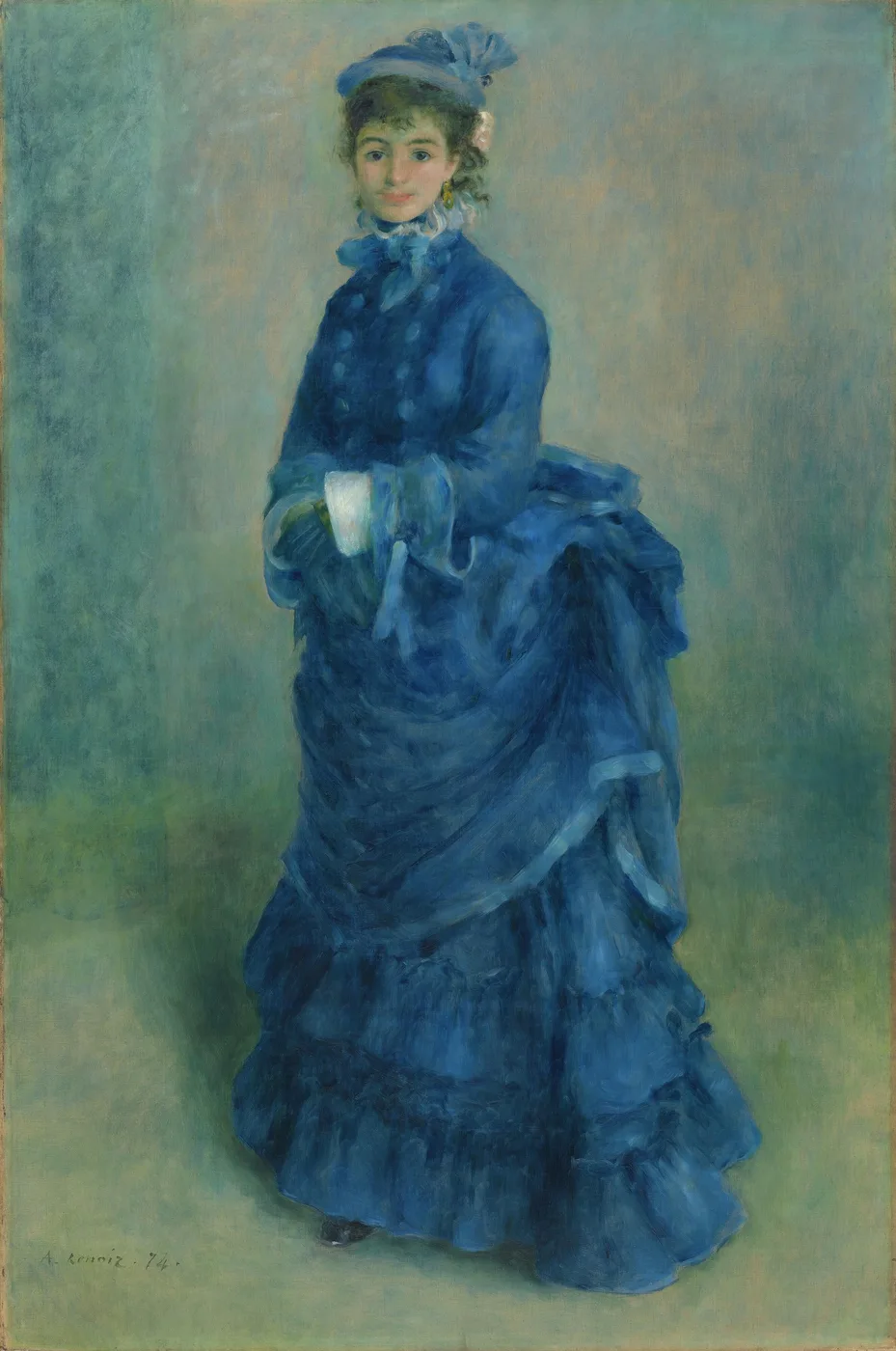
It was this exhibition that gave the movement its name, after a hostile critic seized on the title of a Monet seascape to mock the whole group as mere impressionists. Renoir, then in his early thirties and still largely dependent on portrait commissions and the goodwill of friends, showed several works there, including a large full-length portrait of a young woman in a vivid blue dress that has since become known as La Parisienne.
The sitter is generally identified as Henriette Henriot, an actress and one of Renoir’s favoured models in the mid-1870s, though the picture has always been known simply by its subject’s type rather than her name.
A Blue Dress That Fills the Canvas
The picture is dominated, almost entirely, by one colour. The young woman stands full length, turned slightly to one side, wearing a dress of deep, saturated blue whose ruffled flounces cascade from the waist to the floor in loose, rhythmic folds of paint.
Her head is small in proportion to the tall canvas, tilted and framed by a dark hat, and her gloved hands are held close to her body. Against the blue, Renoir sets only a plain, softly brushed grey-green background, leaving nothing to compete with the dress for attention.
The blue itself is not flat; it shifts from near-black in the deepest shadows of the fabric to a lighter, almost powdery tone where light catches the ruffles, all handled with visible, energetic brushstrokes that describe movement in the cloth rather than its precise structure.
A Society Type, Not a Society Likeness
Unlike a conventional Salon portrait, commissioned to record a specific patron’s features and status, La Parisienne reads as a study of a type: the fashionable, self-possessed young Parisian woman, dressed in the latest colour and cut, that the title itself names.
Renoir was fascinated throughout the 1870s by contemporary fashion and by the way particular colours, especially strong blues, had become newly available and newly popular thanks to synthetic dyes. The dress in this painting is as much a subject of the picture as the woman wearing it.
That interest in surface, cut and colour over individual likeness is part of what made the picture, and the exhibition it hung in, feel radical to visitors used to the tighter finish and narrower palette of academic portraiture.
Loose Handling, Confident Scale
What strikes a viewer standing in front of the actual canvas is its size: this is not a small, intimate sketch but a full-length figure close to life scale, painted with the same rapid, broken brushwork Renoir used in his smaller studies. That combination of ambitious scale and informal technique was itself a small provocation in 1874.
The face is summarised rather than finely modelled, with a few quick touches suggesting eyes, a small mouth and a faint blush of colour on the cheeks. Renoir is far more interested in the fall of light down the length of the blue dress than in the individual features of the sitter’s face.
Renoir was already experimenting, in these years, with painting outdoors and in natural light for his landscapes, and something of that same attention to changing, ambient light carries into this indoor portrait, even though the setting is deliberately left undefined.
From Paris to Wales: The Painting Today
La Parisienne has been in Wales for over a century, part of the remarkable collection of French nineteenth-century art assembled by the sisters Gwendoline and Margaret Davies and later given to what is now the National Museum Cardiff. It remains one of the best-known Impressionist paintings in any Welsh public collection.
In the gallery, the blue of the dress carries the room; visitors tend to see the colour before they register that it is a portrait at all. Under natural light it shifts between navy shadow and a lighter, almost violet blue, a reminder of how much of this picture’s power rests on a single, bold colour decision rather than on any story told about its sitter.
Living with such a painting, even only through repeated visits, means noticing something new in that blue each time: a fold catching light differently, a brushstroke that reads as fabric from a distance and as pure paint up close.
Sizes and materials for La Parisienne are listed on its product page.