Dance in the City
Renoir Turns to the Discipline of Line
By 1883, Renoir had grown uneasy with the loose, broken brushwork that had defined his painting through the 1870s. A recent trip to Italy, where he had studied Raphael’s frescoes and the wall paintings of Pompeii, left him convinced that Impressionism, as he had practised it, risked losing the solidity and drawing he now wanted back in his work.
Dance in the City was one result of that shift. Renoir planned it as a formal, close to life size pair with a second canvas, Dance in the Country, treating the two as deliberate opposites in mood, setting and colour, even though each stands as a complete picture in its own right.
For the woman in Dance in the City, Renoir chose Suzanne Valadon, then working as an artist’s model in Montmartre and only later recognised as a significant painter in her own right. Her partner was posed by Paul Lhote, a novelist and close friend of Renoir who also modelled for the man in the companion picture.
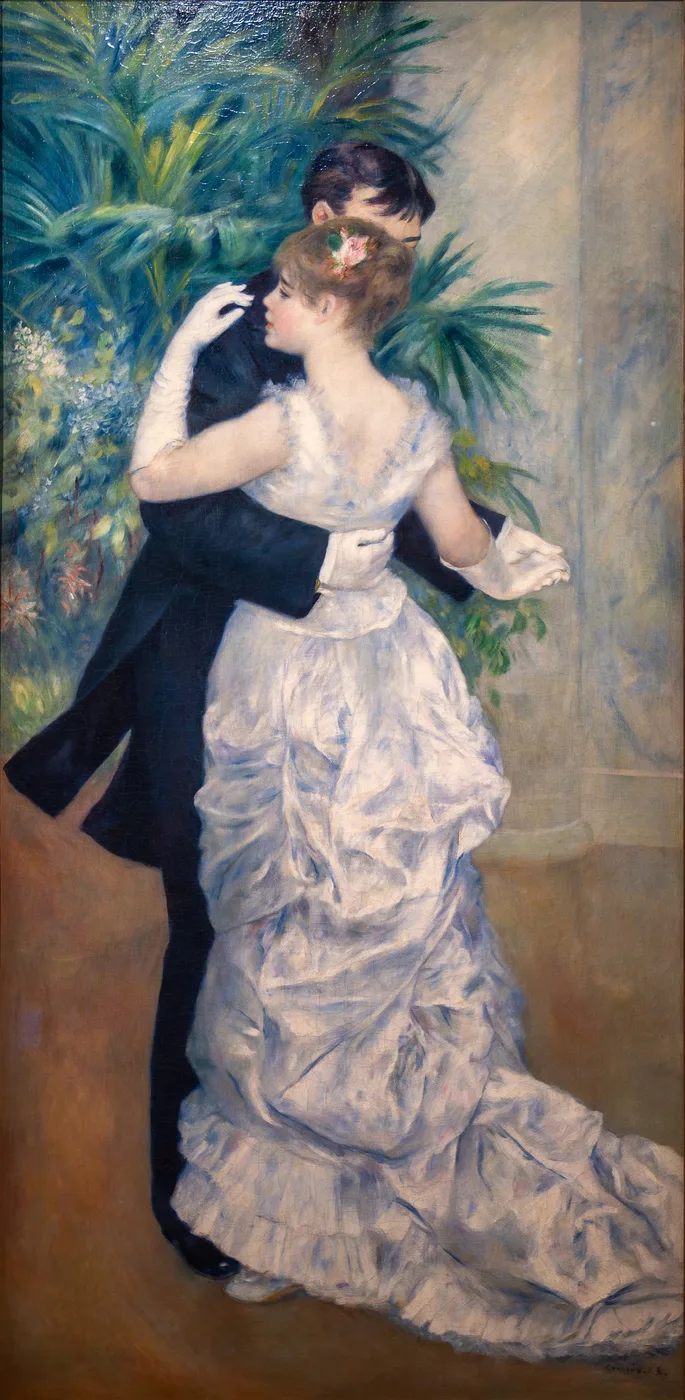
The picture shows the two dancers filling almost the entire canvas, cropped close so no background detail distracts from the pair themselves, a very different approach from the crowded outdoor scenes Renoir had painted only a few years earlier.
Renoir conceived both dance paintings as a pair, letting the two large canvases argue their case together, though each was also sold and has since been exhibited separately at various points in its history. The two remain most often discussed, and displayed, side by side.
A Couple Held in a Formal Embrace
The woman wears a pale satin evening gown, its long train sweeping across the lower right of the canvas in smooth, carefully modelled folds. Her partner, in black evening dress with white gloves, holds her at a formal distance, his gaze fixed somewhere past her shoulder rather than on her face.
Renoir painted the fabric of the gown with a much smoother, more controlled surface than his earlier work, building form through gradations of pale colour rather than through visible dabs of paint. The satin’s sheen and the crisp line of the man’s collar both speak to his new interest in solid, legible drawing.
Their faces are turned away from each other and from the viewer, hers in profile, his largely hidden, which keeps the picture from reading as a portrait of two named individuals and instead presents an idea of formal, choreographed dancing. A slight stiffness in the pose seems entirely intentional.
The background is kept plain and undefined, a pale, neutral space that gives no clue to the room around them, so nothing competes with the sweep of the gown and the dark, upright figure of the man.
Cool Colour for an Indoor Occasion
Renoir restricted his palette here to pale creams, whites and blacks, with only muted touches of colour elsewhere, in sharp contrast to the warm pinks and greens he used for the outdoor companion scene. The effect is one of a cool, formal interior, a ballroom or salon rather than a garden.
Light falls evenly across the woman’s gown, picking out its folds without the dappled, broken sunlight Renoir used elsewhere in his outdoor pictures of the period. The evenness of that light reinforces the sense of an indoor, artificial setting governed by manners rather than weather.
Even the pair’s posture, upright and slightly held back from each other, contributes to this coolness; nothing in the picture suggests the loose-limbed, laughing spontaneity that marks Renoir’s outdoor dancing scene from the same year.
A small bouquet of violets pinned near the woman’s waist is one of the only decorative touches Renoir allowed himself in the whole canvas, and it stands out precisely because everything around it is so plain and controlled.
A Formal Companion Piece in the Musée d’Orsay
Dance in the City now hangs in the Musée d’Orsay in Paris, generally displayed near its outdoor companion so visitors can compare the two directly. Seen together, the pair make Renoir’s argument about mood and setting immediately clear; seen alone, this picture still carries its own complete sense of a formal evening.
Hung on its own in a room at home, the painting’s pale, restrained palette tends to sit quietly rather than dominate, its effect built more from the poise of the two figures than from colour or incident. Different light changes how sharply the gown’s satin folds catch the eye, from a soft gleam in low evening light to a crisper, almost sculptural clarity at midday.
What stays constant is the picture’s cool formality, a moment of practised elegance held perfectly still, quite unlike the tumbling warmth of the picture Renoir painted alongside it.
Sizes and materials for Dance in the City are listed on its product page.