Blonde Girl with a Rose
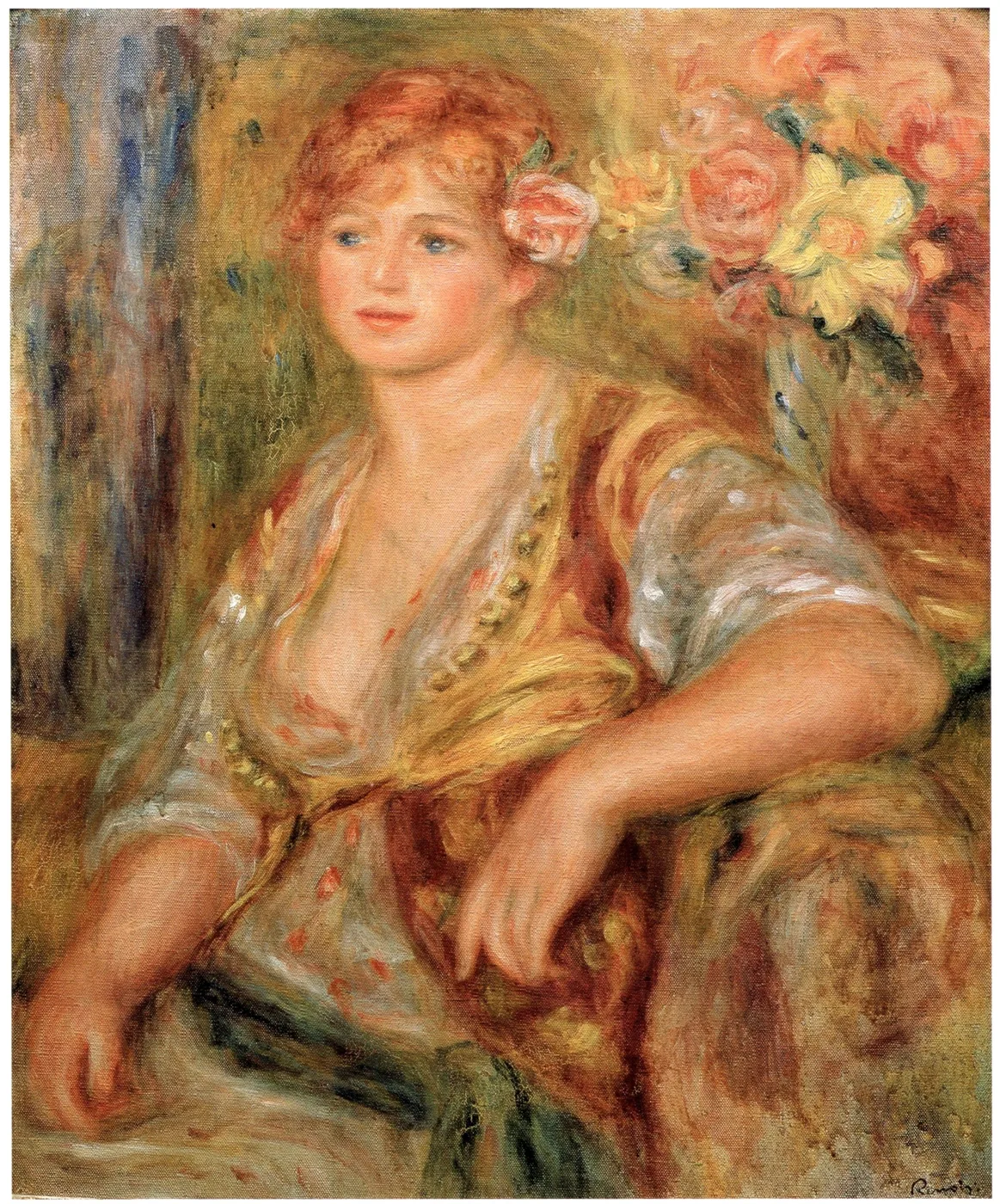
Painting Through Pain at Les Collettes
By 1915, Pierre-Auguste Renoir was seventy-four and living mostly at Les Collettes, his house among the olive groves of Cagnes-sur-Mer. Rheumatoid arthritis had twisted his hands and fused several joints, and he worked with a brush wedged between swollen fingers rather than held in a normal grip. Blonde Girl with a Rose comes from this last, physically demanding phase of his career, painted as France entered the second year of the First World War.
Despite the pain and the anxiety of wartime, Renoir kept working almost daily, using models drawn from the household and from young women in the area around Cagnes. Blonde Girl with a Rose is one of many half-length studies from these years, built around a single model, a flower, and very little else, letting Renoir concentrate entirely on flesh, hair and the fall of light.
A Single Figure, Stripped of Incident
The composition could hardly be simpler. A young blonde woman is shown close to half-length, her head turned slightly, a rose held near her body, with almost nothing else in the picture to distract from her.
There is no interior, no furniture, no other figure competing for space. Renoir reduces the picture to skin, hair, cloth and flower, a format he returned to again and again in his final decade because it let him focus entirely on paint handling rather than on storytelling.
Colour and Touch in Renoir’s Final Style
The colour in Blonde Girl with a Rose is unmistakably late Renoir. Flesh is built from warm reds, oranges and pinks rather than the cooler, more naturalistic tones of his Impressionist years, giving the skin a glowing, almost heated quality.
The rose itself picks up and concentrates that same warm red, so that flower and flesh seem to be made of related colour rather than sitting apart from one another. Renoir’s late brushwork is broad and confident, laid down in visible, fluid strokes that some critics of the period found blurred or overripe and that later audiences have come to see as a deliberate, hard-won looseness.
It is difficult to look at any picture from this period without thinking about how it was made. Contemporaries who visited Les Collettes described Renoir’s fingers as curled and rigid, his palette and brushes arranged for him by assistants, his working sessions limited by pain and fatigue.
Yet the paint surface in Blonde Girl with a Rose shows no hesitation. The strokes are large and sure, built from the shoulder and wrist rather than from fine finger control, and that physical necessity became part of the late style itself, a broad, sensuous handling that would go on to influence younger painters, among them Matisse, who visited Renoir at Cagnes in his final years.
A Painting Now at the Orangerie
Blonde Girl with a Rose is held today at the Musée de l’Orangerie in Paris. The museum was built around the collection of Paul Guillaume and Jean Walter, dealers who championed late Renoir alongside Cézanne, Matisse and Picasso when many still considered the artist’s final period a decline.
The Orangerie sits at the western end of the Tuileries Gardens, best known to many visitors for Monet’s Water Lilies murals. Its rooms also hold one of the richest gatherings of late Renoir anywhere in the world, and this painting is part of that gathering.
Living with a Late Renoir
A picture built this heavily around warm red and gold changes considerably with the light in a room. In the soft, indirect light of a north-facing window, the reds settle and the flesh reads as gently sunlit; under warmer artificial light in the evening, the whole canvas can tip further towards the glowing, almost overripe warmth that defines Renoir’s final years.
There is little narrative to hold onto in a picture like this one, no story to work out and no symbol to decode. What it offers instead is a sustained, close study of a face and a flower, returned to slowly over however long a viewer chooses to look.
Renoir is widely quoted from his final years as having said that pain passes but beauty remains. Whether or not that exact remark belongs to this specific canvas, the picture itself carries no sign of struggle; it is warm, direct and unhurried.
Blonde Girl with a Rose rewards patience rather than a single glance. Its pleasures are in the handling of paint itself, in the way pink shades into red and red into gold across a small stretch of canvas, made by a man for whom every stroke had become a physical effort.
Sizes and materials for Blonde Girl with a Rose are listed on its product page.