Bal du moulin de la Galette
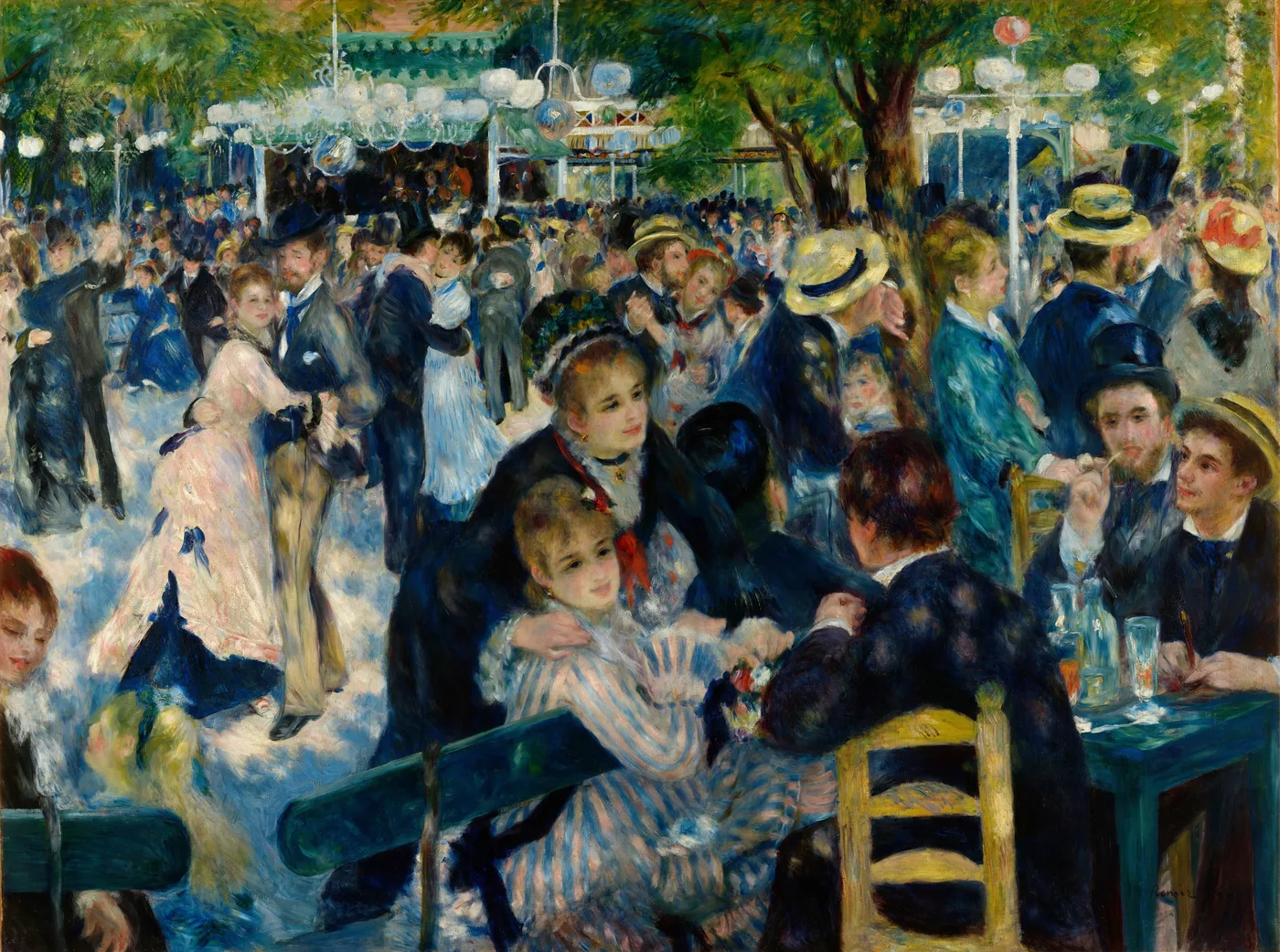
A Sunday Afternoon in Montmartre, 1876
In the spring of 1876, Pierre-Auguste Renoir was living in Montmartre, then still a semi-rural quarter of Paris dotted with windmills, vegetable gardens and cheap studios. He rented a house on the rue Cortot with a garden large enough to store an ambitious new canvas he was carrying back and forth from a nearby dance garden.
That garden, attached to an old windmill called the Moulin de la Galette, hosted open-air dances every Sunday afternoon for the young working people of the neighbourhood. Renoir wanted to capture the atmosphere of one of these gatherings directly, rather than compose it from memory in the studio.
Friends, neighbours and models he knew from the quarter agreed to sit for him amid the real dancers, so the painting mixes portraits of people he knew with the ordinary crowd enjoying its Sunday leisure. He worked on the canvas over several months, carrying it to the site and back so that the light and the crowd could be observed afresh each time.
The finished picture was shown at the third Impressionist exhibition in 1877, where it struck many viewers, favourable and hostile alike, as one of the boldest attempts yet to paint modern life exactly as it looked and felt. It remains one of the works most closely associated with the movement’s ambition to record ordinary contemporary pleasure.
Dappled Light Across a Crowded Garden
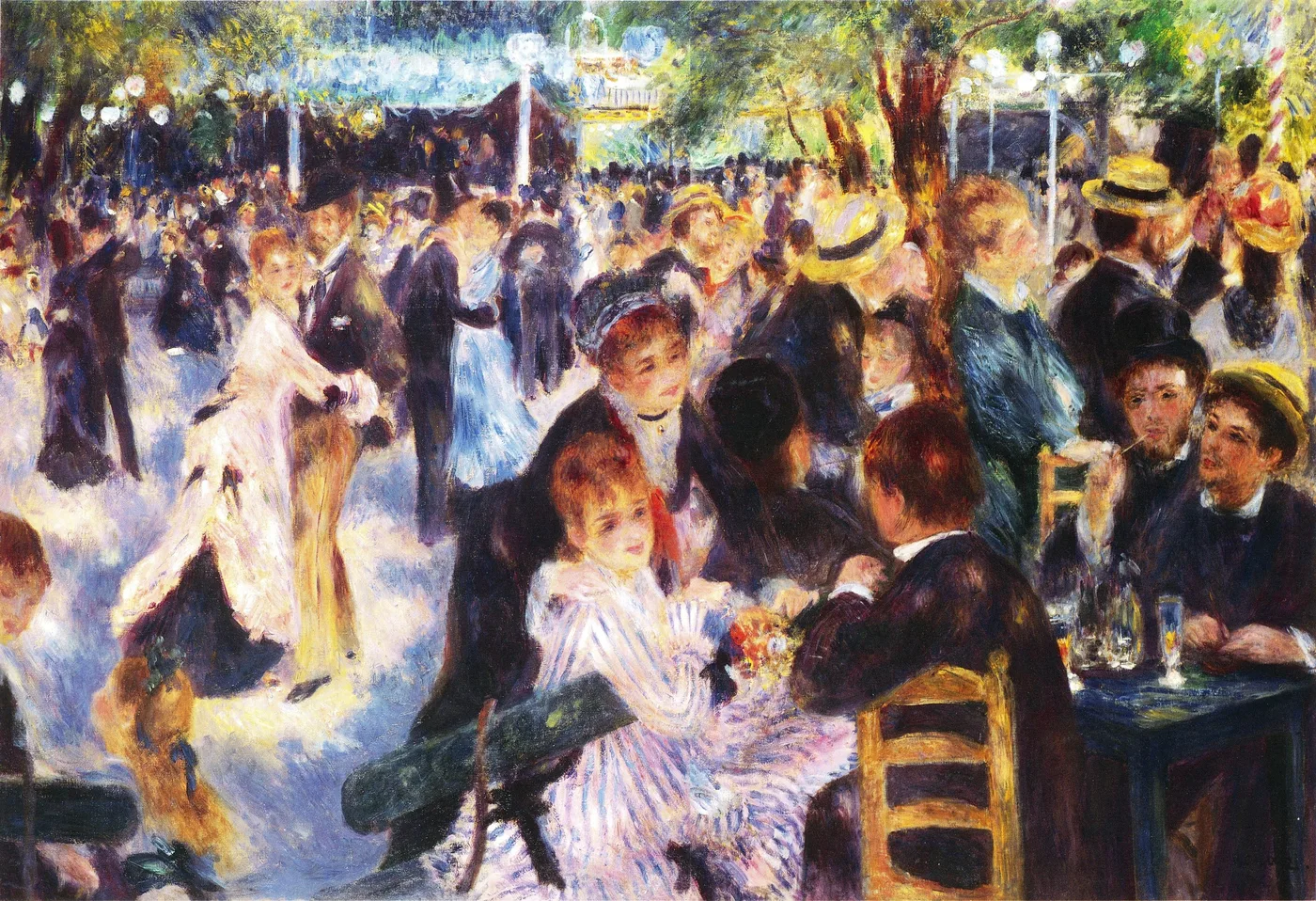
The canvas is large, and it is built around a foreground group of seated and standing figures who talk, drink and watch the dancing beyond them. Sunlight falls through the leaves of the trees overhead and breaks across the scene in irregular patches of yellow and white, landing on hats, shoulders and the surface of a table without ever settling into a single clear source.
Renoir spreads this broken light evenly across straw boaters, dark jackets and pale dresses, so that no single figure is lit more clearly than any other. The effect flattens the usual hierarchy of a group portrait; the eye is drawn first to a young woman in a striped dress seated in the foreground, then pulled outward into the blur of dancing couples further back.
Beyond the foreground group the crowd thins into looser brushwork, faces and limbs dissolving into patches of colour that read as movement rather than as individuals. Blues and violets sit in the shadows of clothing and under the trees, while warm ochres and pinks catch the sunstruck patches, giving the whole scene a shimmering, slightly hazy unity.
There is no single vanishing point pulling the composition into strict perspective. Instead the painting reads as a series of overlapping circles of activity, tables in front, dancers in the middle distance, more dancers and trees beyond, so that the eye keeps circulating rather than resting.
Brushwork Built for Sunlight, Not Line
Renoir applied paint quickly and thinly in places, letting the weave of the canvas show through in the shadowed passages, while building thicker, more worked touches where light strikes fabric or skin directly. This variation in handling suggests warmth and movement without any single figure appearing overworked or stiff.
Faces in the middle distance are reduced to a few economical strokes, just enough to suggest an expression or the turn of a head, which keeps the whole crowd feeling alive and shifting rather than posed. Renoir avoided sharp outlines almost everywhere, preferring to let one colour area meet the next directly.
The palette itself stays relatively narrow: creams, dusty blues, soft greens and a scattering of black in the men’s jackets, with pink and orange reserved for skin and the warmest patches of light. This restraint lets the eye read the play of sunlight as the true subject of the painting.
A Painting That Still Feels Like a Summer Afternoon
What makes the Bal du moulin de la Galette unusual among large group scenes of its period is how little it insists on any single narrative. Nobody looks toward the viewer with obvious intent; nobody is posed as the hero of an anecdote.
Seen in reproduction, the painting can look softly blurred, almost sentimental. Standing in front of the actual canvas at the Musée d’Orsay, the scale changes that impression considerably: the figures are close to life size in the foreground, and the broken light has real physical presence.
On a wall in a domestic room, a reproduction of this scene tends to read differently depending on the time of day, since the picture’s own subject is precisely the flicker of afternoon light across a crowd. Morning light can make the blues in the shadows read cooler, while evening lamplight warms the ochres and pinks.
The painting rewards slow looking rather than a single glance, since so much of its incident is distributed evenly rather than concentrated in one dramatic passage. A viewer who returns to it notices different couples, different faces caught mid conversation, each time.
Nearly a century and a half after it was painted, the scene still communicates something recognisable: the particular restlessness and pleasure of an outdoor gathering on a warm afternoon, with the crowd never quite settling and the light never quite still. That combination, an ordinary social occasion treated with total seriousness of technique, is part of why the painting has remained one of the most studied works to come out of the Impressionist exhibitions of the 1870s.
Sizes and materials for Bal du moulin de la Galette are listed on its product page.