

Description
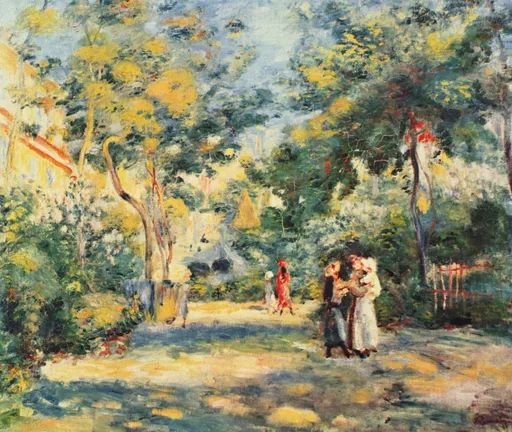
This is less a landscape than a wall of blossom. Renoir crams the whole surface with clotted dabs of gold, rust, and salmon pink, a thicket in full spring flower that all but swallows the picture plane. Only in the upper corners does a strip of hazy blue sky survive, pressed thin between the branches, and a narrow gap of ochre path opens down the center where two small dark figures walk away from us, half hidden by the undergrowth.
The paint is laid on thick and fast, dabbed rather than blended, so that from close up the trees dissolve into flecks of red, yellow, and khaki with almost no drawn structure underneath. Stand back and the flecks snap into branches, leaves, and a fence rail cutting low across the path. The palette is warm almost to excess, gold and rust set against just enough blue-gray sky to keep the heat from tipping into mud.
Renoir painted plenty of gardens and riverbanks, but here the human figures are reduced to two dark smudges, background incident rather than the point of the picture. That is unusual for him: the foliage itself, not a sitter, carries the whole canvas. The brushwork is looser and more agitated than the smooth, creamy handling he is known for in his figure paintings, closer to the broken color of his early landscapes than to the pearly nudes that came later.
On a wall, it reads first as a mass of warm color rather than as a scene, gold and rust that glow at a distance and only resolve into a path and a pair of walkers as you get closer. It is a picture that rewards both a quick glance across a room and a longer look up close, and its density of color makes it a strong, warm anchor in a space that needs some heat.