Description
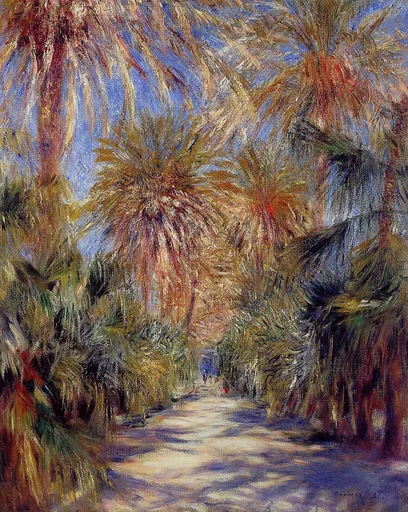
A low horizon opens across a narrow, panoramic canvas, the kind of quick outdoor study Renoir made to catch a fleeting effect of light rather than to record a particular place. Two rounded clumps of bushes anchor the foreground, one at each end of the composition, painted as thick, twisting knots of ochre and burnt sienna with dark green shadows worked in wet-into-wet. Between them the ground falls away into a pale, sandy strip, and above it a band of soft mauve and lilac strokes stands in for distant hills or haze, laid on with a loaded, almost calligraphic brush that leaves ridges of paint visible on the surface.
The palette stays narrow and warm: ochre, rust, dove grey and a pale cream that dominates the upper two thirds of the canvas, so the picture reads as much as a study in tone as a description of a place. Renoir has clearly worked fast, letting single strokes stand for a whole bush or a stretch of sky rather than building up detail, and the coarse weave of the canvas shows through the thin paint in several places, giving the surface a dry, chalky texture.
This is Renoir at his most informal, a working sketch rather than a finished exhibition piece, closer to the plein air landscapes he and his fellow Impressionists traded ideas over in the late 1870s and early 1880s than to his more polished figure paintings of the same years. On a wall, its long horizontal format and hazy, sun-bleached palette read as calm and airy from a distance, while the loose, gestural brushwork rewards a closer look, the kind of picture that changes character depending on how near you stand to it.