Description
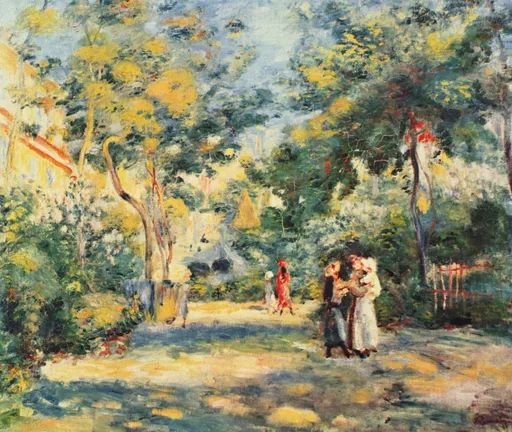
Renoir pushes the viewer straight into a wall of vegetation. There is barely any sky, just a low patch of pale green-gold in the upper corners; everything else is packed with branches, leaves and undergrowth rendered in a dense weave of green: bottle green, olive, sage, and near-black shadow. A dirt path curves in from the lower right, catching a stripe of warm orange-gold light where the sun breaks through the canopy, and pulling the eye back into the depth of the wood.
The paint is applied thickly and quickly, in short dabs and dashes rather than blended passages: dark strokes stab in for shadowed foliage, lighter green and gold flicks stand for sunlit leaves catching the breeze. There is no single tree or branch rendered in detail; the forest reads as a vibration of color and light rather than a botanical inventory. Touches of warm red-brown in the upper branches and orange in the path keep the cool greens from going flat.
Painted in 1875, this canvas belongs to the years when Renoir was working alongside other landscape painters on the changing light of the outdoors, but here he pushes further into abstraction than a typical scene of the period: there is no horizon, no sky to anchor the composition, just the sensation of standing inside dappled shade. It is one of the more purely textural, almost tapestry-like landscapes from this stretch of his career.
Because the surface is so uniformly rich, dark and green, it reads on a wall as a deep, cool block of color, a good foil for a room that needs a quiet, wooded note rather than a bright focal point. The warm gold path keeps the eye moving instead of settling, so up close it rewards a slow look at the individual strokes, while at a distance it simply reads as cool, dappled shade.