Diana
A Young Renoir Aims at the Salon of 1867
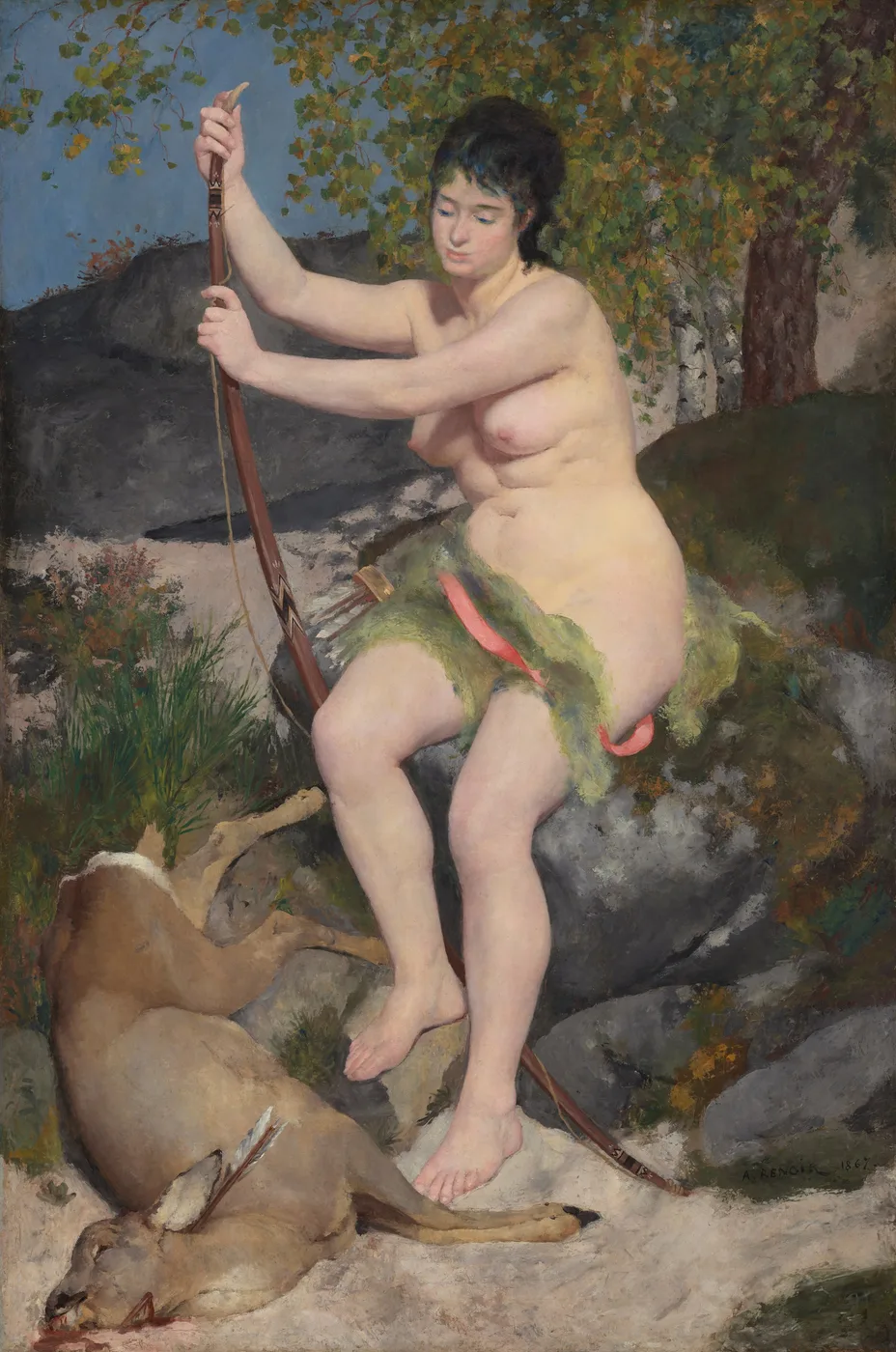
In 1867, Pierre-Auguste Renoir was twenty-six, still years away from the loose, sunlit style that would make him famous, and trying, like every ambitious young painter in Paris, to get his work accepted into the official Salon. Diana, sometimes called Diana the Huntress, was his submission that year, a large mythological nude painted in the academic language the Salon jury expected: a goddess, a bow, a dead animal, a suitably ancient-looking setting.
The jury rejected it. Renoir had hoped that dressing up a contemporary studio nude as the Roman goddess of the hunt would satisfy Salon taste for mythology while still letting him paint from life with the directness he preferred, but the picture was judged too raw, too obviously based on an ordinary model rather than an idealised goddess, and it was turned away.
A Salon rejection in the 1860s was a serious professional setback. The Salon was effectively the only route to public recognition, sales and critical notice for a young painter in Paris, and being refused meant a picture might never be seen by anyone beyond the artist’s immediate circle.
Renoir’s Diana arrived at the Salon jury in the same years that Manet’s Olympia and Déjeuner sur l’herbe had already scandalised Paris with their own unidealised, contemporary treatment of the nude. Renoir’s picture was less confrontational than Manet’s, but it shared the same basic tension between mythological subject matter and a stubbornly real, individual body.
A Goddess Built from a Studio Model
The figure at the centre of the canvas is unmistakably a real woman rather than a classical ideal. Diana stands with a bow, a quiver of arrows nearby and a slain deer at her feet, the conventional attributes that identify her as the huntress of Roman mythology, but her body is painted with the weight and particular proportions of a studio model rather than the smoothed, idealised nudes that Salon juries preferred.
Some historians believe Lise Tréhot, Renoir’s companion and favoured model through much of the 1860s, is thought to have posed for the figure, which would explain the picture’s sense of a specific, known body rather than an invented ideal. The setting behind her is a shadowed, rocky landscape, sketched in rather than elaborated, keeping attention on the figure herself.
Reading the Canvas
Diana’s pose is frontal and slightly turned, her weight settled on one leg, her foot resting near the dead deer that identifies her hunt as complete. Light falls across her body from one side, modelling the flesh in the warm, slightly rosy tones Renoir would use throughout his career, while the landscape behind her sinks into cooler, darker greens and browns.
The brushwork is tighter and more controlled here than in Renoir’s later Impressionist canvases, a sign of a young painter still working close to Salon convention even as he pushed against it. Yet passages of the fur at the deer’s flank and the foliage around Diana’s feet already show the freer, more textured touch that would come to define his mature style.
The bow and quiver root the picture firmly in the vocabulary of history painting, the genre the Salon prized above all others. Renoir needed that vocabulary to have any hope of acceptance, even as the frank, unidealised body at the centre of the composition undercut it.
From a Rejected Canvas to the National Gallery of Art
Diana survived its rejection to become one of the clearer records of Renoir’s formation as a painter, showing exactly what he could do, and what still constrained him, before Impressionism gave him a different language altogether. It is now held in the National Gallery of Art in Washington, D.C.
Seen alongside Renoir’s later work, Diana reads almost as a different artist’s picture: darker, more sculptural, more indebted to Courbet’s realism and to the history of Salon nudes than to the broken colour and outdoor light he would soon make his own. That distance is exactly what makes it valuable to look at today.
An Early Work Worth Slowing Down For
It is tempting to look at an early, rejected picture only for what it predicts, hunting for the seeds of the mature Renoir. Diana rewards a slower look on its own terms, as a serious, ambitious attempt by a young painter to master a difficult genre.
The handling of the deer’s fur and the dappled light on the rocky ground shows real skill with paint even within a fairly conventional composition. Renoir was already a highly capable technician years before he found the subjects and the freedom that would make him one of the central painters of Impressionism.
Diana asks a viewer to hold two things at once: the stiffness of an academic formula Renoir had not yet escaped, and the specific, watchful presence of a real body standing inside that formula. Few of Renoir’s later, more famous pictures give quite so clear a view of the distance he had to travel to reach his mature style.
Sizes and materials for Diana are listed on its product page.