Madame Georges Charpentier and Her Children
A Publisher’s Wife and a Portrait Built to Succeed
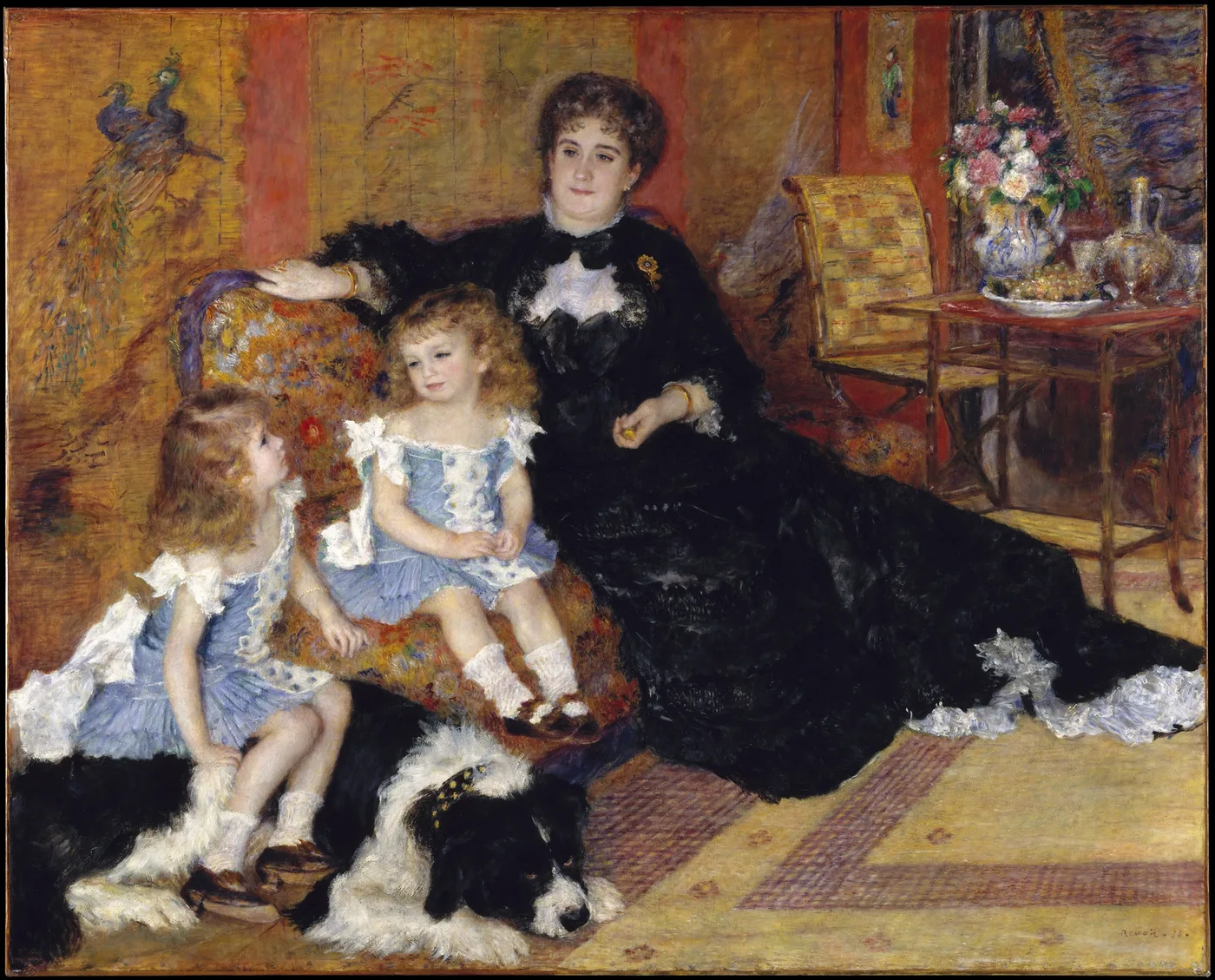
By 1878, Renoir had found an important patron in Georges Charpentier, the publisher of novelists including Emile Zola and Gustave Flaubert, and in his wife Marguerite, who ran one of the most fashionable literary and artistic salons in Paris. Renoir had already painted several members of the Charpentier circle, and this large group portrait of Marguerite Charpentier with her two young children, Georgette and Paul, was his most ambitious commission from the family.
Renoir painted it with an eye on the official Salon rather than the independent Impressionist exhibitions he had helped to found. A Salon acceptance meant reaching a far wider public and, crucially, potential buyers who would never visit an Impressionist show; Marguerite Charpentier’s social standing helped ensure the picture was accepted and well placed when it was shown at the Salon of 1879.
The gamble paid off. The portrait was well received by Salon critics and the public, and it marked a turning point in Renoir’s fortunes after years of financial struggle and mixed reviews for his more overtly Impressionist work.
A Fashionable Drawing Room in Black, White and Gold
The scene is set in the Charpentiers’ Paris drawing room, decorated in the Japanese taste that was fashionable among cultivated Parisian households of the period; folding screens and patterned textiles fill the background rather than a plain wall.
Marguerite Charpentier sits at the centre in a dark, fashionable dress, her pose relaxed but composed, while her two children are arranged beside and partly on top of a large, shaggy black-and-white dog that sprawls across the lower half of the canvas. Georgette, the elder child, sits astride the dog, and her younger brother Paul, dressed in the loose smock typically worn by small boys of the period, leans against his mother.
Renoir handles the room’s patterned fabrics and screens with the same rapid, broken brushwork he used in his landscapes, but the faces of the sitters are more carefully finished, a compromise between Impressionist looseness and the tighter description Salon audiences expected of a portrait.
Light Falling Across a Domestic Interior
Light in the painting seems to come from in front and slightly above the group, warming the pale skin of the children and catching the gold threads and highlights scattered through the surrounding fabrics. The overall palette leans toward warm creams, blacks and soft flesh tones, set off by cooler patches of blue and green in the screens behind the family.
Nothing in the composition feels stiffly posed despite its scale; the children’s informal arrangement around the dog, with Georgette perched rather than seated, gives the group a sense of a moment caught during an ordinary afternoon rather than a formal sitting arranged for the occasion.
The dog itself, often identified as a Newfoundland or similar large domestic breed kept as a family pet, does much of the compositional work, its dark bulk anchoring the lower portion of a canvas that might otherwise have felt top-heavy with the three human figures.
A Salon Success That Changed Renoir’s Standing
The reception of this portrait at the 1879 Salon did more for Renoir’s public reputation than almost anything he had painted before it. Critics who had dismissed his Impressionist exhibition pieces as unfinished sketches found, in this large and clearly legible group portrait, evidence that he could work convincingly within the more traditional expectations of portraiture.
That credibility mattered enormously within the tightly controlled world of the Salon, where jury acceptance and favourable placement could make or break a painter’s career for years at a time.
For Renoir personally, the commission and its warm reception brought both income and a widening circle of society sitters in the years that followed, even as he continued to paint more experimental landscapes and figure studies away from the Salon spotlight.
The Portrait in New York
The painting has been in the United States for well over a century and now hangs in the Metropolitan Museum of Art in New York, where its scale and the sheer density of pattern in the Charpentiers’ drawing room continue to draw visitors close to examine the brushwork.
Seen at full size, the canvas rewards both distance and proximity: from across a gallery, the composition reads clearly as a mother and her children at home; up close, the screens, fabrics and even the dog’s fur dissolve into passages of rapid, confident paint handling that never quite lose their descriptive purpose.
It remains one of the clearest demonstrations of how Renoir could bend Impressionist technique toward an entirely different audience and purpose, without abandoning the loose, light-filled brushwork that defined his independent work of the same decade.
Sizes and materials for Madame Georges Charpentier and her Children are listed on its product page.