Portrait of Jeanne Samary
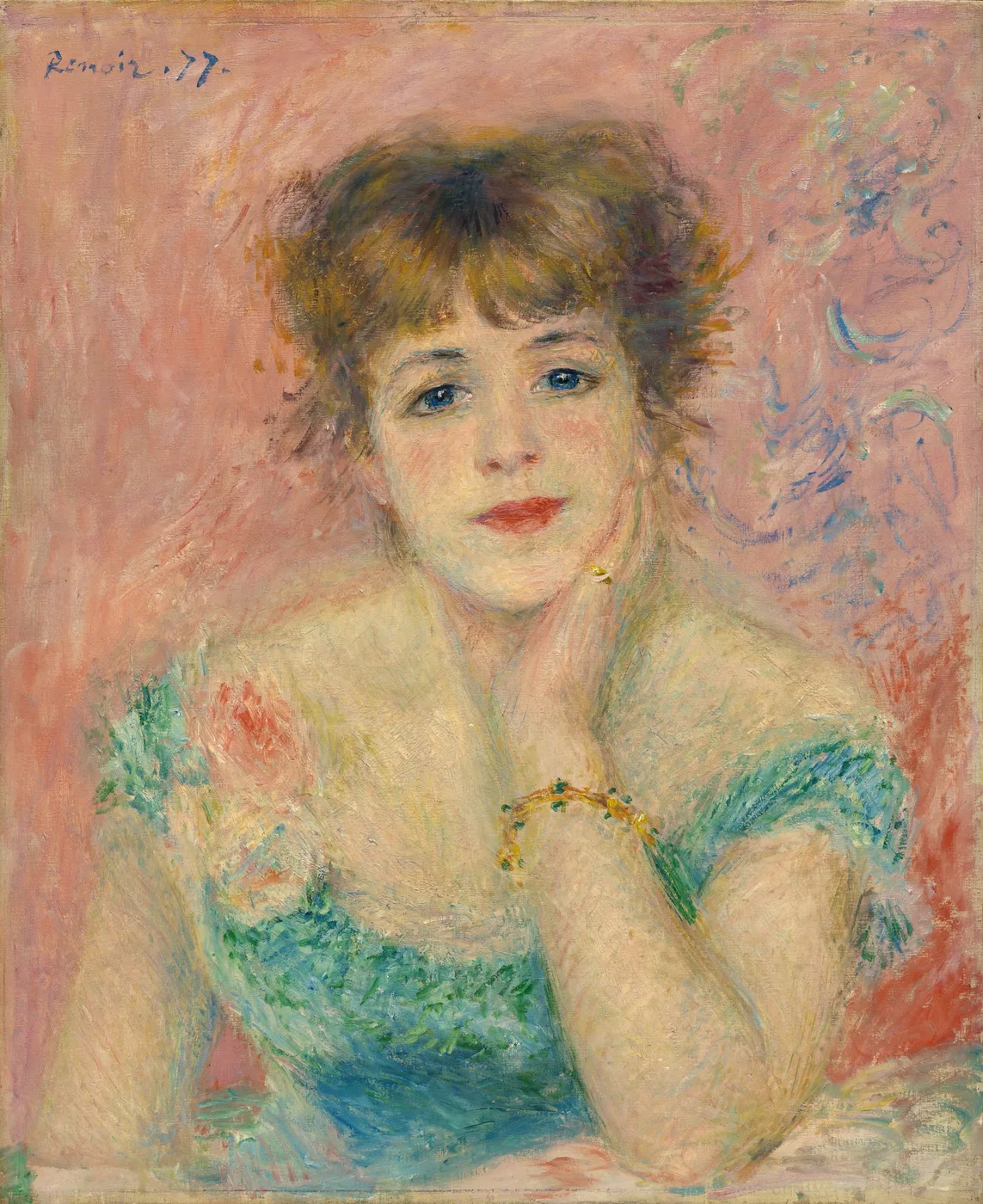
A Portrait Painted for the Impressionists’ Third Exhibition
In the spring of 1877, Pierre-Auguste Renoir was preparing work for the third group exhibition that he and his fellow Impressionists were mounting independently of the official Paris Salon. Money was tight, as it usually was for Renoir in these years, and portrait commissions from friends and patrons mattered as much as any painterly experiment.
Among the sitters who came to his studio was Jeanne Samary, a young actress attached to the Comédie-Française who moved in the same Parisian social circle as Renoir’s most important patrons, the publisher Georges Charpentier and his wife Marguerite. Samary was in her early twenties, already admired for the warmth and comic timing she brought to soubrette roles on stage.
Renoir painted her more than once in these years, drawn to a face that seemed to hold an expression rather than freeze one. This particular canvas, dated 1877, is a substantial, close to life-size portrait that he showed to the Parisian public at the group’s exhibition that April.
Rose Pink Against a Field of Blue-Green
The picture is built on a single, deliberate colour contrast. Samary stands turned slightly toward the viewer in a low-cut evening dress of rose pink, its folds picked out in deeper carmine shadow, and behind her the background dissolves into a loose field of turquoise and blue-green that has no defined walls, furniture or floor.
That pairing of warm pink against cool green is a textbook complementary contrast, and Renoir leans on it hard; the dress seems to glow because of the colour standing behind it, not because of any added light source. Samary’s reddish-gold hair is swept up, catching the same warm key as her dress and skin.
Her face is turned toward the viewer with a faint, unguarded smile, cheeks touched with pink, and her bare shoulders and neck are rendered in the same soft, warm flesh tones that recur throughout Renoir’s portraits of women in this decade. There is little in the picture that reads as a fixed setting; the emphasis falls entirely on the sitter’s colouring and expression.
An Actress Known for Her Warmth on Stage
Samary was known on the Comédie-Française stage for a naturalness and charm that set her apart from more mannered players of the period, and Renoir’s portrait seems to chase exactly that quality rather than her stage costumes or theatrical roles. She is presented here as a private woman rather than as a performer in character.
The sittings took place in Renoir’s Paris studio, part of a wider network of portraits he painted for and around the Charpentier household in the mid to late 1870s. These commissions gave him steady access to sitters from the world of Parisian publishing, theatre and fashionable society, at a point when official Salon recognition was still hard to come by.
Renoir would return to Samary’s face again in the years that followed, but this 1877 portrait remains one of the more direct and least formal of the group, closer in spirit to a study of a friend than to a commissioned society likeness.
Brushwork That Will Not Sit Still
Look closely at the paint surface and almost nothing is drawn with a hard outline. The edges where the pink dress meets the turquoise ground are broken up into short, comma-like strokes that blend optically rather than through careful blending on the canvas.
This loose, visibly rapid handling was one of the qualities that separated Renoir and his colleagues from the polished, high-finish portraiture favoured by the official Salon jury in the 1870s. Skin is built from touches of pink, cream and a little violet rather than smoothly modelled tone, and hair is suggested with a handful of quick, curling marks rather than painted strand by strand.
The overall effect is of a portrait caught in a moment of movement or conversation, an impression reinforced by Samary’s slightly parted lips and the alertness in her eyes, rather than a formally posed sitting.
The Portrait in Moscow Today
The painting now hangs in the Pushkin Museum of Fine Arts in Moscow, among a notable holding of French nineteenth-century painting that gives visitors an unusually rich encounter with Impressionism outside France. It is one of several Renoir portraits of Samary that survive in different collections, each catching her at a slightly different angle and mood.
Seen in the flesh, the picture rewards a slow look rather than a quick one. The pink and turquoise shift against each other as the light in the room changes, and Samary’s expression, caught somewhere between amusement and attention, keeps the portrait from ever feeling entirely settled or posed.
What stays with a viewer afterwards is less the specific likeness of an actress most people today have never heard of, and more the sheer confidence of the colour choice; a portrait built almost entirely on the friction between one warm hue and one cool one, and the human face caught in between them.
Sizes and materials for Portrait of the actress Jeanne Samary are listed on its product page.