La Promenade
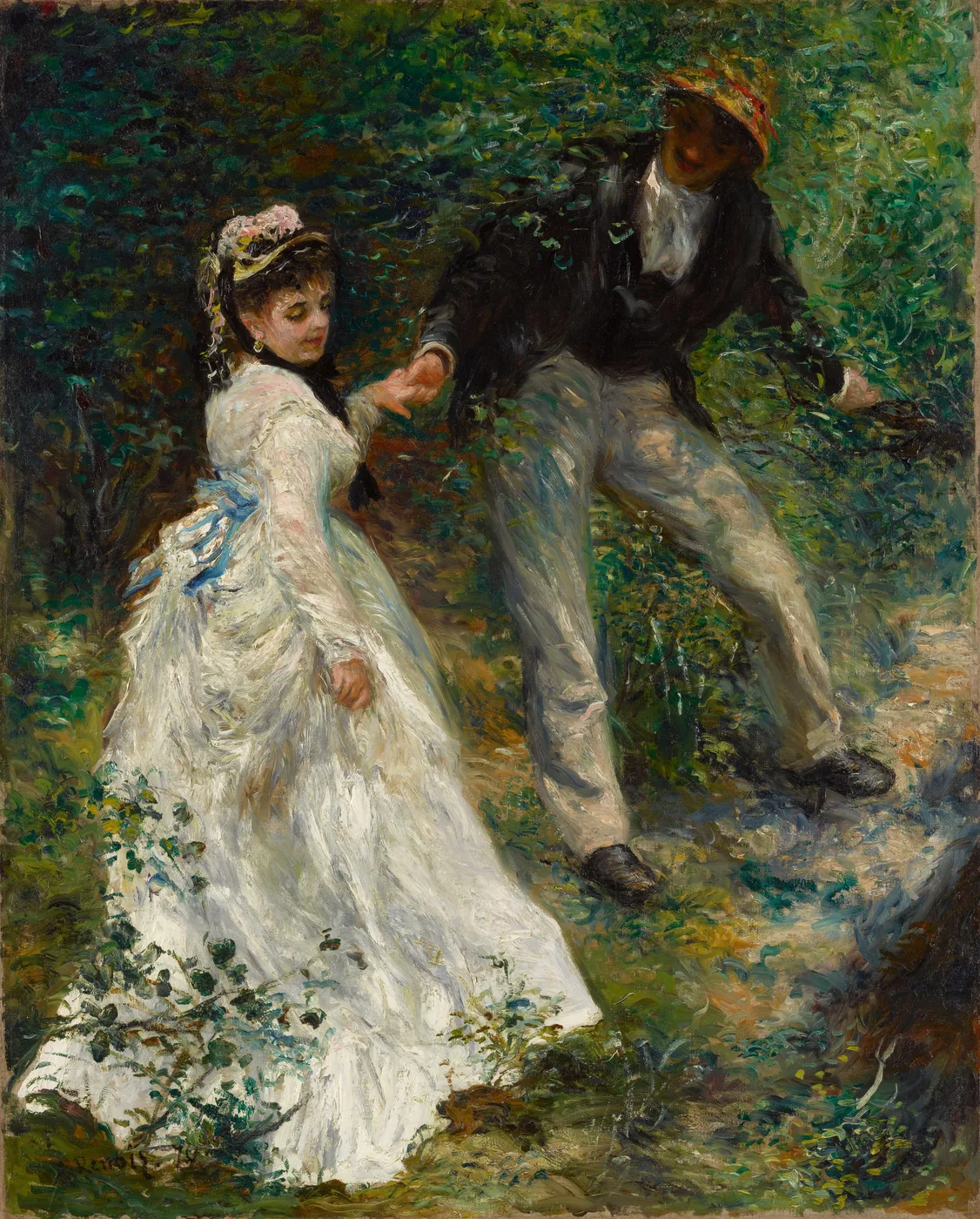
A Couple in the Woods, Painted in 1870
In 1870 Renoir was twenty-nine, still years away from wide recognition, and dividing his time between Paris and the countryside around Fontainebleau and Louveciennes, where several of his friends were also painting outdoor scenes of contemporary life. That same year France went to war with Prussia, an upheaval that would soon disrupt the lives of Renoir and his circle, but La Promenade belongs to the calmer months before the conflict took hold.
The painting shows a young man and woman walking together through dense woodland, a subject with no narrative title beyond its simple description, a promenade, an outing. It is one of several paintings from this period in which Renoir set a courting or intimate couple within thick summer foliage rather than a recognisable Parisian street or park.
Renoir was working at this point in close contact with Claude Monet and Alfred Sisley. Together they tested how much of a picture could be devoted to the play of light through leaves without losing the sense of a specific human moment happening beneath it.
A Guiding Hand and a Downcast Glance
The man, dressed in a dark suit, leans down toward his companion, one hand resting near her back or arm as they move along a narrow path. She wears a pale dress and looks downward, her expression difficult to read, somewhere between shyness and quiet absorption in what he is saying.
Their faces are close together but not directly presented to the viewer, so the picture reads less as a portrait of two named individuals than as a study of a private exchange glimpsed from a slight distance. Renoir gives few details that would identify who they are, letting the gesture between them carry the picture’s emotional content.
This kind of unnamed, intimate genre scene was common in Renoir’s work of the period, drawing on his circle of friends and models, including Lise Tréhot. It does not necessarily record a specific, identifiable pair.
Foliage as a Curtain of Light
The couple is almost enveloped by vegetation, with tall grasses, leaves, and dappled shadow filling most of the canvas around them. Sunlight breaks through unevenly overhead, scattering patches of bright green and gold across the woman’s dress and the ground at their feet.
Renoir handles this foliage with loose, energetic strokes that suggest depth and shifting light without describing individual leaves, a technique closer to shorthand than to botanical accuracy. The effect is of a living, changeable screen of light that partly conceals the couple even as it illuminates them.
Green dominates the palette, offset by the pale cream of the woman’s dress and the dark note of the man’s suit, with small flashes of warmer gold where the sun breaks through most directly. The overall effect is intimate and slightly secretive, as though the viewer has come upon the couple rather than been invited to observe them.
Renoir Between Realism and Something Softer
La Promenade sits at a point in Renoir’s development where the careful drawing of academic training was giving way to a freer, more atmospheric handling of paint, particularly in the treatment of landscape and light. The figures retain more definition than the surrounding foliage, a balance Renoir would continue to adjust throughout the following decade.
Compared with his more formal Salon submissions of the same years, this painting is smaller in ambition and more personal in feeling, closer to a private study of mood than to a picture designed to impress a jury. It belongs to a body of work in which Renoir explored courtship and tenderness as subjects in their own right, alongside his better-known scenes of dance and leisure from later in his career.
The painting also reflects the influence of plein-air practice on figure painting more broadly. Renoir and his friends increasingly treated outdoor light as a subject worth as much attention as the people standing within it.
La Promenade on a Wall
La Promenade is held today at the Getty Center in Los Angeles, part of a collection of European paintings the museum has built since opening in the 1990s. In the gallery, the density of the greenery and the closeness of the two figures give the canvas an intimacy that rewards standing near it rather than viewing it from across a room.
On a domestic wall, the picture’s heavy foliage responds strongly to changes in natural light. Bright daylight brings out the range of greens Renoir mixed for the leaves and grass, while dimmer evening light flattens them into a single dark mass, throwing more attention onto the pale dress and the gesture between the two figures.
Whatever the light, the picture keeps its quality of a moment overheard rather than posed, two figures caught mid-conversation in a wood that seems to close gently around them. That sense of privacy, more than any specific detail of who the couple were, is what gives La Promenade its lasting quiet charm.
Sizes and materials for La Promenade are listed on its product page.