Dance at Bougival
A Riverside Dance Hall Outside Paris
By 1883 Renoir was in his early forties and increasingly uneasy with the loose, broken brushwork that had defined Impressionism through the 1870s. He had recently travelled in Italy, studying Raphael and the wall paintings at Pompeii, and had come back questioning whether Impressionist technique could still deliver solid, well-drawn figures.
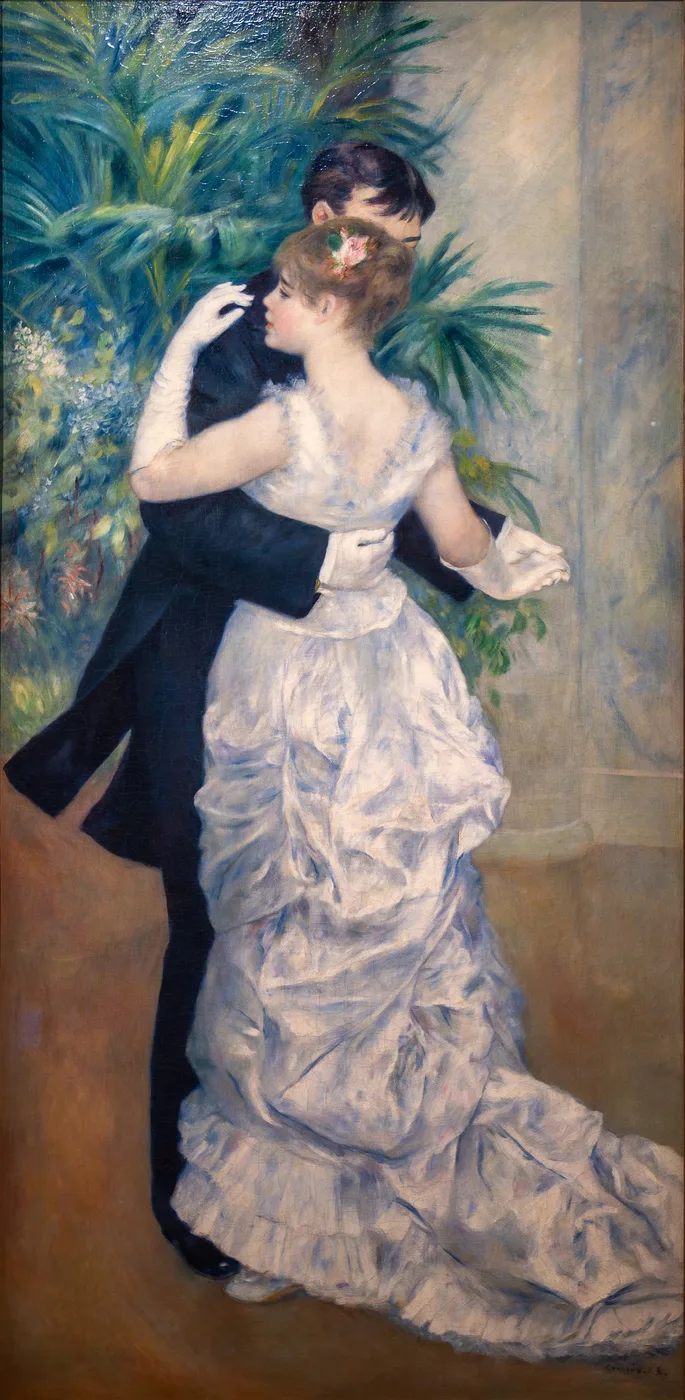
Dance at Bougival is one of three large dance paintings he completed that year, alongside Dance in the City and Dance in the Country. Each of the three tested a different social setting for the same subject.
Bougival was a village on the Seine west of Paris, popular with Parisians for boating, swimming, and outdoor dancing at riverside guinguettes, the informal open-air dance halls that had already appeared in earlier Impressionist paintings of the area. It was a place associated with leisure across the social classes, which suited Renoir’s interest in ordinary modern pleasure.
Painting a dancing couple let Renoir combine several things he cared about at once: the human figure in movement, contemporary dress, and a crowded, sociable setting. He rendered all of it at a scale closer to history painting than to a casual outdoor sketch.
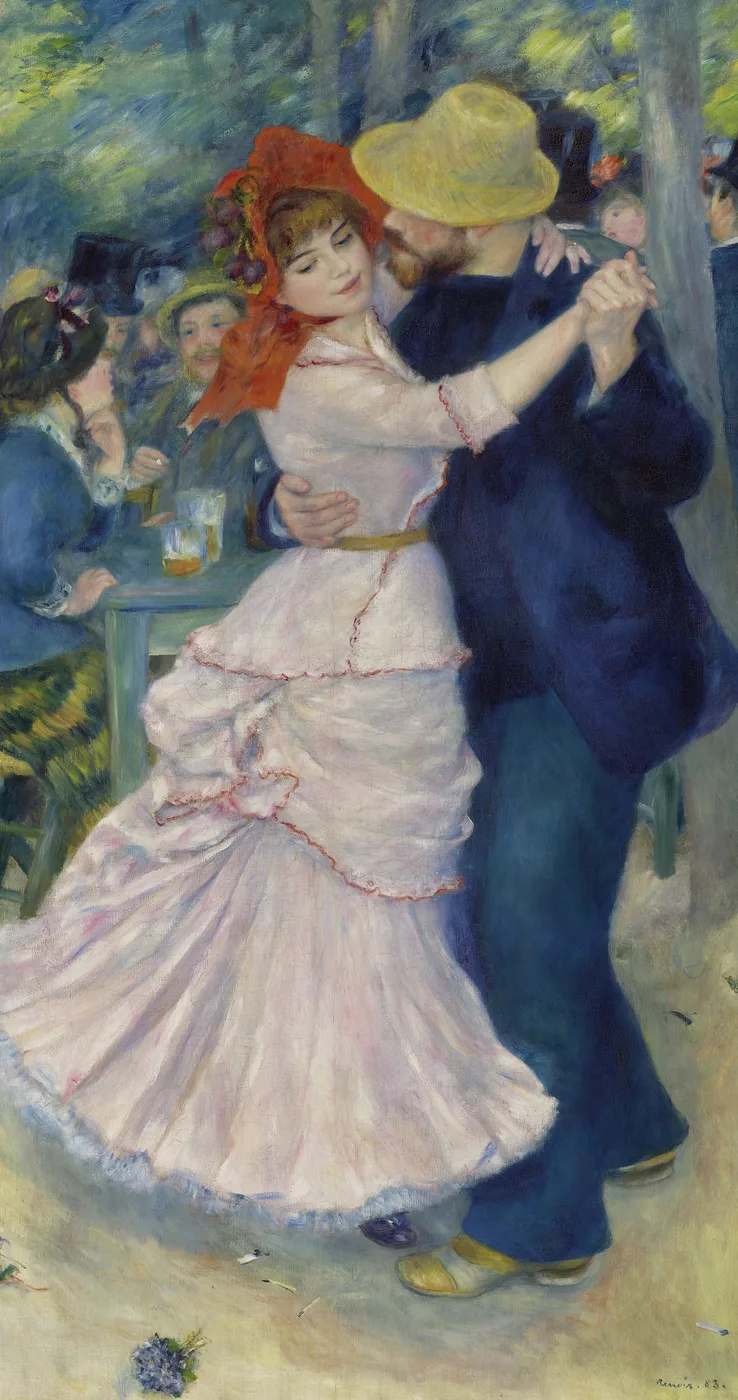
Suzanne Valadon and Paul Lhote in Motion
The woman in pink is generally identified as Suzanne Valadon, who worked as an artist’s model in Montmartre during these years before becoming a celebrated painter in her own right. The man, dressed in a blue coat and straw boater, is usually identified as Paul Lhote, a journalist and close friend of Renoir who appears in several of his paintings from the early 1880s.
Renoir poses the couple at the height of a turn, her face largely hidden beneath the brim of a red bonnet as she leans into the dance, his gaze fixed on her rather than on the viewer. The pairing of a half-hidden face with a fully engaged posture keeps the picture from reading as a formal double portrait, closer instead to a moment glimpsed in passing.
Behind them, other dancers and onlookers are suggested rather than individually described. This loosely brushed crowd establishes the noise and business of the dance hall without competing with the two principal figures.
Pink Silk Against a Blurred Crowd
The woman’s pink dress is the picture’s dominant note, a warm, saturated colour that Renoir sets against the cooler blues and greys of her partner’s suit and the muted background. Cut flowers and a discarded cigarette lie on the ground near her feet, small still-life details that ground the scene in a specific, observed place.
The two figures fill most of the canvas, cropped close enough that their bodies and clothing dominate the composition, while the background dance hall recedes into softer, less resolved paint. This closeness gives the picture an intimacy unusual for a subject that is, in essence, a public entertainment.
Renoir balances the pink dress against passages of yellow straw hat, blue coat, and the pale ground beneath the dancers’ feet, keeping the palette warm overall despite these cooler accents. Light falls fairly evenly across the couple, without the strong dappling seen in his outdoor paintings of the previous decade.
A Turn Toward Firmer Drawing
The drawing of the two figures is notably firmer than in Renoir’s Impressionist work of the 1870s, with clear contours defining the woman’s dress and the man’s jacket rather than dissolving them into broken touches of colour. This reflects the more linear, classicising approach Renoir was experimenting with after his Italian trip, sometimes called his Ingres period after the earlier French painter whose draughtsmanship he admired.
At the same time, the background retains a looser, more Impressionist handling, so the painting sits at a hinge point between two phases of Renoir’s career. The contrast between crisp foreground figures and a softly brushed crowd is deliberate, a way of keeping the picture’s central subject sharp while still suggesting a lively, moving environment around it.
This combination of careful drawing and atmospheric surroundings would carry through into much of Renoir’s later work. He moved away from the fully dissolved brushwork of pure Impressionism toward a sturdier treatment of the figure.
Dance at Bougival in a Room Today
Dance at Bougival has been in the collection of the Museum of Fine Arts, Boston since the early twentieth century, where it is regularly shown as one of the museum’s key Impressionist holdings. Standing in front of it, the canvas is large enough that the dancing couple appears close to life-size, an effect reproductions rarely convey.
Hung in a room at home, the picture’s warmth tends to dominate whatever light it receives, the pink dress holding its colour even in relatively dim conditions. Brighter daylight sharpens the contrast between the crisply drawn couple and the softer crowd behind them, making the surrounding activity of the dance hall more apparent.
What a viewer keeps returning to, whatever the light, is the tilt of the woman’s hidden face and the way her partner watches her rather than the room. That small, private exchange inside a public dance hall is the quiet centre of a painting otherwise full of colour and motion.
Sizes and materials for Dance at Bougival are listed on its product page.