The Great Bathers
A Deliberate Break from Impressionism
Renoir began work on The Great Bathers in 1884, at a point when he had grown openly dissatisfied with the loose, spontaneous brushwork that had defined his painting through the 1870s. He later described feeling that he had reached a dead end with Impressionist technique, and he spent much of the following years working through a more deliberate, carefully drawn approach in response.
For this painting, unlike his earlier outdoor scenes painted quickly in front of the subject, Renoir prepared extensively, making numerous drawn studies of the individual figures before committing to the final composition. The process took him several years to complete, a striking change of pace for an artist previously associated with rapid, direct execution.
He drew inspiration from French classical and Renaissance sources, including relief sculpture he had studied and admired, seeking a firmer, more sculptural sense of form than the atmospheric blur of his 1870s work had allowed. The result is often described as the clearest statement of what is sometimes called his Ingres period, named after the French painter whose crisp draughtsmanship Renoir was consciously studying.
The finished canvas is now held by the Philadelphia Museum of Art, where it is recognised as one of the pivotal works marking Renoir’s shift away from pure Impressionism toward a more classically grounded late style.
Three Bathers on a Riverbank
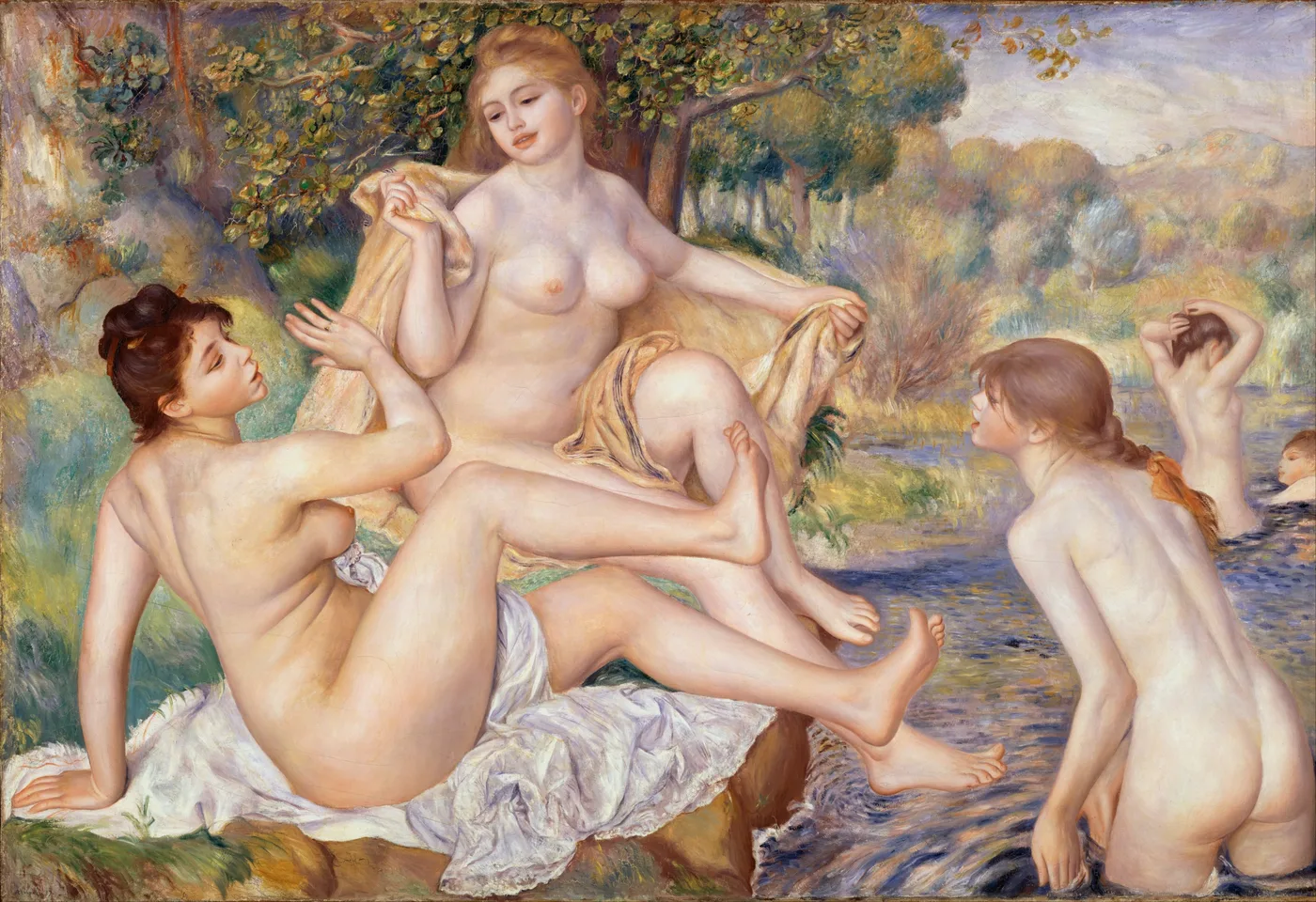
The composition centres on three nude women arranged beside a stretch of water, two seated close together in the foreground and a third standing slightly behind them, her weight shifted onto one leg in a pose derived from classical sculpture. Their forms are drawn with clear, continuous outlines rather than the broken, dissolving edges typical of Renoir’s earlier outdoor figures.
Behind the group, two more figures are visible bathing in the water, smaller in scale and less fully resolved, which helps establish depth without competing with the three principal figures for attention. The setting is a soft, pastoral riverbank with pale golden light and a suggestion of foliage, rendered more simply than the figures themselves.
Skin tones dominate the canvas, pale and smooth, modelled with careful gradations from light to shadow that give the bodies a rounded, almost sculptural solidity. This is a marked departure from the flickering, broken light of Renoir’s 1870s outdoor paintings, where figures often dissolved into the surrounding atmosphere.
The water beside the bathers is rendered in cooler blues and greens, providing a calm contrast to the warm flesh tones and helping to separate the figures clearly from their surroundings rather than letting them merge into it.
Line Restored, Colour Held Back
Renoir’s draughtsmanship here is far more pronounced than in his earlier work; the outlines of the figures are firm and continuous, closer to drawing than to the loose patches of colour he had favoured a decade earlier. This renewed emphasis on line was a deliberate correction, born from his sense that Impressionist technique alone could not achieve the solidity of form he wanted.
Colour is used more sparingly and more locally than in his 1870s work, applied within clearly defined boundaries rather than allowed to blur across them. The palette stays relatively cool and pale compared with the warmer, denser colour of his later work, giving The Great Bathers a slightly drier, more restrained surface.
Renoir worked and reworked the surface over an extended period, and some passages show a more laboured, built-up quality than the fluid, single-session handling typical of his earlier outdoor paintings. Contemporaries and later critics have noted this shift as evidence of how seriously Renoir treated the technical problem he had set himself.
A Painting That Argues With Itself
The Great Bathers occupies an unusual position in Renoir’s output because it represents a conscious argument against his own earlier achievements, an attempt to prove that careful drawing and classical structure could coexist with the sense of pleasure and warmth that had always defined his work. Not every critic at the time was convinced the experiment succeeded.
Displayed today, the painting’s pale, even colour and firm outlines mean it reads with reasonable consistency across different lighting conditions, unlike Renoir’s more atmospheric outdoor scenes, which shift considerably with the quality of light around them.
The calm, static poses of the three main figures give the composition a stillness closer to a frieze or relief than to a captured, spontaneous moment, which was precisely the effect Renoir was reaching for after years of working in the opposite direction.
Renoir would go on, after this painting, to soften his line again and return to warmer colour and looser brushwork through the 1890s and beyond, but he never entirely abandoned the greater solidity of form he had worked to achieve here. Seen at the Philadelphia Museum of Art, The Great Bathers stands as the clearest record of a deliberate, difficult turn in Renoir’s career.
Sizes and materials for The Great Bathers are listed on its product page.