Girls at the Piano
A Commission from the French State
By 1892 Renoir’s reputation had recovered from the harsh self-doubt of the mid-1880s, when he had grown dissatisfied with Impressionist technique and pushed himself through a more linear, tightly drawn style before easing back toward looser brushwork and warmer colour. That year the French state, through its fine arts administration, commissioned a painting from him intended for the Musée du Luxembourg, then the official gallery of living artists’ work in Paris.
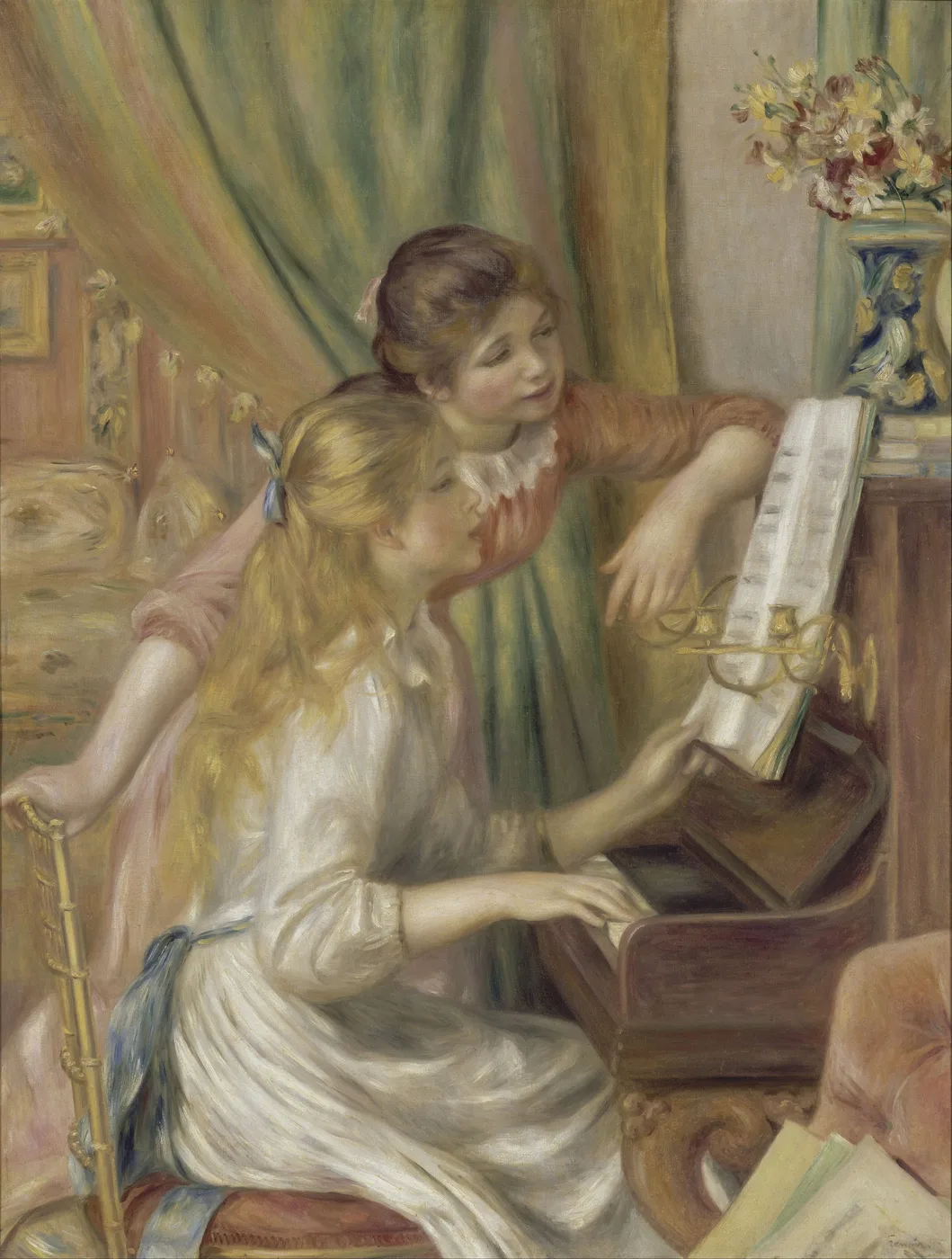
Renoir chose to paint two young girls at a piano, a subject with no political or historical weight, well suited to a decorative, domestic mood rather than any grand civic statement. He worked through the composition several times, producing a small group of closely related versions before settling on the one the state acquired.
The version now in the Musée d’Orsay is generally understood to be the final, most resolved treatment of the subject, the one formally accepted for the national collection. Its acceptance marked a significant moment of official recognition for an artist who, only a decade earlier, had still been treated with considerable suspicion by the Salon establishment.
The commission situates the painting differently from Renoir’s earlier outdoor Impressionist scenes; it was made for an interior, aimed at a domestic and institutional audience rather than painted in front of its subject in the open air.
Two Girls, One Instrument, Warm Light
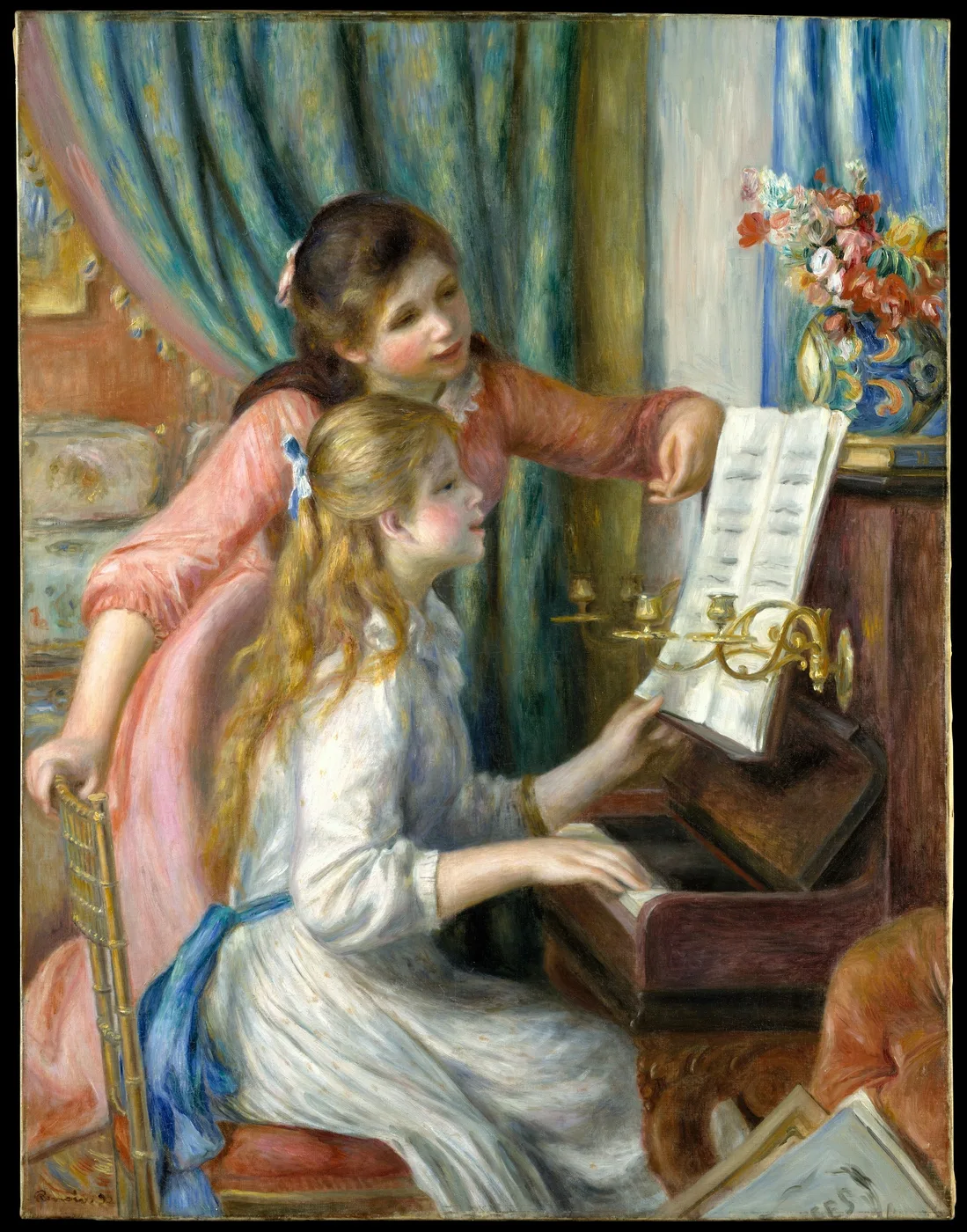
The composition is close and intimate, built around two girls seated and standing beside an upright piano in a softly furnished interior. One girl, seated, reads the sheet music and appears to be playing, while the other leans in beside her, one arm resting near the keyboard, watching or waiting to turn the page.
Both girls wear pale dresses that catch the room’s warm, even light, their hair loosely tied, their faces rendered with the soft, rounded modelling that had become characteristic of Renoir’s work by this date. There is no harsh source of light or deep shadow in the room; instead the illumination is diffuse and gentle, wrapping around the figures rather than cutting across them.
The piano itself, along with a patterned curtain or wallpaper visible behind the girls, is rendered in warm golds and soft greens that frame the pale figures without competing for attention. Sheet music on the stand is suggested rather than drawn in precise detail, enough to establish the activity without turning the picture into an illustration of a specific piece.
Renoir keeps the background shallow and decorative, closer to a patterned backdrop than a deep, fully realised room, which pushes the two girls forward as the clear focus of the composition.
A Softer, Rounder Style Than the 1870s
The brushwork here is noticeably smoother and more blended than in Renoir’s outdoor paintings of the 1870s, with fewer visible individual strokes and a more even, glazed finish across skin and fabric. This change reflects the calmer, more classically influenced direction his painting had taken since his uncertainty of the mid-1880s.
Colour remains warm throughout, built from creams, soft pinks and golden yellows, with cooler greens reserved for the background pattern rather than for the figures themselves. The overall effect is gentler and more enclosed than the sunlit, outdoor scenes for which Renoir is often best known.
Renoir painted several versions of this same subject in fairly close succession, a working method that let him refine the pose, the light and the balance between the two girls across multiple attempts rather than settling everything within a single canvas.
A Domestic Scene Made for Indoor Light
Because it was conceived from the outset as an interior subject rather than an outdoor study of sunlight, Girls at the Piano suits indoor display in a way that some of Renoir’s garden scenes do not; its warm, even tones do not depend on strong daylight to read correctly.
In softer lamplight, the golds and creams in the picture tend to deepen and draw closer together, while brighter daylight sharpens the contrast between the pale dresses and the warmer background pattern behind them.
The quiet, everyday activity at the centre of the picture, two girls occupied with music in a comfortable room, gives it a settled, unhurried mood distinct from the more social, crowded scenes Renoir painted in the previous decade.
Its acceptance into the national collection in 1892 also marked a turning point in how official Paris regarded Renoir, no longer an outsider to be dismissed but an artist whose warmer, more classically grounded later style could sit comfortably within a state museum. Today, seen in the Musée d’Orsay, the painting shows how far his technique had travelled in less than twenty years.
Sizes and materials for Girls at the Piano are listed on its product page.