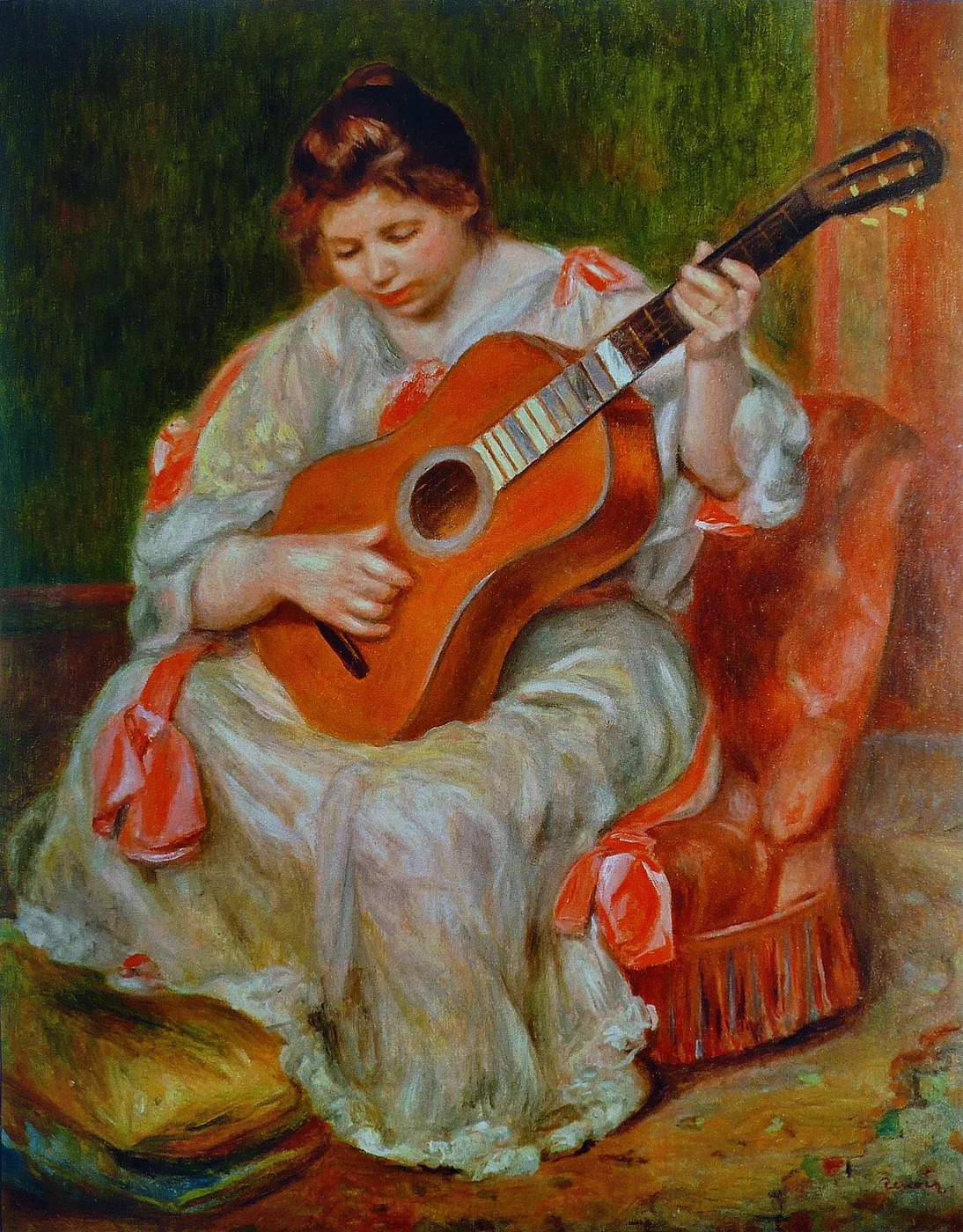
Woman Playing a Guitar
A Fall From a Bicycle, and a Summer at Essoyes
In the summer of 1897 Renoir came off his bicycle near his house in Essoyes, the small village in Champagne where his wife Aline’s family came from, and broke his right arm. He was fifty-six, already troubled by the first signs of the rheumatism that would eventually cripple his hands, and the accident kept him from painting for weeks. When he could hold a brush again he turned, as he so often did in these years, to a single female model seated indoors, absorbed in some small domestic occupation.
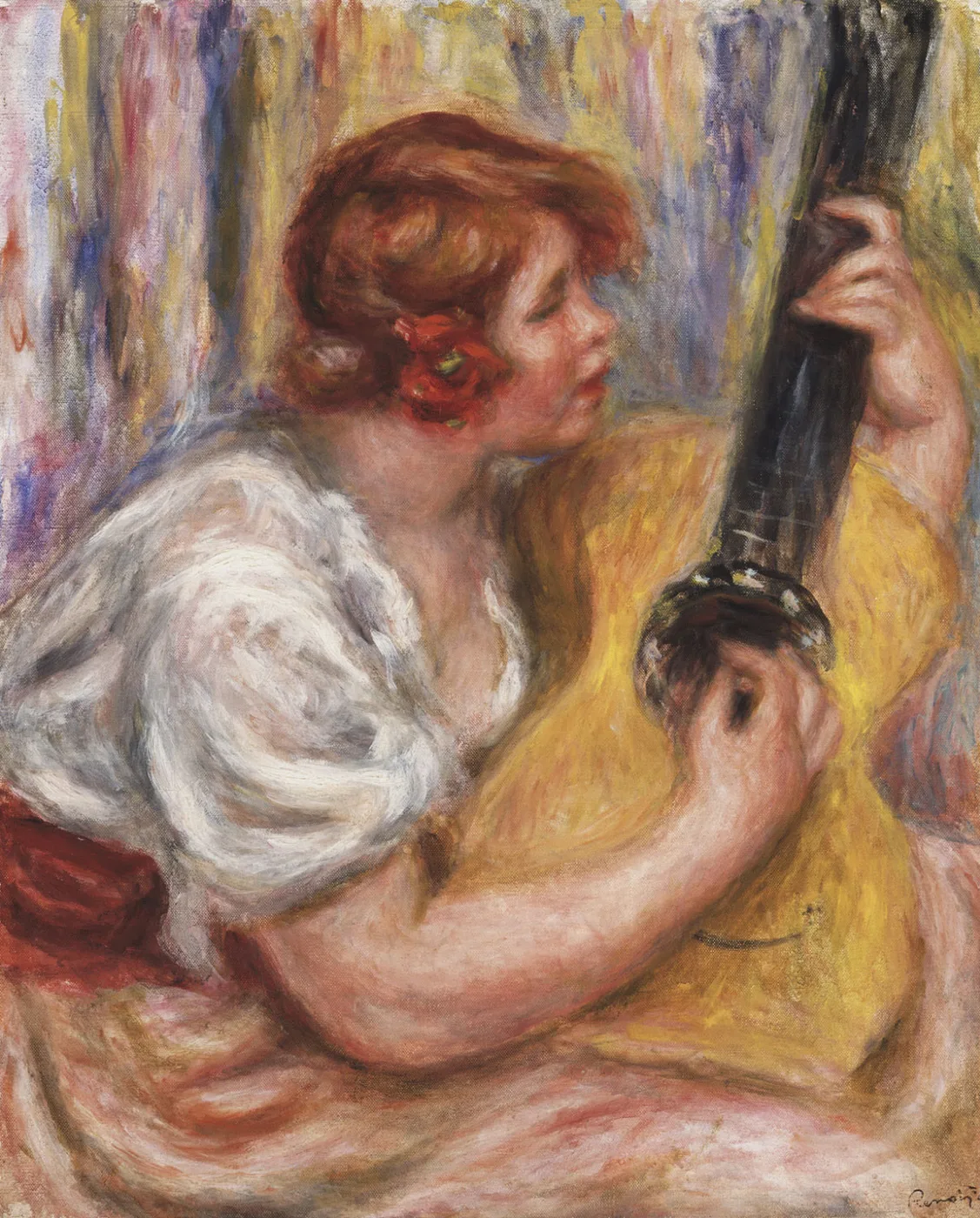
Woman Playing a Guitar belongs to that stretch of the 1890s. Renoir had by then left behind the tight, linear manner of his so-called Ingres period of the mid-1880s and settled into a fuller, softer way of painting flesh and fabric that some writers call his pearly period. The picture shows none of the anxiety of that recovery; it is an image of quiet, private pleasure.
There is no audience in the picture, no stage, no listener. The guitar is played for its own sake, in a room lit by an unseen window, and the painting asks the viewer to share that solitude rather than to watch a performance.
A Song Without an Audience
The woman sits with the instrument held close against her body, her head inclined toward the strings in the attitude of someone listening as much as playing. Renoir gives her rounded shoulders, a full neck, and the soft, unfocused features that mark almost every female face he painted after 1890; individual likeness interested him less than the general rhythm of a body absorbed in an action.
Her dress is loose and pale, catching warm light along the folds where the arm draws back to reach the strings. The guitar itself, a dark curved shape against the lighter cloth, anchors the lower half of the composition and gives the eye somewhere firm to rest before it travels up to the face.
Renoir has kept the background deliberately vague, a warm, indistinct haze of ochre and rose that could be a curtain, a wall, or simply air. Nothing in the room competes with the single figure; the whole canvas is built around the closed, private loop of hands, instrument and downturned eyes.
Rose, Ivory and the Late Renoir Touch
By the 1890s Renoir was painting with a palette that had grown warmer and narrower than in his high Impressionist years of the 1870s. Reds, pinks and creamy whites dominate Woman Playing a Guitar, applied in short, loaded strokes that build up the flesh of the hands and face in layers rather than in a single pass.
The brushwork is soft at the edges, almost powdery, so that the contour between skin and dress, or between hair and background, is never a hard line but a zone of blended colour. The result is a surface where flesh looks less drawn than modelled, closer to warm, rose-tinted stone than to a sharply outlined figure.
Renoir was working, by his own account, toward a kind of painting that felt less analytical than his Impressionist canvases of the 1870s and more instinctive, closer to the fresco painters he had admired since his trip to Italy. Woman Playing a Guitar carries that ambition in its glowing, unbroken surface.
From a Private Collection to the Museum of Fine Arts of Lyon
The painting is now held by the Museum of Fine Arts of Lyon, one of the largest and oldest museums in France outside Paris, which has built a strong holding of nineteenth-century French painting alongside its older collections. It sits there among other works from Renoir’s late maturity, a period the museum has represented with some care.
Seen in Lyon, the picture reads less as a portrait of an identifiable sitter than as a study of concentration itself, the particular stillness of a person who has forgotten she is being watched.
Living With a Quiet Room
A painting this warm changes considerably with the light of the room it hangs in. In direct daylight the pinks and creams can look almost too sweet, verging on decoration; in the low light of evening the same colours deepen and the figure seems to withdraw further into her own private music.
There is little incident to tire of. The composition offers one figure, one gesture, one soft light source, and repeated viewing tends to draw attention not to new details but to the handling itself, the way a sleeve is built from a dozen overlapping strokes rather than one continuous line.
What stays with a viewer, over time, is less the guitar than the angle of the head, tipped down and slightly to one side, the posture of someone listening closely to something only she can hear.
In that sense Woman Playing a Guitar asks very little of the room around it. It does not demand a grand wall or dramatic lighting; it rewards instead the ordinary changes of an ordinary day, morning light and evening lamp alike drawing something different from the same warm, unhurried surface.
Sizes and materials for Woman Playing a Guitar are listed on its product page.