
Mother Anthony’s Tavern
An Inn at Marlotte, and the Painters Who Gathered There
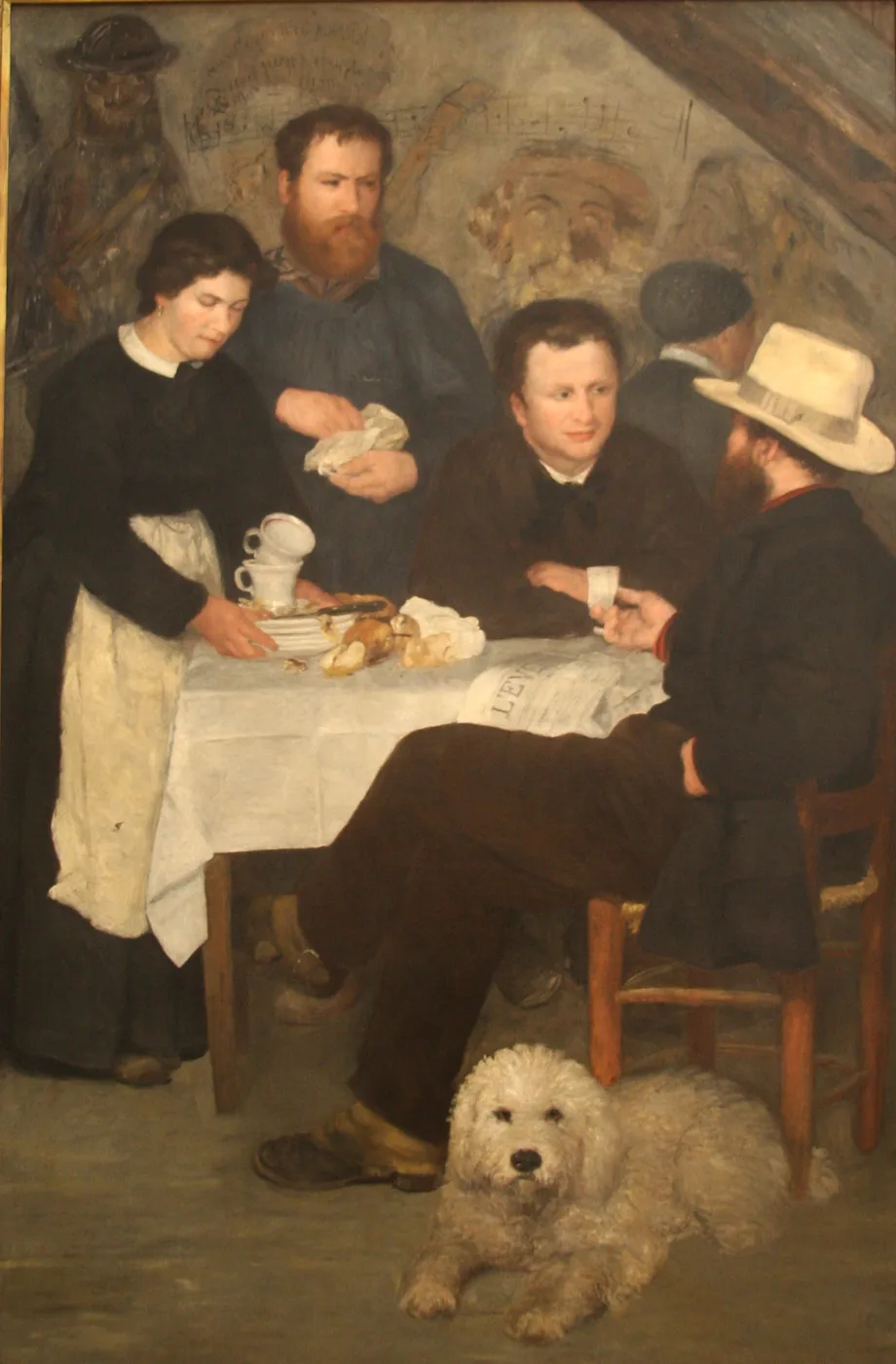
In the mid-1860s, Renoir often left Paris for the village of Marlotte, on the edge of the Forest of Fontainebleau, where a modest inn run by a woman known as Mother Anthony had become an informal meeting place for a group of young, largely unrecognised painters. Mother Anthony’s Tavern, painted in 1866, records that world directly, showing the inn’s cramped dining room crowded with figures.
The Forest of Fontainebleau had long drawn painters out of the city, offering woodland and rural motifs quite different from anything Paris could provide. For Renoir and his friends, the inn itself became almost as important as the surrounding landscape, a place to eat, argue about painting, and sit for one another.
Among the figures gathered at the table is the painter Alfred Sisley, a close friend from these formative years with whom Renoir shared both artistic ambitions and long stretches of the Fontainebleau countryside.
Reading the Room: A Waitress and a Watchful Dog
In the foreground, a young woman, generally identified as the innkeeper’s daughter and known familiarly as Nana, stands reading a newspaper, her figure catching the light more directly than the seated men behind her.
A dog sits beneath the table, adding a further note of everyday, unposed life to the scene. Its presence, along with the scattered plates, bottles and glasses on the table, roots the painting firmly in the texture of ordinary inn life rather than any idealised gathering.
The composition is dense and slightly awkward, packed with figures and objects in a way that shows Renoir still working out how to organise a complex group scene. That crowding, however, gives the picture much of its documentary charge, the sense of a real room actually occupied by real people.
Debts to Courbet and Manet
The dark, earthy palette and the direct, unglamorised treatment of ordinary people at table owe an evident debt to Gustave Courbet’s realism, which had already shown a generation of younger painters that everyday subjects deserved serious treatment.
Édouard Manet’s influence is also present in the confident, somewhat flattened handling of individual figures, and in the willingness to let contemporary dress and setting stand in for any more elevated subject matter.
Renoir was, at this stage, still several years from the loose, light-filled brushwork of his mature Impressionist paintings. The paint here is applied more heavily, the tonal contrasts stronger, closer in spirit to the Salon realism of the early 1860s than to the broken colour he would develop later.
Even so, the informality of the scene, a group of friends caught mid-conversation rather than formally posed, points toward the kind of unguarded, contemporary subject matter that would become central to Impressionist painting within a few years.
A Dark, Crowded Canvas in Stockholm
Mother Anthony’s Tavern is now held at the Nationalmuseum in Stockholm, Sweden, where it stands as an important early document of Renoir’s development and of the social world of young French painters in the years before Impressionism had a name.
At the Nationalmuseum, the painting sits among the museum’s broader holdings of European painting, offering Swedish and international visitors a rare chance to see Renoir working in this darker, more crowded register before his style lightened considerably.
For a viewer used to Renoir’s later gardens and portraits, this canvas can come as something of a surprise. The mood is convivial rather than lyrical, the lighting dim rather than bright, the brushwork dense rather than airy.
Living with an image of this painting means living with its bustle. It is not a quiet or restful picture; it is full of incident, glasses and plates crowding the table, figures turned at different angles, attention scattered across several points at once.
In dimmer light, the dark background recedes further, throwing the pale figure of the reading waitress into sharper relief. In brighter light, more of the individual faces around the table become legible, and the picture starts to read less as a single mood and more as a group portrait of specific, named people.
That tension between anecdote and portraiture is part of what makes the painting rewarding to return to. It is as much a record of friendship and a particular place as it is a formal exercise in composition, painted by a young artist still several years from the recognition he would eventually find.
Sizes and materials for Mother Anthony’s Tavern are listed on its product page.