Mlle Irene Cahen d’Anvers
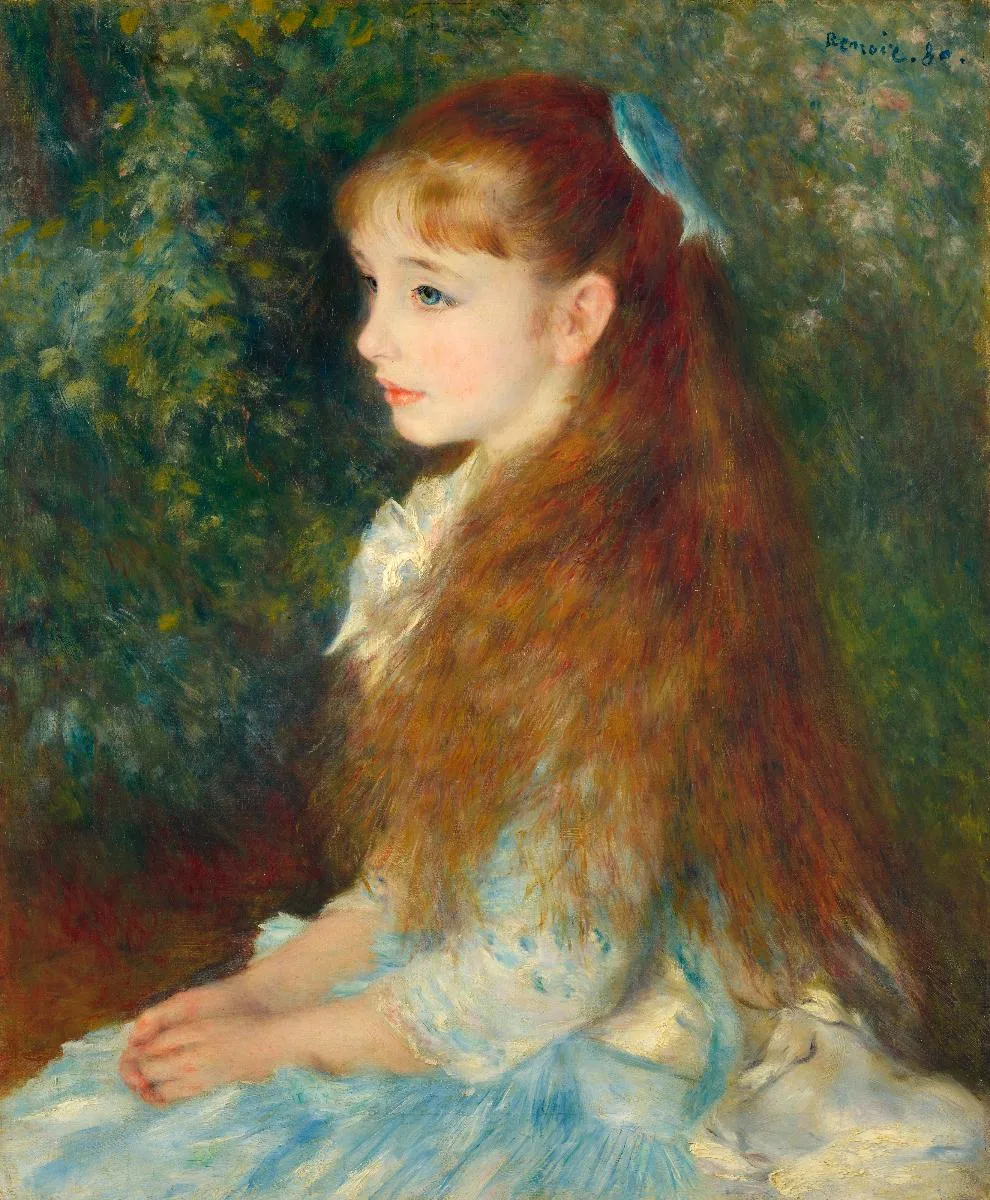
A Commission From the Cahen d’Anvers Family
By 1880 Renoir had spent more than a decade painting alongside Monet and the other Impressionists, exhibiting in their group shows while still struggling to make a stable living from his art. Portrait commissions from wealthy Parisian families offered a more reliable income than landscapes or scenes of modern leisure, and Renoir increasingly relied on them through the late 1870s and into the 1880s.
One such commission came from Louise Cahen d’Anvers, wife of the banker Louis Cahen d’Anvers, who asked Renoir to paint her young daughter Irène. The Cahen d’Anvers family belonged to a circle of wealthy patrons, several connected to banking, who supported Impressionist painters during years when official recognition was still slow to arrive.
Irène was about eight years old when Renoir painted her. The resulting picture, often called La Petite Irène, became one of his most admired portraits of a child, prized for its combination of formal poise and genuine warmth.
Red-Gold Hair Against Blue Silk
Renoir shows Irène seated, turned slightly toward the viewer, with a great fall of red-gold hair spread loosely over her shoulders and down her back. The hair is the picture’s most striking feature, painted in warm strokes of copper, auburn, and gold that catch the light far more vividly than anything else in the composition.
She wears a blue dress with a wide sash, its cool tone set deliberately against the warmth of her hair and the soft pink of her skin. Renoir keeps the background plain and muted, a blurred field of grey-green, so that nothing distracts from the contrast between the blue fabric and the glowing hair above it.
Her hands rest quietly in her lap, and her expression is calm and slightly reserved, neither smiling broadly nor looking away. That restraint gives the portrait a dignity beyond her years without making her look artificially adult.
A Child’s Portrait, Painted Like a Grown Sitter
Renoir painted Irène with the same careful attention to surface and light that he brought to his adult sitters, avoiding the sentimentalised sweetness common in much nineteenth-century child portraiture. Her face is modelled with soft, warm brushwork, the skin given a gentle glow rather than a porcelain smoothness.
This seriousness of treatment is part of what distinguishes the painting from a merely decorative likeness. Renoir treats the sitter’s presence, her posture, and the fall of her hair as worthy of the same close observation he applied to landscapes and adult portraits, rather than simplifying the picture for a young subject.
The result is a portrait that works equally well as a study of colour and light and as a record of a specific child at a specific age. That double appeal is part of why it has remained one of Renoir’s most reproduced portraits of the period.
Renoir the Portraitist in 1880
Commissions like this one placed Renoir in an unusual position among his Impressionist colleagues, several of whom struggled to find portrait work from wealthy Parisian society. His gift for flattering yet convincing likeness, combined with his warm, appealing colour, made him more employable in this genre than colleagues who worked mainly in landscape.
These portrait commissions did not stop Renoir from exhibiting more experimental work; the early 1880s were also the years of his large dance paintings and his growing interest in firmer, more classical drawing. Portraits of children like Irène sit alongside those more ambitious canvases as evidence of how varied his output was during this decade.
The financial security that portraits like this provided allowed Renoir to travel. His most notable journey was to Italy in 1881, a trip that would change his approach to drawing and composition in the years that followed.
La Petite Irène at Home
The portrait of Irène Cahen d’Anvers is part of the Foundation E.G. Bührle collection, assembled by the Zurich industrialist Emil Bührle in the twentieth century and now counted among the notable holdings of Impressionist portraiture outside France. It remains one of the paintings most associated with that collection.
On a wall in an ordinary room, the picture’s warmth comes almost entirely from the hair, which seems to hold its own light regardless of the room’s actual illumination. Softer evening light tends to make the blue dress recede further, leaving the coppery hair and pale skin as the picture’s clear focus.
In brighter conditions, the contrast between the cool dress and warm hair becomes more pronounced, and the plain background asserts itself as a deliberate, calming frame around the child. Either way, it is Irène’s quiet, steady gaze that anchors the painting, however the light around it shifts.
Sizes and materials for Mlle Irene Cahen d’Anvers are listed on its product page.