Lunch at the Restaurant Fournaise
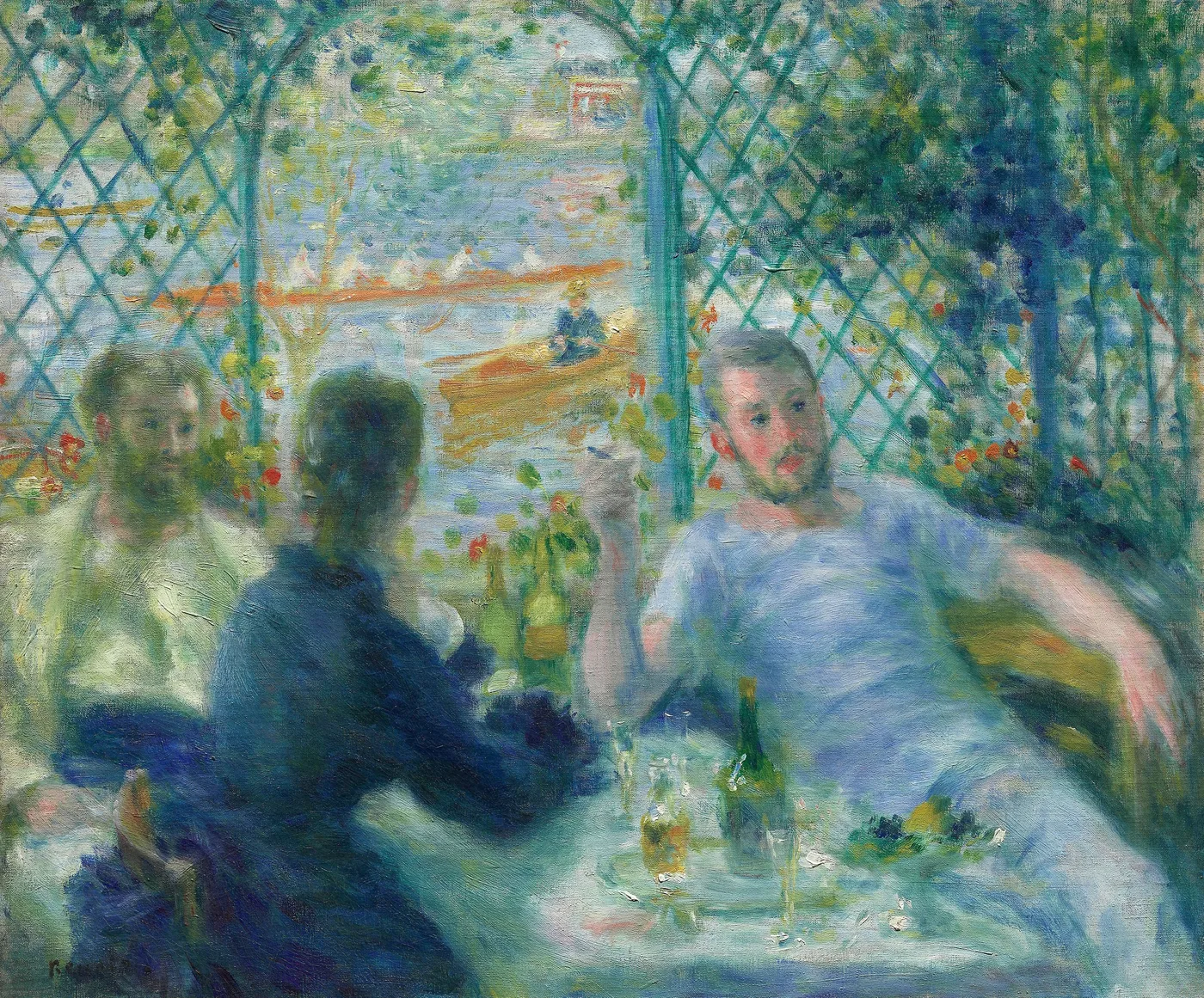
In the mid-1870s Renoir spent long stretches of the warmer months at Chatou, a small town on the Seine a short train ride west of Paris, where the Fournaise family ran a restaurant and boat-hire business on an island in the river. The terrace, shaded by an awning and overlooking the water, drew rowers, Sunday trippers and a handful of painters who had begun exhibiting together as the group later called the Impressionists.
Renoir was not yet thirty-five and still largely unrecognised outside a small circle of friends and dealers. He had shown at the first Impressionist exhibition in 1874 to mixed and often hostile reviews, and paintings like this one, made on the terrace at Chatou, were part of his continuing effort to find subjects that combined modern Parisian leisure with the loose, light-filled handling he and his colleagues were developing.
A Terrace on the Seine at Chatou
The painting places the viewer at a table on the restaurant terrace, close enough to the figures seated there to feel part of the gathering. A young woman, fashionably dressed, sits with a companion; the white cloth on the table, glasses and a bottle catch the light in quick, confident strokes. Beyond the railing the Seine opens out, dotted with a rowing boat and touched with reflected sky.
Sunlight falls across the scene unevenly, filtered through the awning and surrounding trees, so that patches of bright colour sit next to passages of cooler shadow on the tablecloth and on the sitters’ clothing. This dappled, broken light is one of the hallmarks of Renoir’s work from these years, built up with short, visible brushstrokes rather than smooth, blended colour.
The Restaurant that Shaped an Impressionist Circle
The Fournaise establishment became one of the informal meeting points of Impressionist painting in the 1870s and early 1880s. Renoir returned to it repeatedly, and its terrace and boats appear across several of his canvases from the period, culminating a few years later in his much larger Luncheon of the Boating Party, which shows a fuller gathering of friends at the same location.
This earlier lunch scene is smaller and quieter, closer to a single observed moment than to the ensemble portrait he would attempt later. It belongs to a period when Renoir was testing how far he could push everyday, unposed-looking subjects, people eating, drinking and talking outdoors, as material for serious painting.
Light, Linen and a Half-Finished Meal
What the eye meets first is the brightness of the white tablecloth, broken into flickers of blue, violet and yellow shadow rather than painted as flat white. Renoir uses this passage to demonstrate, in miniature, the whole Impressionist argument that local colour is constantly modified by the light falling on it.
The figures themselves are handled with less finish than the tablecloth and the play of light around it. Faces are suggested rather than sharply drawn, hands loosely blocked in, so that the overall impression is of a fleeting glimpse rather than a formal portrait sitting.
Behind the table, the river and its far bank are painted with even freer strokes, greens and blues laid side by side without much blending. This recession from tight foreground detail to loose background handling gives the picture a sense of depth without relying on traditional perspective drawing.
A Rehearsal for a Larger Canvas
Seen alongside Renoir’s later Chatou paintings, this lunch scene reads almost as a rehearsal, a first attempt at a setting and a mood he would revisit with greater ambition. It lacks the crowd and the narrative incident of the later boating party picture, offering instead a single, contained exchange between two people at a table.
That restraint is part of its appeal. There is no anecdote being told, no clear relationship spelled out between the figures, only the fact of a meal shared outdoors on a bright afternoon, which was itself a fairly new subject for serious painting in France at the time.
The painting is now held at the Art Institute of Chicago, part of a collection that includes several other major Impressionist works and allows this Chatou lunch to be seen alongside paintings by Monet, Degas and Caillebotte, artists Renoir knew personally and exhibited with during these same years. Seeing the picture in that context underlines how central this stretch of the Seine became to Impressionist painting through the 1870s and beyond.
An Afternoon That Keeps Returning
On a wall, the painting carries the temperature of a particular kind of summer afternoon, warm without being harsh, the light softened by the awning overhead. Its palette of whites, greens and warm skin tones shifts gently with the light in the room across a day.
Looked at closely, the loose brushwork resolves into something quite specific: a bottle, a glass, the fall of a sleeve. Looked at from across a room, those same marks blur back into the general shimmer of a riverside lunch, which is precisely the effect Renoir was chasing on the Fournaise terrace in 1875.
Sizes and materials for Lunch at the Restaurant Fournaise are listed on its product page.