La Loge
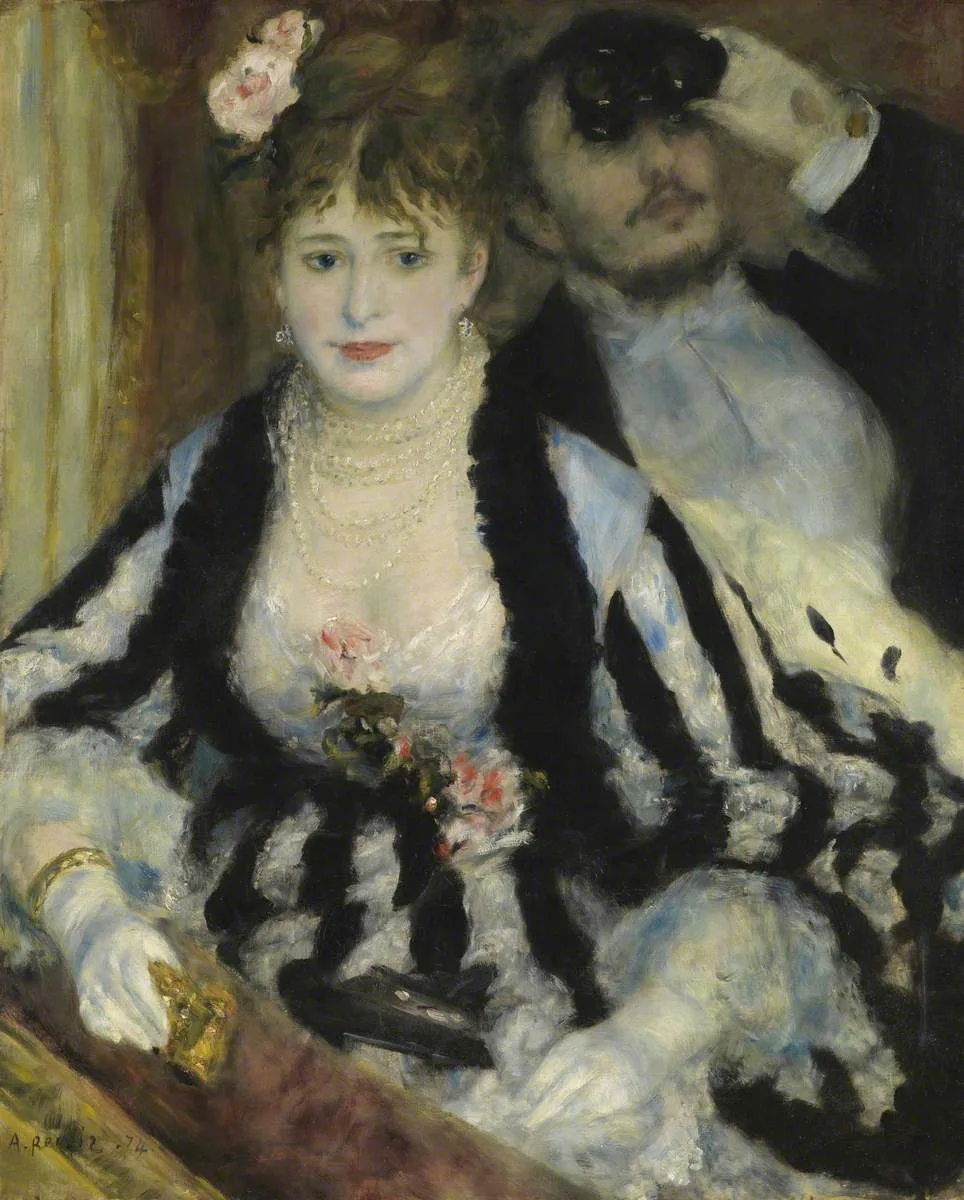
Nini Lopez Takes a Seat in a Rented Box
In the early months of 1874, Renoir was thirty-two years old and working in Paris among a loose band of painters whom the official Salon jury had repeatedly turned away. That spring they resolved to show their own work independently, in a former photographic studio on the Boulevard des Capucines, and Renoir needed something ambitious to send.
He hired a young professional model from Montmartre named Nini Lopez and dressed her in a striped satin gown that, by most accounts, was borrowed rather than her own. Beside her, playing the part of her escort, he placed his younger brother Edmond Renoir, a journalist willing to sit for the price of a favour.
The result, La Loge, shows the pair crowded into the narrow front of a theatre box, the kind of seat fashionable Parisians used as much to display themselves as to watch the performance. It was one of the pictures Renoir sent to that first independent exhibition in April 1874, the show that eventually gave the Impressionists their name.
Most critics who saw the exhibition that spring mocked the group’s loose, sketch-like brushwork, treating it as evidence the painters had simply failed to finish their canvases. La Loge, with its confident handling of satin and pearls, drew more careful attention than many pictures in the same rooms.
Nobody at the time could have guessed how enduring this single picture of Nini Lopez would become. She modelled for Renoir on other occasions, though this is the picture of her that has travelled furthest and hung in the most public collections.
A Dress of Black and White Stripes
The woman fills most of the canvas, seated close to the picture plane so that almost nothing of the box itself is visible beyond a strip of red velvet at the lower edge. Her gown is built from broad bands of black and white satin, painted with loose, confident strokes that catch the light differently along each fold.
A pink rose sits in her dark hair, and a second pink flower is pinned near the neckline of her dress, the only warm colour set against all that black, white and pale skin. A string of pearls circles her wrist, and a heavier pearl choker sits at her throat.
In one gloved hand she holds a closed fan; in the other, resting in her lap, a pair of opera glasses she is not using. Her gaze turns outward, past the viewer, somewhere into the auditorium, an expression that is composed, faintly distant, and gives away very little.
Renoir handled her face and shoulders with smoother, more finished brushwork than the loose flicks of paint that describe the stripes of her dress, so the eye settles first on her calm expression before it registers the dazzle of black and white below it.
A Joke About Who Is Really Being Watched
Behind her, Edmond Renoir leans back and raises his own opera glasses, not towards the stage but up and to one side, evidently more interested in someone in another box than in whatever is being performed. His pose is a small piece of social comedy.
Theatre boxes in Paris were understood as places to see and be seen, and this picture plays on that double meaning with some wit. The woman holds glasses she does not raise; the man raises glasses aimed elsewhere; and it is the woman, sitting still and looking at nothing in particular, who becomes the true spectacle of the picture.
Renoir gives no indication of what is happening on stage, no glimpse of footlights or curtain. The theatre exists only through this one box and its two occupants, which keeps the picture focused entirely on the ritual of fashionable looking rather than on any performance.
That narrow focus was itself a departure from more conventional theatre pictures of the period, which often tried to show the stage, the chandelier and the whole architecture of the house. Renoir instead trusted two figures and a few props to carry the entire idea.
A Small Canvas That Rewards Standing Close
La Loge now hangs in the Courtauld Gallery in London, part of the collection assembled by the industrialist Samuel Courtauld in the early twentieth century. It is not a large painting, and in the gallery it draws viewers in close, the way the sitter’s own steady gaze seems to invite.
Seen at short range, the stripes of the dress separate into individual strokes of black, white, grey and the faintest blue, a reminder that Renoir was already thinking about paint as much as about likeness. Step back and the strokes resolve into shimmering satin again.
Living with a picture like this on a wall means noticing how much changes with distance and light. Under lamplight in the evening the pearls and the pink rose catch a soft glow; in daylight the black-and-white stripes take on a cooler, almost photographic clarity.
What does not change is the sitter’s expression, calm and slightly withheld, which meets the viewer’s eye at every hour without ever quite explaining itself. That steadiness is a large part of why the picture still holds attention after a century and a half.
Sizes and materials for La Loge (The Theatre Box) are listed on its product page.