Judgement of Paris
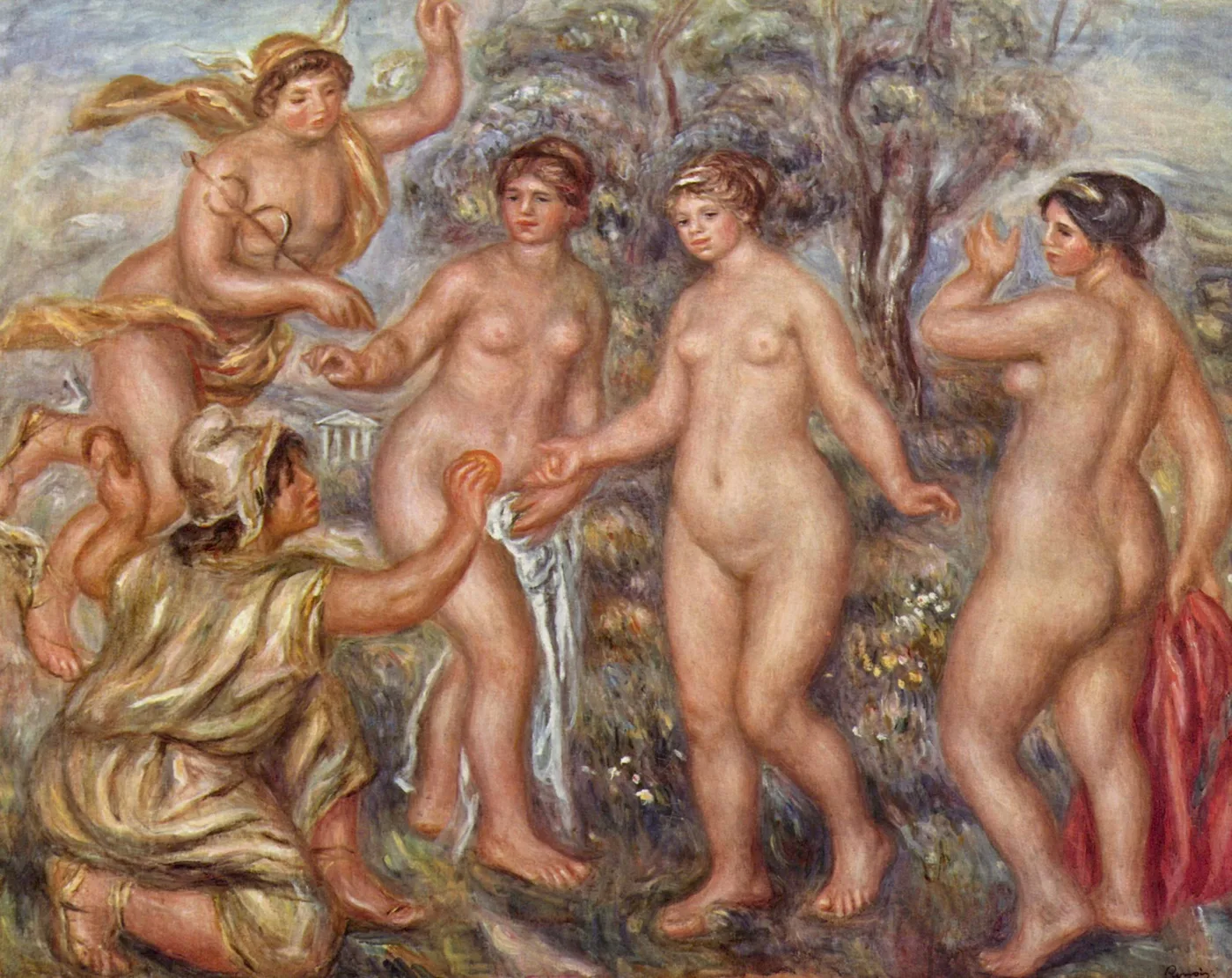
By 1913 Pierre-Auguste Renoir was working from a wheelchair at Les Collettes, his farmhouse above Cagnes-sur-Mer, his hands so deformed by rheumatoid arthritis that he could no longer grip a brush in the ordinary way. He was in his early seventies, and he increasingly turned to subjects he had loved since his youth: mythology, the female nude, and the old masters he had studied in the Louvre as a student.
The Judgement of Paris was one of the stories he returned to more than once in this late period. It tells of the Trojan prince Paris, asked by the gods to decide which of three goddesses, Juno, Minerva and Venus, was the most beautiful, and to award her a golden apple. His choice of Venus, who bribed him with the promise of the world’s most beautiful woman, set the Trojan War in motion.
A Trojan Myth Revisited at Les Collettes
Renoir was not interested in narrating the myth’s consequences. He wanted the excuse it gave him to paint several nude women in one composition, arranged around a seated male figure, in a landscape flooded with warm light. The story is present but almost incidental, a scaffold for a study of flesh, pose and colour.
The golden apple at the centre of the story, inscribed for the fairest, had been thrown among the gods by Eris, goddess of discord, at a wedding to which she had not been invited. Renoir rarely dwelt on this detail; his interest lay in the aftermath, the moment of comparison between three bodies, rather than in the mechanics of the myth.
Paris sits at one side of the canvas, shown as tradition demands as a shepherd, while the three goddesses turn and twist around him in various states of undress. The background dissolves into loose strokes of foliage and sky rather than any specific setting.
Painting Against a Failing Body
What makes this canvas remarkable is not only what it shows but how it was made. Renoir could no longer hold a brush in the ordinary way, could no longer walk to his easel without help, yet the paintings from these years show no loss of ambition. If anything the figures grow larger, the colour bolder, the brushwork looser and more confident.
Accounts from those close to him in this period describe a man who painted for hours despite obvious pain, propped in his chair, his crippled hands wrapped around brushes that assistants positioned for him. The Judgement of Paris belongs to this daily discipline, a late flowering rather than a decline.
Colour, Flesh and the Weight of Three Goddesses
The palette is dominated by warm reds, oranges and pinks, the colours for which Renoir’s final decade is often remembered. Flesh is rendered not as pale porcelain but as something glowing and substantial, closer to the nudes of Rubens or Titian than to the cooler, more delicate bathers he had painted thirty years earlier.
The brushwork is broad and visibly worked, with little interest in fine detail around the faces or hands. Renoir was after mass and movement rather than portraiture. The three goddesses read as one continuous rhythm of curved bodies, their limbs overlapping so that the eye moves in a circle around the canvas rather than settling on a single figure.
Renoir’s Late Return to the Old Masters
By this stage of his life Renoir spoke often of wanting to paint like the artists he had copied as a young man in the Louvre. He admired the fleshiness and confidence of Rubens in particular, and the Judgement of Paris gave him a subject that painter and many others before him had tackled. Renoir was placing himself, consciously, in that older tradition of history painting built around the nude.
This was also a period when Renoir experimented with sculpture, directing an assistant’s hands to model clay figures since his own hands could not do the work. The monumental, weighty quality of the goddesses in this painting owes something to that sculptural thinking, bodies conceived as volumes to be turned in space rather than as flat decorative shapes.
This version of the subject is held at the Hiroshima Museum of Art, where it forms part of a collection built around French painting from the Impressionist and Post-Impressionist decades. The museum pairs Renoir with works by his contemporaries and successors, giving visitors a chance to see how the story he was still telling in 1913 fits into the wider arc of French art.
Living with a Myth in Warm Light
Hung on a wall, this is not a quiet picture. The reds and oranges hold their heat even in dim rooms, and the crowded, twisting figures give the eye plenty to travel across on repeated viewings. It rewards being looked at slowly, from a chair rather than in passing.
In direct daylight the canvas can feel almost hot, the flesh tones intensifying; under softer evening light the colours settle into something closer to embers. Either way it carries the presence of a large, ambitious late work, made by a painter who refused to let a failing body shrink his subjects.
Sizes and materials for Judgement of Paris are listed on its product page.