In the Summer
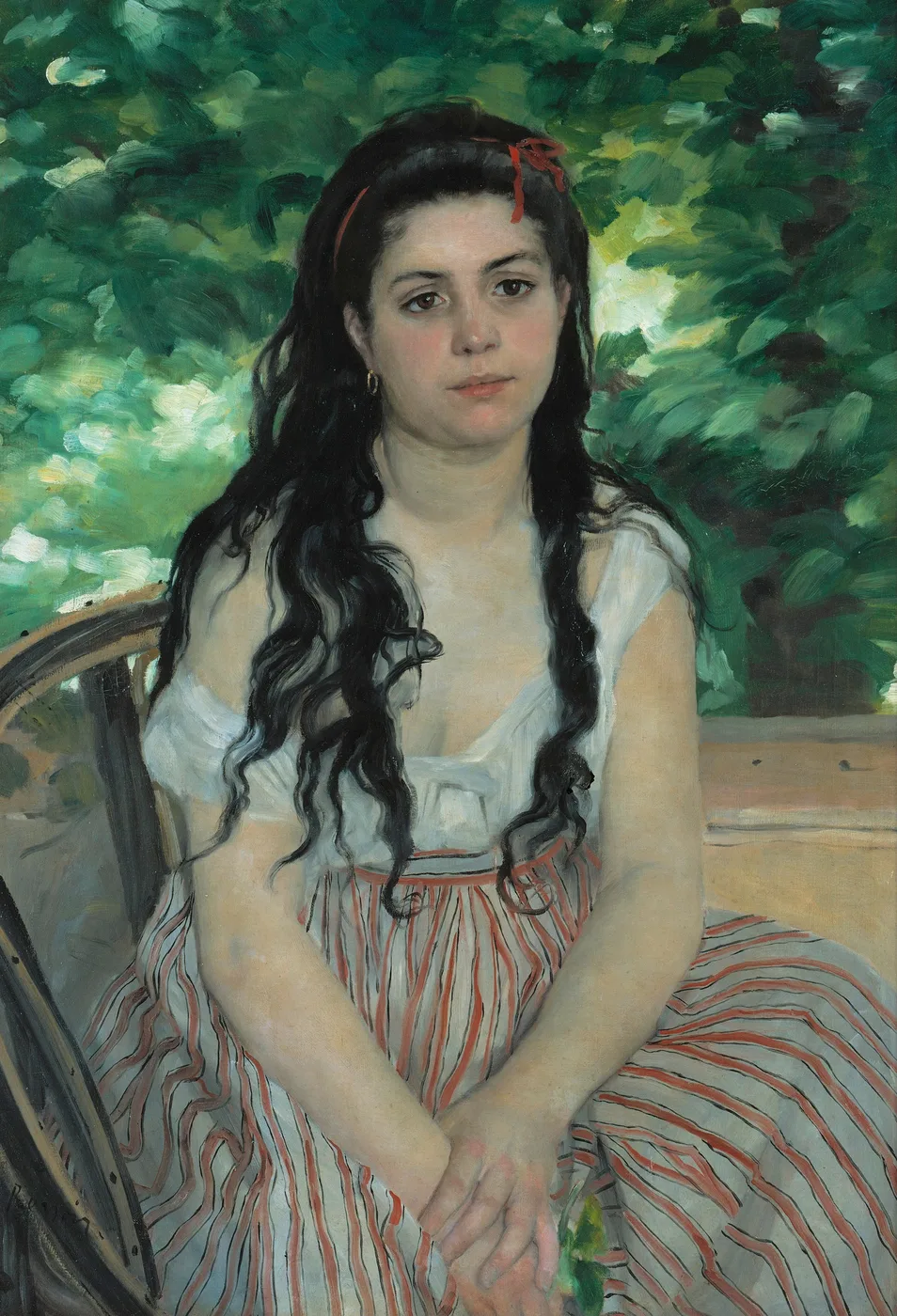
A Young Woman Dressed as a Bohémienne
In 1868 Pierre-Auguste Renoir was twenty-seven, sharing a cramped Paris studio with his friend Frédéric Bazille and scraping by on portrait commissions. He had spent recent summers painting in the forest of Fontainebleau alongside Claude Monet and Alfred Sisley, testing how far a canvas could hold real outdoor light.
His most frequent sitter that year was Lise Tréhot, a young woman he had met through his friend Jules Le Coeur’s family circle. She remained his companion and favoured model for several more years.
For In the Summer, also known as La Bohémienne, Renoir did not paint Lise in fashionable Parisian dress, as he had for the full-length portrait he sent to the Salon that same year. Instead he cast her in the loose, informal costume of a gypsy or wandering entertainer, a stock character borrowed from earlier genre painting and popular theatre. It let him paint a striking woman rather than a specific occasion or social rank.
The picture belongs to a moment when Renoir was still deciding what kind of painter he wanted to be, torn between Salon respectability and the freer instincts that would soon define Impressionism. In the Summer sits closer to the experimental end of that spectrum, a study of a face and a costume more than a formal portrait.
Green Shade and a White Blouse
The canvas shows Lise from the waist up, turned slightly toward the viewer with her dark hair loosely gathered and a few strands escaping around her face. She wears a black bodice over a white blouse that catches the light in broad, simplified folds. Her dark eyes meet the viewer directly, giving the picture an unusual candour for a costume study.
Behind her, the background dissolves into a soft haze of green and ochre, more suggestion than describable place, likely a garden or woodland clearing. Renoir keeps this backdrop deliberately vague so that nothing competes with the figure, letting the eye rest on Lise’s face and the pale skin at her collarbone.
Light falls warmly across her cheek and the white blouse, the two brightest passages in the composition, while the black bodice anchors the lower half of the canvas in shadow. The palette is restrained: black, white, a warm flesh tone, and a screen of summer green, held together by the golden light named in the title.
Renoir’s Brush Loosens in the Forest
The brushwork is looser than anything Renoir would have shown at the official Salon, built from visible strokes rather than smoothed into an academic finish. The blouse is described in a handful of confident, broad marks rather than laboriously rendered creases, a shorthand he had been developing during his summers painting outdoors.
In the hair and the shadowed folds of the bodice, the paint is thinner and more fluid, allowing the warm ground beneath to show through and give the shadows a glow rather than a flatness. Only the face receives more careful, blended handling, keeping Lise’s features legible while everything around her stays comparatively free.
This contrast between a tightly observed face and a loosely handled costume is typical of Renoir at this stage of his career. He had not yet abandoned the discipline of academic figure painting, but he was already impatient with its polish, and In the Summer shows both instincts working on the same canvas.
Between Portrait and Invention
Because Lise is dressed as an imagined character rather than as herself, the painting sits in an odd space between portrait and invention. Viewers who know her face from Renoir’s other paintings of the period recognise her immediately, yet the costume asks them to read her as a type, a bohemian, rather than as a named individual.
This kind of role-play portrait had a long tradition behind it, reaching back through French and Dutch genre painting to images of gypsies, shepherdesses, and other picturesque figures. Renoir was drawing on that tradition while updating it with a model he knew intimately and a handling of paint that owed more to his own generation than to the old masters he was echoing.
The result is neither a straightforward likeness nor a purely imaginary figure, but something that moves between the two. That ambiguity is part of why the painting has carried more than one title over the years.
In the Summer on a Wall Today
Today In the Summer hangs at the Alte Nationalgalerie in Berlin, among the nineteenth-century French paintings the museum has collected since the late 1800s. In a gallery setting it reads as a study in warmth, the kind of picture that draws a viewer in for the face and holds them for the light on the blouse.
On a wall in a home rather than a museum, a picture like this changes considerably with the hours. Morning light tends to flatten the greens in the background, while a lower, warmer light in the evening picks out the gold in Lise’s skin and hair and makes the white blouse glow rather than simply appear pale.
What stays constant is the directness of her gaze, which does not soften or recede however the room around it changes. It is that steady presence, more than the costume or the story behind it, that gives the painting its lasting pull.
Sizes and materials for In the Summer are listed on its product page.