Claude Renoir as a Clown
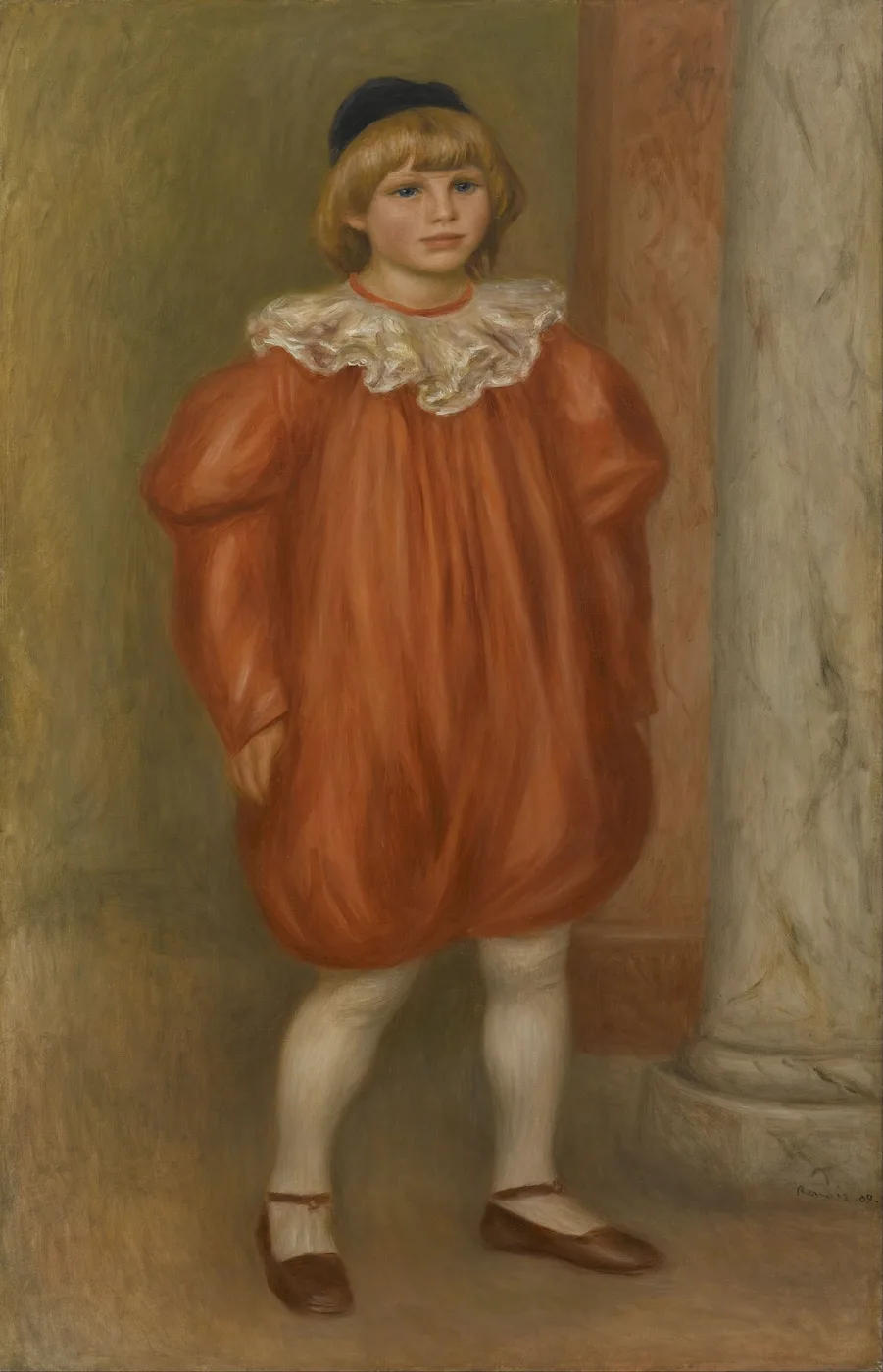
In 1909 Renoir was living at Les Collettes, the farmhouse and olive grove he had bought a couple of years earlier above Cagnes-sur-Mer in the south of France, largely for the sake of his health and the mild climate. His youngest son, Claude, born in 1901 and known within the family as Coco, was eight years old and one of the most frequent models available to a painter who by then found long journeys and outside sittings increasingly difficult.
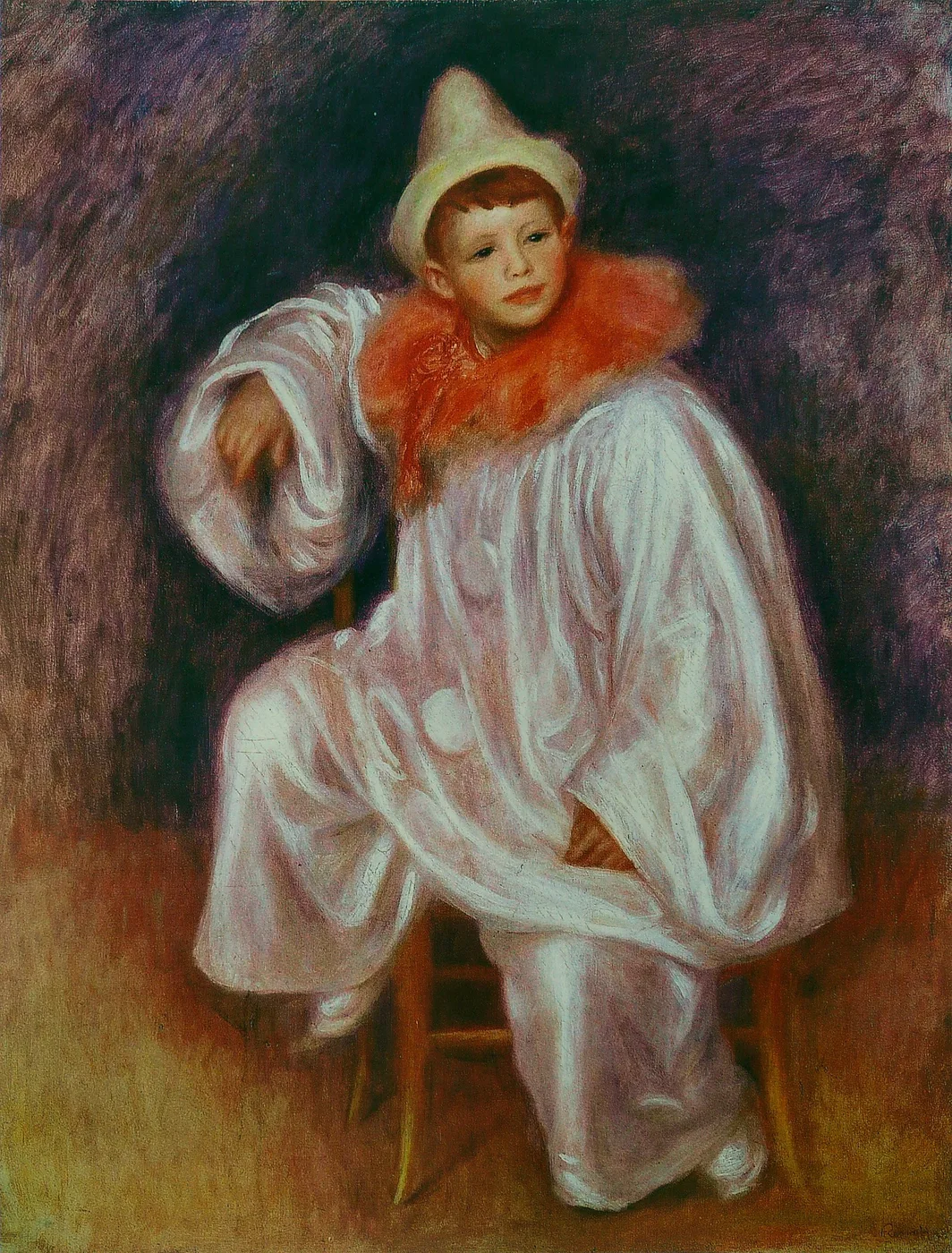
Renoir dressed Coco in a white Pierrot-style clown costume for this portrait, complete with a ruffled collar and soft cap, a piece of dressing-up that let the painter revisit an old tradition in French art of portraying children and performers in the guise of clowns and commedia dell’arte figures. The choice also gave him an excuse to paint white fabric against warm skin and background colour, a technical problem he clearly relished.
Coco in Costume at Les Collettes
The boy is shown close to half length, turned slightly toward the viewer, his round face and dark eyes the clear focus of the composition. The ruffled white collar frames his neck and shoulders in soft, loosely brushed folds, catching light unevenly rather than reading as a crisp, laundered garment.
Renoir’s brush moves quickly and loosely across the costume, building the ruffles from broken strokes of white, cream and pale grey rather than outlining each fold. Against this, Coco’s warm skin tones and dark hair stand out with real solidity, the most carefully modelled passage in the whole canvas.
Unlike the more posed, formal portraits Renoir painted as a young man, this picture has an unforced, domestic quality. Coco does not perform for the viewer; he simply sits, dressed up, patient in the way children asked to hold still for a parent often are.
A Father’s Late Style Turned on His Son
By this point in his career Renoir was painting almost exclusively in the warm, high-keyed palette that marks his final decade, dominated by reds, oranges and golden yellows even in pictures that, like this one, include large passages of white. The background here is kept loose and largely undefined, warm reddish tones dissolving into soft brushwork that gives no specific sense of a room or a particular piece of furniture.
This lack of detail is deliberate. Renoir wanted nothing in the setting to compete with the contrast between the white costume and the warm colour surrounding it, or with the directness of his son’s gaze, which carries more presence than any described interior could add.
Family portraits of this kind were common practice in Renoir’s household during these years. His children, and often local children hired from the village near Les Collettes, sat for him repeatedly, in costume or plain dress, giving him a constant supply of models once travel and formal commissions became harder to manage.
White Ruffles Against a Field of Red
The central visual event of the painting is the meeting of the white collar with the warm reds of the background and the pinkish tones of the boy’s face. Renoir builds this contrast without hard edges, letting colours bleed softly into one another so that the costume seems to emerge from the surrounding warmth rather than sit flatly on top of it.
Little attention is paid to the clown cap or any other prop that might turn the picture into a costume study rather than a portrait. The emphasis stays on Coco’s face and the steady, slightly serious expression Renoir captures there, an expression that has little to do with the playful associations of a clown costume.
A Boy’s Portrait in a Paris Museum
The painting is now part of the Walter-Guillaume collection at the Musée de l’Orangerie in Paris, a group of works assembled first by the dealer Paul Guillaume and later by Jean Walter before being given to the French state. The Orangerie holds a substantial number of Renoir’s late paintings, allowing this portrait of Coco to be seen alongside other family portraits and late nudes from the same years at Les Collettes.
Claude Renoir himself grew up to work for a time in ceramics and ran a pottery business, and later generations of the family included the film director Jean Renoir, his elder brother, whose own memoir of his father remains one of the most detailed accounts of these last years at Les Collettes. That memoir, along with family photographs from the period, helps confirm how central Coco and his siblings were to Renoir’s working life once travel became difficult.
A Child’s Portrait That Still Performs
On a wall, the painting keeps something of its theatrical origin, a costume put on for the sake of a picture rather than for an actual performance. Its warm reds hold their intensity in most lighting conditions, while the white collar catches whatever light is available and reflects it back into the surrounding colour.
Looked at over time, what stays memorable is not the clown costume but the directness of the boy’s expression, patient and a little solemn, looking out from beneath the ruffled collar his father had arranged around him. It is a portrait that survives its own dressing-up, closer in the end to a study of a particular child than to a costume piece.
Sizes and materials for Claude Renoir as a Clown are listed on its product page.